Follistatin regulates germ cell nest breakdown and primordial follicle formation
- PMID: 21106872
- PMCID: PMC3037165
- DOI: 10.1210/en.2010-0950
Follistatin regulates germ cell nest breakdown and primordial follicle formation
Abstract
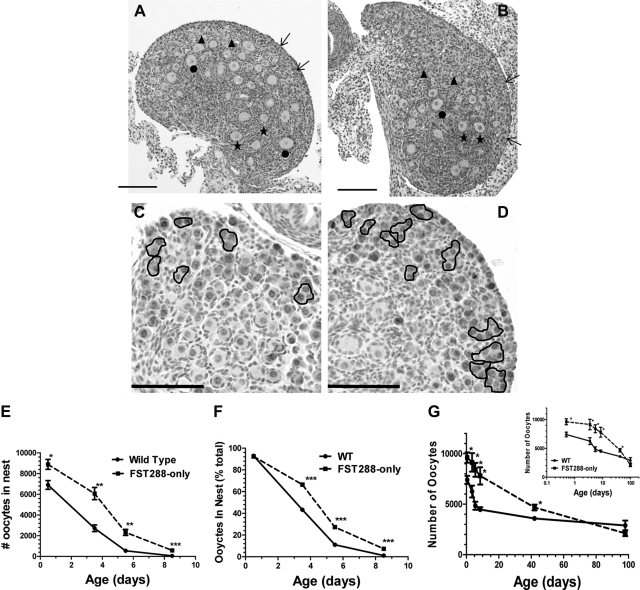
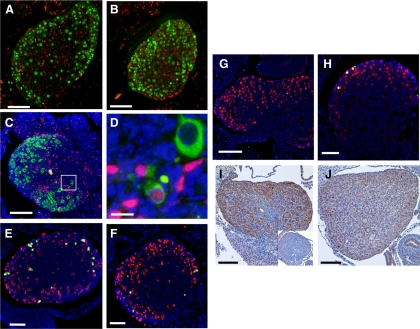
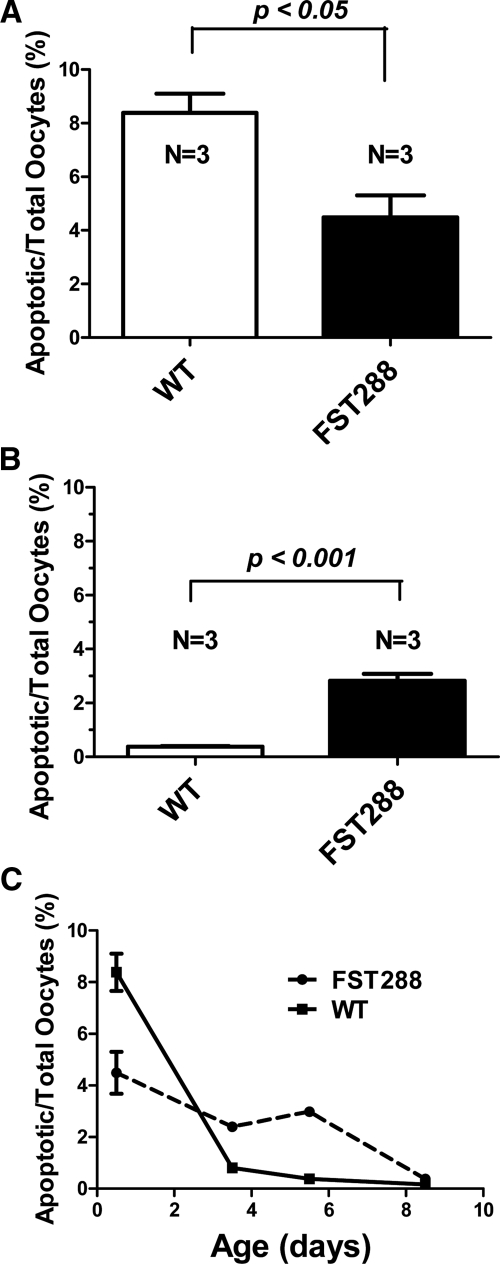
Follistatin (FST) is an antagonist of activin and related TGFβ superfamily members that has important reproductive actions as well as critical regulatory functions in other tissues and systems. FST is produced as three protein isoforms that differ in their biochemical properties and in their localization within the body. We created FST288-only mice that only express the short FST288 isoform and previously reported that females are subfertile, but have an excess of primordial follicles on postnatal day (PND) 8.5 that undergo accelerated demise in adults. We have now examined germ cell nest breakdown and primordial follicle formation in the critical PND 0.5-8.5 period to test the hypothesis that the excess primordial follicles derive from increased proliferation and decreased apoptosis during germ cell nest breakdown. Using double immunofluorescence microscopy we found that there is virtually no germ cell proliferation after birth in wild-type or FST288-only females. However, the entire process of germ cell nest breakdown was extended in time (through at least PND 8.5) and apoptosis was significantly reduced in FST288-only females. In addition, FST288-only females are born with more germ cells within the nests. Thus, the excess primordial follicles in FST288-only mice derive from a greater number of germ cells at birth as well as a reduced rate of apoptosis during nest breakdown. These results also demonstrate that FST is critical for normal regulation of germ cell nest breakdown and that loss of the FST303 and/or FST315 isoforms leads to excess primordial follicles with accelerated demise, resulting in premature cessation of ovarian function.
Figures
References
-
- Tortoriello DV, Sidis Y, Holtzman DA, Holmes WE, Schneyer AL. 2001. Human follistatin-related protein: a structural homologue of follistatin with nuclear localization. Endocrinology 142:3426–3434 - PubMed
-
- Sugino K, Kurosawa N, Nakamura T, Takio K, Shimasaki S, Ling N, Titani K, Sugino H. 1993. Molecular heterogeneity of follistatin, an activin-binding protein. Higher affinity of the carboxyl-terminal truncated forms for heparan sulfate proteoglycans on the ovarian granulosa cell. J Biol Chem 68:15579–15587 - PubMed
-
- Vale W, Rivier C, Hsueh A, Campen C, Meunier H, Bicsak T, Vaughan J, Corrigan A, Bardin W, Sawchenko P, Spiess J, Rivier J. 1988. Chemical and biological characterization of the inhibin family of protein hormones. Rec Prog Horm Res 44:1–34 - PubMed
-
- Mather JP, Moore A, Li RH. 1997. Activins, inhibins, and follistatins: further thoughts on a growing family of regulators. Proc Soc Exp Biol Med 215:209–222 - PubMed
Publication types
MeSH terms
Substances
Grants and funding
LinkOut - more resources
Full Text Sources
Molecular Biology Databases
Miscellaneous