Review
. 2011 Jan;33(1):52-60.
doi: 10.1002/bies.201000043.

Function and evolution of sex determination mechanisms, genes and pathways in insects

Affiliations
Free PMC article
Review

Function and evolution of sex determination mechanisms, genes and pathways in insects

Tanja Gempe et al. Bioessays. 2011 Jan.
Free PMC article

Abstract

Animals have evolved a bewildering diversity of mechanisms to determine the two sexes. Studies of sex determination genes--their history and function--in non-model insects and Drosophila have allowed us to begin to understand the generation of sex determination diversity. One common theme from these studies is that evolved mechanisms produce activities in either males or females to control a shared gene switch that regulates sexual development. Only a few small-scale changes in existing and duplicated genes are sufficient to generate large differences in sex determination systems. This review summarises recent findings in insects, surveys evidence of how and why sex determination mechanisms can change rapidly and suggests fruitful areas of future research.


Figures
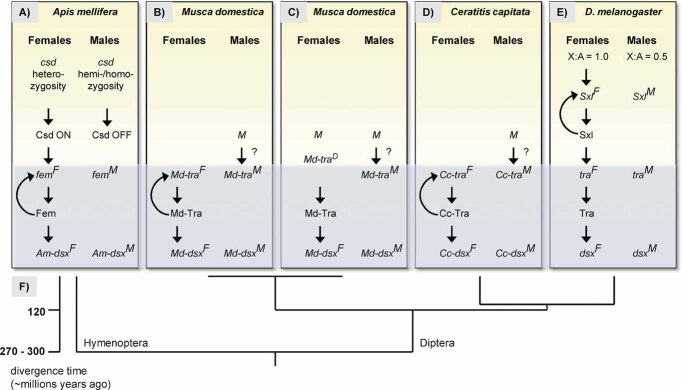
Figure 1
Figure 1
Sex determination in insect model species, with their phylogenetic relationships representing ∼300 million years of evolution. The fruit fly D. melanogaster, the housefly M. domestica, the medfly Ceratis capitata and the honeybee Apis mellifera share a common pathway (indicated by a grey box) composed of the transformer (tra) gene and its downstream target doublesex (dsx). Female spliced tra transcripts (traF) give rise to Tra proteins that direct splicing of dsxF mRNAs, production of DsxF proteins and female development. When tra is spliced into the male variant, no Tra proteins are produced. This results in splicing of male dsxM mRNAs, DsxM proteins and male development. A: Sex in the honeybee (A. mellifera) is determined by the heterozygosity or homo-/hemizygosity of the csd gene. In females, different Csd proteins, derived from a heterozygous csd gene, direct the processing of female fem mRNAs (femF) . The fem gene is apparently an orthologue of the tra gene 12). Fem protein regulates female splicing of dsx, but also self-sustains the female splicing of fem. In males, inactive Csd proteins that are derived from the same alleles (homo- or hemizygous csd genes) result in a default splicing of fem (femM). (B and C) Models of two alternative sex determination systems that co-exist in M. domestica populations , . B: Sex is determined by the absence/presence of an unidentified male-determiner M. In the absence of M, maternally-derived Md-tra gene products establish an auto-regulative loop in females in which Md-Tra protein mediates the production of more female Md-tra mRNA. Presence of M impairs this tra auto-regulatory loop and also mediates the splicing of male Md-tra mRNAs. C: Sex in M. domestica can also be determined by a female determiner. Presence/absence of a tra allele, Md-traD(=FD), determines sexual fate. In females, the presence of Md-traD leads to female splice products and Md-Tra protein, even in the presence of the male-determiner M . In males, the male-determiner M mediates male Md-traM mRNAs in the absence of the Md-traD allele. D: Sex in C. capitata , is determined by presence/absence of a, thus far, unidentified male-determiner M. In the absence of M, maternally-derived Cc-tra gene products appear to establish a Cc-tra auto-regulative loop . Presence of M mediates the splicing of male Cc-tra transcripts (traM). E: Sex in D. melanogaster is determined by the dose of X chromosomes , . Double doses of X in females activate the Sxl gene and expression of Sxl proteins. Sxl proteins direct splicing of female traF mRNAs that give rise to functional proteins. Sxl proteins also establish an auto-regulatory feedback loop by directing splicing of productive female SxlF mRNAs, which maintain the female state throughout development. In addition, there is an additional feedback activity in which Tra proteins stimulate Sxl positive auto-regulation . In males, the single dose of X chromosomes does not direct early Sxl protein expression. As a consequence the downstream regulatory decisions do not occur and male dsxM is produced. F: The evolutionary relationship of the species used in the comparison with their approximate time scale of divergence , .
Figure 2
Figure 2
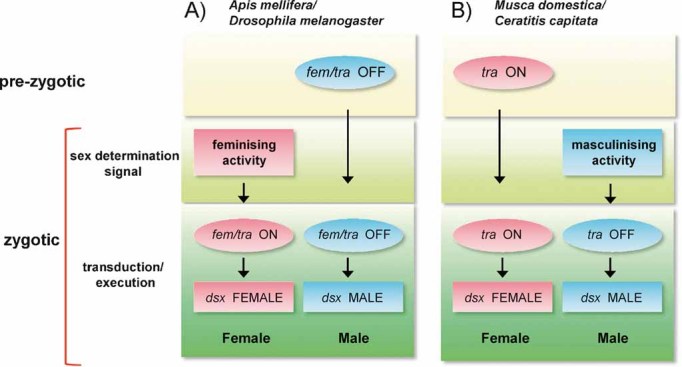
The regulatory principle underlying insect sex determination mechanisms. Species-specific, sex determination systems produce either a feminising or a masculinsing activity in the zygote to determine the two sexes in the proper proportions. In the absence of this activity, the pre-determined tra activity in the pre-zygote produces the alternative sex. A: Feminising activity in D. melanogaster and A. mellifera switches the tra gene from the pre-zygotic OFF (non-active) into the ON (active) state. B: Masculinising activity in C. capitata and M. domestica switches the tra gene from the pre-zygotic ON to the OFF state.
Figure 3
Figure 3
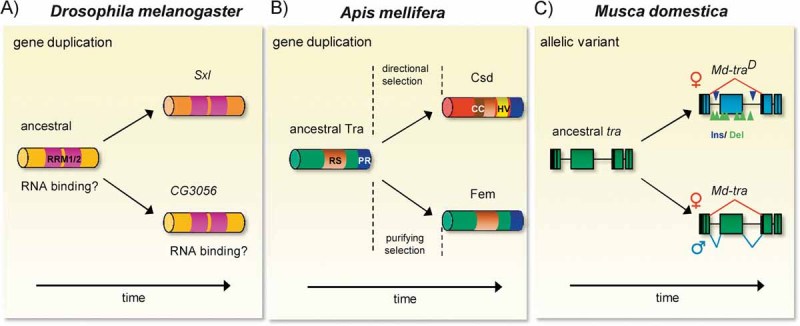
Mutational routes for the evolutionary origin of novel sex determination functions. A: The origin of the Sxl gene by gene duplication of CG3056 in dipteran insects . The encoding proteins are presented schematically. RRM 1 and RRM 2 denote the two RNA-binding domains. B: The origin of the csd gene by tandem gene duplication of the ancestral tra gene in the Apis lineage. The encoding proteins are presented schematically. The evolutionary rise of the csd gene was accompanied by the evolution of an asparagine/tyrosine-enriched repeat that varies in number in the different allelic specificities (denoted as HV: hyper-variable region) and with the origin of a putative coiled-coil domain (denoted as CC) possibly involved in protein binding , . Adaptive evolution (directional selection) was involved in shaping the evolutionary rise of the csd gene . The paralogous sister gene fem evolved under purifying selection, consistent with its ancestral function . RS denotes the arginine/serine-enriched (RS) domain and PR denotes the proline-rich domain. C: The evolutionary origin of the Md-traD allele from the ancestral Md-tra gene in M. domestica populations . The Md-tra genome structure is presented schematically. Blue triangles denote nucleotide insertions and the green triangles represent nucleotide deletions in the Md-traD allele that lost the ability to produce the male splice variant traM in the presence of M.

References

    1. Cline TW, Meyer BJ. Vive la difference: males vs. females in flies vs. worms. Annu Rev Genet. 1996;30:637–702. - PubMed
    1. Zarkower D. Somatic sex determination. WormBook. 2006:1–12. - PMC - PubMed
    1. Lovell-Badge R, Canning C, Sekido R. Sex-determining genes in mice: building pathways. Novartis Found Symp. 2002;244:4–18. - PubMed
    1. Sekido R, Lovell-Badge R. Sex determination involves synergistic action of SRY and SF1 on a specific Sox9 enhancer. Nature. 2008;453:930–4. - PubMed
    1. Marshall Graves JA. Weird animal genomes and the evolution of vertebrate sex and sex chromosomes. Annu Rev Genet. 2008;42:565–86. - PubMed

LinkOut - more resources