


Corneal power measurement with Fourier-domain optical coherence tomography
- PMID: 21111315
- PMCID: PMC3005697
- DOI: 10.1016/j.jcrs.2010.07.018
Corneal power measurement with Fourier-domain optical coherence tomography
Abstract
Purpose: To study the accuracy and repeatability of anterior, posterior, and net corneal power measured by Fourier-domain optical coherence tomography (OCT).
Setting: Doheny Eye Institute, Los Angeles, California, USA.
Design: Cross-sectional study.
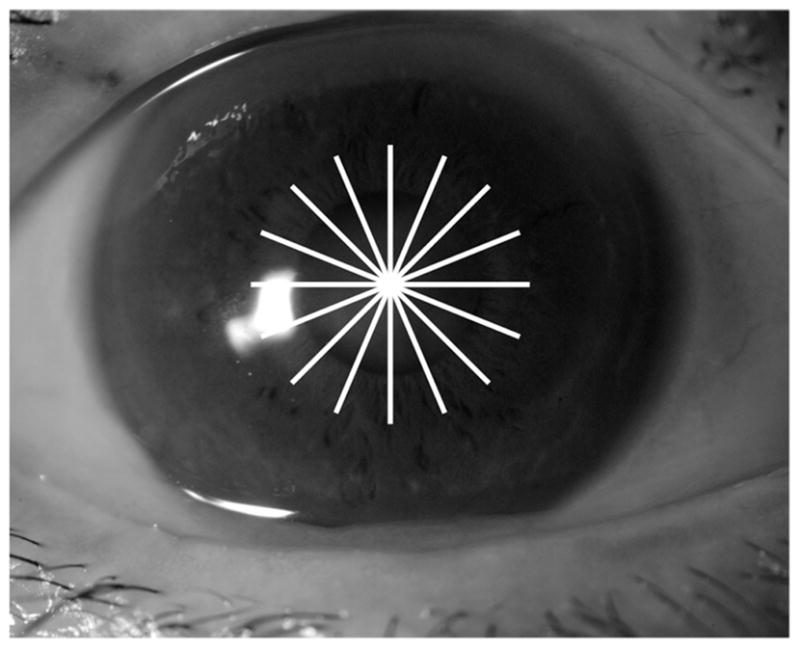
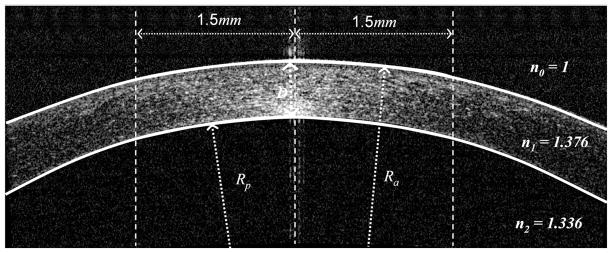
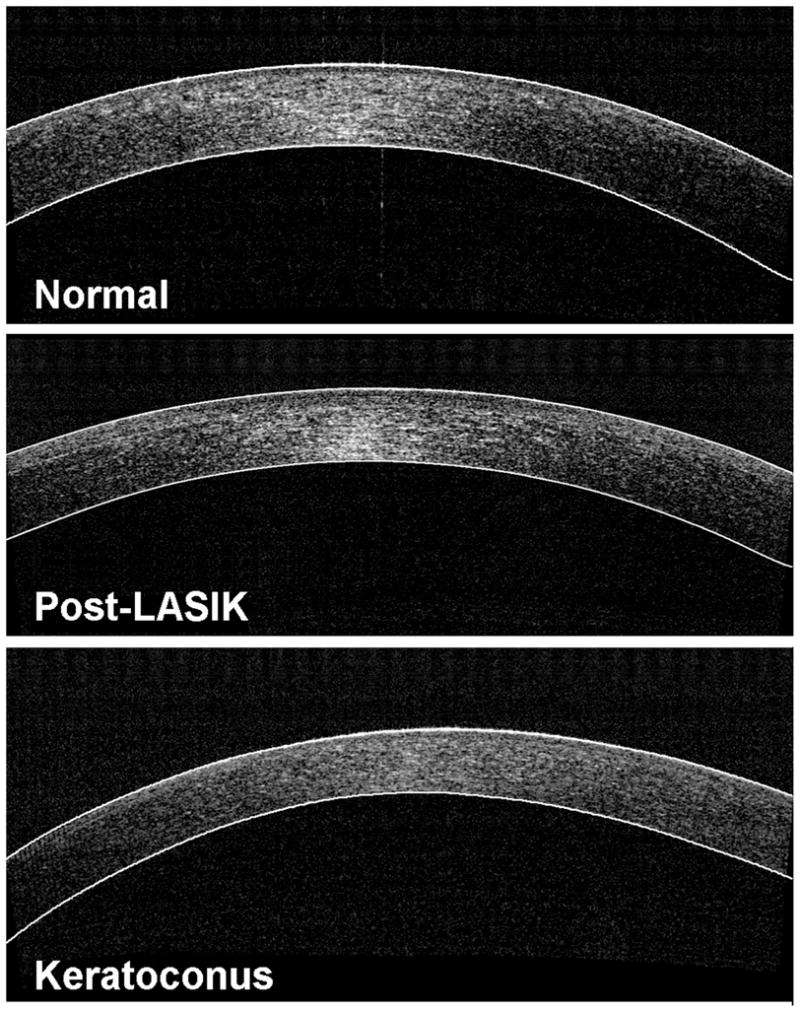
Methods: A Fourier-domain OCT system (RTVue) was used to scan normal eyes, eyes after myopic laser in situ keratomileusis (LASIK), and keratoconic eyes. After the corneal surfaces were delineated, the system calculated anterior and posterior corneal powers by curve fitting over the central 3.0 mm diameter area. Net corneal power was calculated using a thick-lens formula. The repeatability of the calculations was evaluated by the pooled standard deviation of 3 measurements from the same visit. The net corneal power values were compared with standard automated keratometry measurements (IOLMaster).
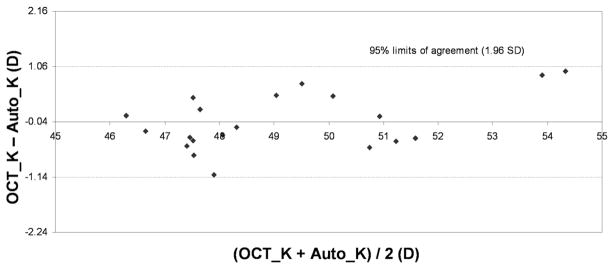
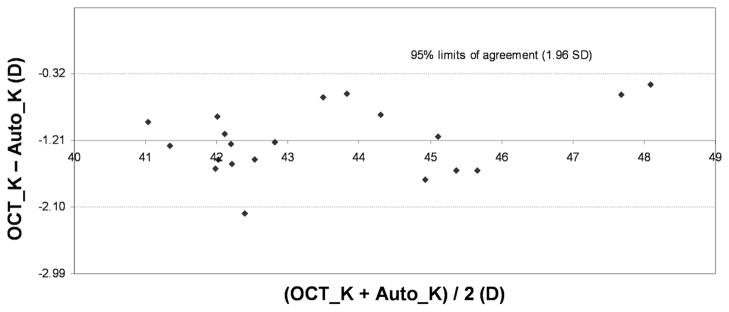
Results: The repeatability of Fourier-domain OCT net corneal power was 0.19 diopters (D), 0.26 D, and 0.30 D in the normal, post-LASIK, and keratoconus groups, respectively. The Fourier-domain OCT net corneal power was significantly lower than keratometry by a mean of -1.21 D, -2.89 D, and -3.07 D, respectively (P<.001). The anterior-posterior curvature ratio was lower in post-LASIK and keratoconic eyes than in normal eyes (P<.001).
Conclusions: Corneal power measured by Fourier-domain OCT achieved good repeatability in all 3 groups. The repeatability was better than slower time-domain OCT systems. Because Fourier-domain OCT directly measures both anterior and posterior corneal surfaces, it may produce more consistent results than standard keratometry in post-LASIK and keratoconic eyes in which the anterior-posterior corneal curvature ratios are altered by surgery or disease.
Copyright © 2010 ASCRS and ESCRS. Published by Elsevier Inc. All rights reserved.
Figures
References
-
- Norrby S. Pentacam keratometry and IOL power calculation [letter] J Cataract Refract Surg. 2008;34:3. reply by E Borasio, 4. - PubMed
-
- Sónego-Krone S, López-Moreno G, Beaujon-Balbi OV, Arce CG, Schor P, Campos M. A direct method to measure the power of the central cornea after myopic laser in situ keratomileusis. Arch Ophthalmol. 2004. [Accessed August 16, 2010]. pp. 159–166. Available at: http://archopht.ama-assn.org/cgi/reprint/122/2/159.pdf. - PubMed
-
- Srivannaboon S, Reinstein DZ, Sutton HFS, Holland SP. Accuracy of Orbscan total optical power maps in detecting refractive change after myopic laser in situ keratomileusis. J Cataract Refract Surg. 1999;25:1596–1599. - PubMed
-
- Bland JM, Altman DG. Statistical methods for assessing agreement between two methods of clinical measurement. Lancet. 1986. [Accessed August 16, 2010]. pp. 307–310. Available at: http://www-users.york.ac.uk/~mb55/meas/ba.pdf. - PubMed
Publication types
MeSH terms
Grants and funding
LinkOut - more resources
Full Text Sources
Other Literature Sources
