


Exploring successful community pharmacist-physician collaborative working relationships using mixed methods
- PMID: 21111388
- PMCID: PMC3004536
- DOI: 10.1016/j.sapharm.2009.11.008
Exploring successful community pharmacist-physician collaborative working relationships using mixed methods
Abstract
Background: Collaborative working relationships (CWRs) between community pharmacists and physicians may foster the provision of medication therapy management services, disease state management, and other patient care activities; however, pharmacists have expressed difficulty in developing such relationships. Additional work is needed to understand the specific pharmacist-physician exchanges that effectively contribute to the development of CWR. Data from successful pairs of community pharmacists and physicians may provide further insights into these exchange variables and expand research on models of professional collaboration.
Objective: To describe the professional exchanges that occurred between community pharmacists and physicians engaged in successful CWRs, using a published conceptual model and tool for quantifying the extent of collaboration.
Methods: A national pool of experts in community pharmacy practice identified community pharmacists engaged in CWRs with physicians. Five pairs of community pharmacists and physician colleagues participated in individual semistructured interviews, and 4 of these pairs completed the Pharmacist-Physician Collaborative Index (PPCI). Main outcome measures include quantitative (ie, scores on the PPCI) and qualitative information about professional exchanges within 3 domains found previously to influence relationship development: relationship initiation, trustworthiness, and role specification.
Results: On the PPCI, participants scored similarly on trustworthiness; however, physicians scored higher on relationship initiation and role specification. The qualitative interviews revealed that when initiating relationships, it was important for many pharmacists to establish open communication through face-to-face visits with physicians. Furthermore, physicians were able to recognize in these pharmacists a commitment for improved patient care. Trustworthiness was established by pharmacists making consistent contributions to care that improved patient outcomes over time. Open discussions regarding professional roles and an acknowledgment of professional norms (ie, physicians as decision makers) were essential.
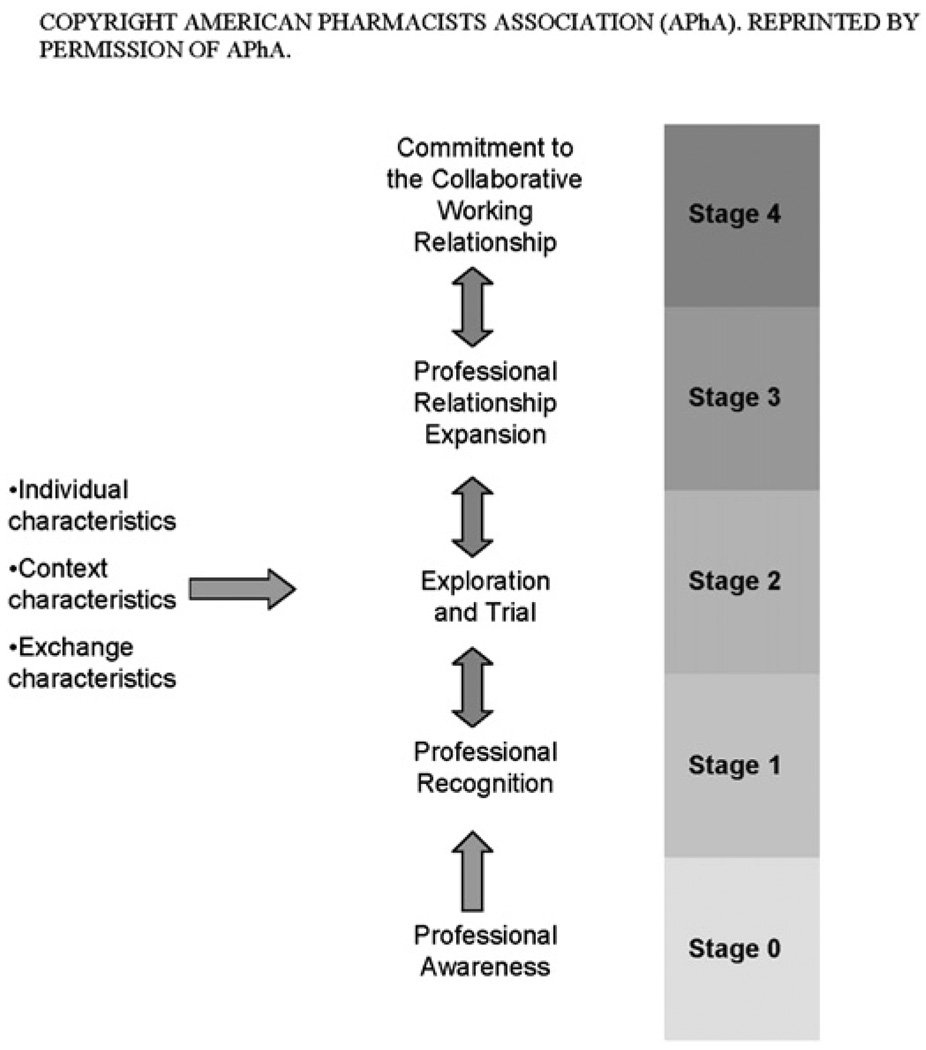
Conclusions: The findings support and extend the literature on pharmacist-physician CWRs by examining the exchange domains of relationship initiation, trustworthiness, and role specification qualitatively and quantitatively among pairs of practitioners. Relationships appeared to develop in a manner consistent with a published model for CWRs, including the pharmacist as relationship initiator, the importance of communication during early stages of the relationship, and an emphasis on high-quality pharmacist contributions.
Copyright © 2010 Elsevier Inc. All rights reserved.
Conflict of interest statement
Financial isclosure: The authors declare no conflicts of interest or financial interests in any product or service mentioned in this article, including grants, employments, gifts, stock, holdings, or honoraria.
Figures
References
-
- Centers for Medicare and Medicaid Services. Medicare prescription drug benefit final rule. Federal Register. 2005. Jan 28 [Accessed January 4, 2010]. pp. 4279–4283. Available at: http://edocket.access.gpo.gov/2005/pdf/05-1321.pdf. - PubMed
-
- American Pharmacists Association, National Association of Chain Drug Stores Foundation. Medication therapy management in pharmacy practice: core elements of an MTM service model. Version 2.0. J Am Pharm Assoc. 2008;48:341–353. - PubMed
-
- Leape LL, Cullen DJ, Clapp MD, et al. Pharmacist participation on physician rounds and adverse drug events in the intensive care unit. JAMA. 1999;281:267–270. - PubMed
-
- Schumock GT, Meek PD, Ploetz PA, Vermeulen LC. Economic evaluations of clinical pharmacy services—1988–1995. Pharmacotherapy. 1996;16:1188–1208. - PubMed
-
- Cranor CW, Bunting BA, Christensen DB. The Asheville project: long term clinical and economic outcomes of a community pharmacy diabetes care program. J Am Pharm Assoc. 2003;43:173–184. - PubMed
MeSH terms
Grants and funding
LinkOut - more resources
Full Text Sources
