Review
. 2011 Feb;15(1):137-43.
doi: 10.1016/j.cbpa.2010.10.011. Epub 2010 Nov 24.

Recent advances in awakening silent biosynthetic gene clusters and linking orphan clusters to natural products in microorganisms

Affiliations
Review

Recent advances in awakening silent biosynthetic gene clusters and linking orphan clusters to natural products in microorganisms

Yi-Ming Chiang et al. Curr Opin Chem Biol. 2011 Feb.

Abstract

Secondary metabolites from microorganisms have a broad spectrum of applications, particularly in therapeutics. The growing number of sequenced microbial genomes has revealed a remarkably large number of natural product biosynthetic clusters for which the products are still unknown. These cryptic clusters are potentially a treasure house of medically useful compounds. The recent development of new methodologies has made it possible to begin unlock this treasure house, to discover new natural products and to determine their biosynthesis pathways. This review will highlight some of the most recent strategies to activate silent biosynthetic gene clusters and to elucidate their corresponding products and pathways.


Figures

Figure 1
Figure 1
Recent advances in awakening silent gene clusters. (a) Chromatin-level remodeling, a proposed model by which relaxed chromatin leads to the de-repression of secondary metabolite biosynthesis. The COMPASS complex represses the production of emodin and related compounds, monodictyphenone, and F-9775A/F-9775B. (b) Fungal-bacterial physical interaction induced the silent gene cluster (ors) and the production of secondary metabolites. (c) Ribosome engineering, mutation of the ribosomal protein S12 (an essential component of the ribosomal 30S subunit) at K88 enhances protein synthesis and a mutation at RNAP at H437 increases the promoter binding affinity in stationary growth phase. This led to the expression of bacterial silent gene cluster and the production of antibiotic piperidamycins.
Figure 2
Figure 2
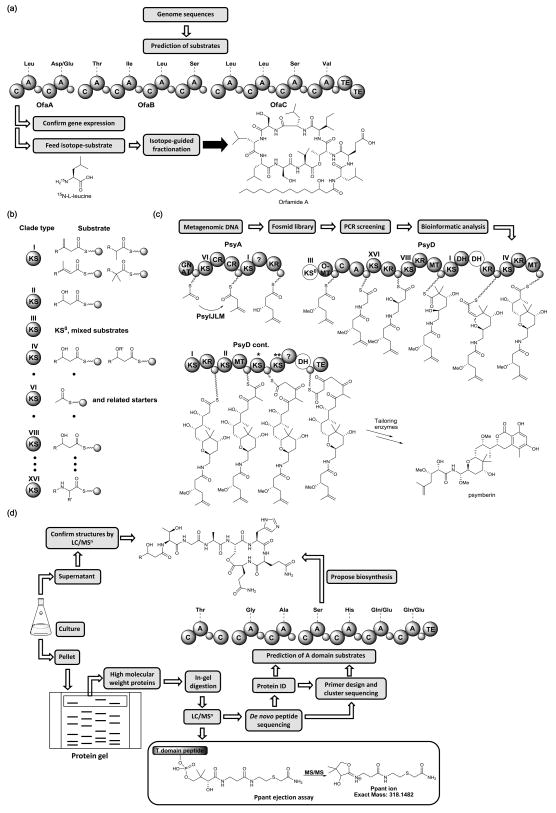
Linking orphan clusters to molecules. (a) Flowchart of the “genomisotopic approach” for the isotope-guided isolation of orfamide A biosynthesized from the ofa gene cluster. C, condensation domain; A, adenylation domain; TE, thioesterase domain; small circles symbolize the thiolation (T) domain. (b) Phylogeny of trans-AT KS domains, KS domains that accept similar substrates fall into the same clade type. (c) Cloning of the psy gene cluster and the elucidation of its biosynthetic pathway from a highly complicated metagenome by the chemical structure-based gene targeting approach. The KS with one asterisk is rare and no clade exists so far. The KS with two asterisks falls into the cis-AT group. Domains shown in white lack conserved catalytic residues and are non-functional. For the abbreviation for each domain, see reference [27]. (d) Flowchart of PrISM for the identification of robustly expressed NRPSs. The high molecular weight proteins from microbial cultures are subjected to in-gel digestion and proteomics analysis by LC/MSn. Peptides that contain Ppant arms can be traced by the Ppant ejection assay. Peptide sequences obtained from de novo peptide sequencing are used to design degenerate primers to amplify regions of the expressed gene cluster. The A domains of the identified NRPS cluster are used to predict the substrates of amino acid incorporated. The metabolites with the predicted amino acid sequences are ultimately confirmed by LC/MSn in the culture supernatant.

References

    1. Scherlach K, Hertweck C. Triggering cryptic natural product biosynthesis in microorganisms. Org Biomol Chem. 2009;7:1753–1760. - PubMed
    1. Gross H. Strategies to unravel the function of orphan biosynthesis pathways: recent examples and future prospects. Appl Microbiol Biotechnol. 2007;75:267–277. - PubMed
    1. Fischbach MA, Walsh CT. Assembly-line enzymology for polyketide and nonribosomal Peptide antibiotics: logic, machinery, and mechanisms. Chem Rev. 2006;106:3468–3496. - PubMed
    1. Walsh CT, Fischbach MA. Natural products version 2.0: connecting genes to molecules. J Am Chem Soc. 2010;132:2469–2493. - PMC - PubMed
    1. Hertweck C. The biosynthetic logic of polyketide diversity. Angew Chem Int Ed Engl. 2009;48:4688–4716. - PubMed

Publication types

LinkOut - more resources