. 2011 Mar 1;55(1):389-400.
doi: 10.1016/j.neuroimage.2010.11.057. Epub 2010 Nov 25.

Phasic and sustained fear in humans elicits distinct patterns of brain activity

Affiliations

Phasic and sustained fear in humans elicits distinct patterns of brain activity

Ruben P Alvarez et al. Neuroimage. .

Abstract

Aversive events are typically more debilitating when they occur unpredictably than predictably. Studies in humans and animals indicate that predictable and unpredictable aversive events can induce phasic and sustained fear, respectively. Research in rodents suggests that anatomically related but distinct neural circuits may mediate phasic and sustained fear. We explored this issue in humans by examining threat predictability in three virtual reality contexts, one in which electric shocks were predictably signaled by a cue, a second in which shocks occurred unpredictably but never paired with a cue, and a third in which no shocks were delivered. Evidence of threat-induced phasic and sustained fear was presented using fear ratings and skin conductance. Utilizing recent advances in functional magnetic resonance imaging (fMRI), we were able to conduct whole-brain fMRI at relatively high spatial resolution and still have enough sensitivity to detect transient and sustained signal changes in the basal forebrain. We found that both predictable and unpredictable threat evoked transient activity in the dorsal amygdala, but that only unpredictable threat produced sustained activity in a forebrain region corresponding to the bed nucleus of the stria terminalis complex. Consistent with animal models hypothesizing a role for the cortex in generating sustained fear, sustained signal increases to unpredictable threat were also found in anterior insula and a frontoparietal cortical network associated with hypervigilance. In addition, unpredictable threat led to transient activity in the ventral amygdala-hippocampal area and pregenual anterior cingulate cortex, as well as transient activation and subsequent deactivation of subgenual anterior cingulate cortex, limbic structures that have been implicated in the regulation of emotional behavior and stress responses. In line with basic findings in rodents, these results provide evidence that phasic and sustained fear in humans may manifest similar signs of distress, but appear to be associated with different patterns of neural activity in the human basal forebrain.


Figures

Fig. 1
Fig. 1
Experimental paradigm. (A) In each of six runs (one shown), subjects were presented with three different virtual reality (VR) contexts: no-shock (N), predictable shock (P), and unpredictable shock (U). During each 40-s context presentation, a 3-s tone (250 Hz) was presented 1–3 times, followed by a 40-s rest period. In the P context, shocks were delivered as the tone terminated making it a cue for shock; tones had no signal value in the U and N contexts. In the U context, shocks were delivered at any time, making it a signal for temporally unpredictable shock. In the N context, no shock was ever administered, making it a clear signal of safety. (B) Snapshots of the VR contexts. The restaurant was always the no-shock context, and the casino and bank served as predictable and unpredictable contexts counterbalanced across subjects.
Fig. 2
Fig. 2
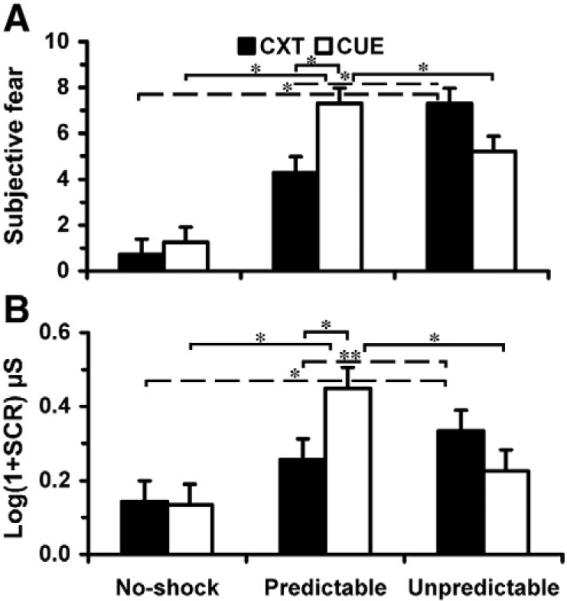
Behavioral data. (A) Subjective fear ratings and (B) SCRs to context (CXT) onset by Stimulus Type (CXT, CUE) and Condition (No-shock, Predictable, Unpredictable). *P<0.001; **P=0.09. Error bars are 95% confidence intervals.
Fig. 3
Fig. 3
Threat-induced transient and sustained brain activity in the extended amygdala. Predictable threat evoked transient activity in the (A) dorsal amygdala (AMYG) (peak at −22 −5 −8), whereas the onset of unpredictable threat elicited transient activity in the (B) bed nucleus of the stria terminalis (BNST) complex (peak at −9 2 10, left; 9 0 10, right). In addition, unpredictable threat produced sustained, increased activity in the vicinity of the (C) supracapsular division of the BNST (peak at −10 −2 16). Brain activity appears on a group structural image aligned to functional data. Adjoining each image is a plot depicting peristimulus time courses of the hemodynamic response. Error bars reflect SE.
Fig. 4
Fig. 4
Additional brain regions showing transient and sustained brain activity to predictable and unpredictable threat. (A) Compared to baseline, the predictable threat cue evoked transient activity in dorsomedial prefrontal/dorsal anterior cingulate (dmPFC/dACC), medial orbital (morb), insula/inferior frontal (INS/ifg), and inferior parietal (ipar) regions. (B) The onset of unpredictable threat was associated with transient activity in pregenual anterior cingulate cortex (pACC), dorsal anterior cingulate cortex (dACC), subgenual anterior cingulate cortex (sACC), medial caudate (CdM) and middle temporal (mtp) regions. (C) In addition, unpredictable threat produced sustained, increased activity in frontopolar (fp), cingulate/superior frontal (sf), anterior insula (aINS), insula (INS), middle frontal (mfr), right and left inferior frontal (ifg), and precentral (prc) regions, as well as sustained decreased activity in sACC. (D) Peristimulus time course plots of the hemodynamic response for selected brain regions in C and Table 2: L anterior insula (−32 21 7); R anterior insula (34 24 10); R inferior frontal (48 14 3); R inferior parietal (56 −46 38); R subgenual ACC (14 34 −11); L medial orbital (−5 46 −15). Error bars reflect SE. L=left; R=right.
Fig. 5
Fig. 5
ROI and linear trend analyses. (A) ROI data showing significant transient activity to unpredictable threat onset (Uons-Nons) in right dorsal amygdala (AMYG) but not left dorsal amygdala. (B) ROI data from the anterior portion of the bed nucleus of the stria terminalis complex (BNST) showing a linear trend in transient brain activity from the no-shock to predictable shock to unpredictable shock context. (C) ROI data from the dorsal portion of the BNST showing a linear trend in sustained brain activity from the no-shock to predictable shock to unpredictable shock context. Error bars indicate SEs.

References

    1. Alheid GF, Heimer L. New perspectives in basal forebrain organization of special relevance for neuropsychiatric disorders: the striatopallidal, amygdaloid, and corticopetal components of substantia innominata. Neuroscience. 1988;27:1–39. - PubMed
    1. Alvarez RP, Biggs A, Chen G, Pine DS, Grillon C. Contextual fear conditioning in humans: cortical-hippocampal and amygdala contributions. J. Neurosci. 2008;28:6211–6219. - PMC - PubMed
    1. Amaral DG, Price JL, Pitkanen A, Carmichael ST. Anatomical organization of the primate amygdaloid complex. In: Aggleton JP, editor. The amygdala: neurobiological aspects of emotion, memory, and mental dysfunction. Wiley-Liss; New York: 1992.
    1. Amunts K, Kedo O, Kindler M, Pieperhoff P, Mohlberg H, Shah NJ, Habel U, Schneider F, Zilles K. Cytoarchitectonic mapping of the human amygdala, hippocampal region and entorhinal cortex: intersubject variability and probability maps. Anat. Embryol. (Berl) 2005;210:343–352. - PubMed
    1. Bellgowan PS, Bandettini PA, van Gelderen P, Martin A, Bodurka J. Improved BOLD detection in the medial temporal region using parallel imaging and voxel volume reduction. Neuroimage. 2006;29:1244–1251. - PubMed

Publication types