


Actively paranoid patients with schizophrenia over attribute anger to neutral faces
- PMID: 21112186
- PMCID: PMC3031724
- DOI: 10.1016/j.schres.2010.11.006
Actively paranoid patients with schizophrenia over attribute anger to neutral faces
Abstract
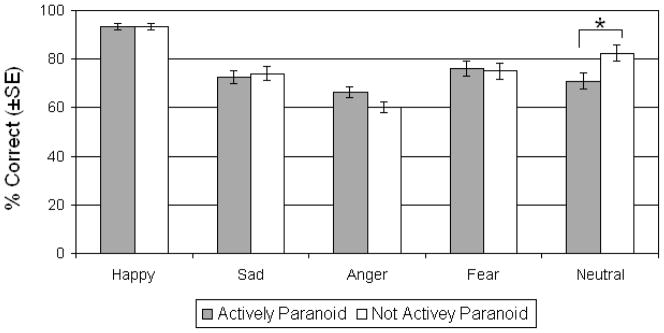
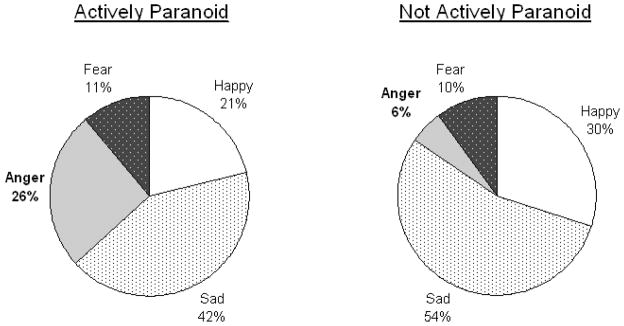
Previous investigations of the influence of paranoia on facial affect recognition in schizophrenia have been inconclusive as some studies demonstrate better performance for paranoid relative to non-paranoid patients and others show that paranoid patients display greater impairments. These studies have been limited by small sample sizes and inconsistencies in the criteria used to define groups. Here, we utilized an established emotion recognition task and a large sample to examine differential performance in emotion recognition ability between patients who were actively paranoid (AP) and those who were not actively paranoid (NAP). Accuracy and error patterns on the Penn Emotion Recognition test (ER40) were examined in 132 patients (64 NAP and 68 AP). Groups were defined based on the presence of paranoid ideation at the time of testing rather than diagnostic subtype. AP and NAP patients did not differ in overall task accuracy; however, an emotion by group interaction indicated that AP patients were significantly worse than NAP patients at correctly labeling neutral faces. A comparison of error patterns on neutral stimuli revealed that the groups differed only in misattributions of anger expressions, with AP patients being significantly more likely to misidentify a neutral expression as angry. The present findings suggest that paranoia is associated with a tendency to over attribute threat to ambiguous stimuli and also lend support to emerging hypotheses of amygdala hyperactivation as a potential neural mechanism for paranoid ideation.
Copyright © 2010 Elsevier B.V. All rights reserved.
Figures
References
-
- Adolphs R. Neural systems for recognizing emotion. Curr Opin Neurobiol. 2002;12(2):169–177. - PubMed
-
- Adolphs R, Tranel D, Damasio AR. The human amygdala in social judgment. Nature. 1998;393(6684):470–474. - PubMed
-
- Aleman A, Kahn RS. Strange feelings: do amygdala abnormalities dysregulate the emotional brain in schizophrenia? Prog Neurobiol. 2005;77(5):283–298. - PubMed
-
- Andreasen NC. Scale for the Assessment of Negative Symptoms (SANS) Iowa City: University of Iowa; 1984a.
Publication types
MeSH terms
Grants and funding
LinkOut - more resources
Full Text Sources
Research Materials
