Review
. 2011 Jan;27(1):1-16.
doi: 10.1016/j.dental.2010.10.016. Epub 2010 Nov 27.

State of the art etch-and-rinse adhesives

Affiliations
Review

State of the art etch-and-rinse adhesives

David H Pashley et al. Dent Mater. 2011 Jan.

Abstract

Objectives: The aim of this study was to explore the therapeutic opportunities of each step of 3-step etch-and-rinse adhesives.

Methods: Etch-and-rinse adhesive systems are the oldest of the multi-generation evolution of resin bonding systems. In the 3-step version, they involve acid-etching, priming and application of a separate adhesive. Each step can accomplish multiple goals. Acid-etching, using 32-37% phosphoric acid (pH 0.1-0.4) not only simultaneously etches enamel and dentin, but the low pH kills many residual bacteria.

Results: Some etchants include anti-microbial compounds such as benzalkonium chloride that also inhibits matrix metalloproteinases (MMPs) in dentin. Primers are usually water and HEMA-rich solutions that ensure complete expansion of the collagen fibril meshwork and wet the collagen with hydrophilic monomers. However, water alone can re-expand dried dentin and can also serve as a vehicle for protease inhibitors or protein cross-linking agents that may increase the durability of resin-dentin bonds. In the future, ethanol or other water-free solvents may serve as dehydrating primers that may also contain antibacterial quaternary ammonium methacrylates to inhibit dentin MMPs and increase the durability of resin-dentin bonds. The complete evaporation of solvents is nearly impossible.

Significance: Manufacturers may need to optimize solvent concentrations. Solvent-free adhesives can seal resin-dentin interfaces with hydrophobic resins that may also contain fluoride and antimicrobial compounds. Etch-and-rinse adhesives produce higher resin-dentin bonds that are more durable than most 1 and 2-step adhesives. Incorporation of protease inhibitors in etchants and/or cross-linking agents in primers may increase the durability of resin-dentin bonds. The therapeutic potential of etch-and-rinse adhesives has yet to be fully exploited.


Figures

Figure 1
Figure 1
Schematic of a hybrid layer (HL) created by an etch-and-rinse adhesive. Note that the depth of the hybrid layer (green) is about four acid-etched tubule diameters (i.e. ca. 8 μm). The collagen fibrils in the HL are continuous with the underlying mineralized matrix. A single dentinal tubule is shown devoid of a resin tag to illustrate its presence.
Figure 2
Figure 2
Scanning electron micrograph of acid-etched dentin showing two dentinal tubules containing remnants of peritubular dentin matrix. INSERT: High magnification of branching collagen fibrils (ca. 75 nm in diameter) separated by interfibrillar spaces that serve as channels for resin infiltrations during bonding.
Figure 3
Figure 3
Transmission electron micrograph of an adhesive layer containing a fluid-filled droplet of dentinal fluid that exuded from a dentinal tubule before the adhesive polymerized. H = hybrid layer; T = dentinal tubule; D: = underlying mineralized dentin that was demineralized during laboratory processing, exposing cross-banded collagen fibrils.
Figures 4
Figures 4
A&B – Unstained transmission electron micrograph (TEM) of resin-dentin bond created by an acid-etched adhesive. After immersion in 50 wt% ammoniacal silver nitrate for 24 h to reveal the distribution of water in the hybrid and adhesive layers, the specimens were processed for TEM. A: Lower power TEM showing a water tree (black arrow) in the adhesive (A) layer. The region between the opposing open arrows is the hybrid layer. Large silver grains in the hybrid layer are due to the terminations of lateral branches of dentinal tubules. C = composite; D = underlying dentin. B: High magnification of Fig. 4A showing silver grains in terminal branches of tubules in the hybrid (H) layer. The black arrow points to a linear array of tiny silver grains thought to reside in intrafibrillar water inside collagen fibrils.
Figure 5
Figure 5
A very high magnification TEM of the top of a hybrid layer (H). A: adhesive layer. Note the 67 nm cross-banding (open arrowhead) of collagen fibrils. These fibrils are about 75 nm in diameter. Note that the interfibrillar spaces are only 20 nm wide. They are filed with electron-lucent resin.
Figure 6
Figure 6
A&B – Stained transmission electron micrographs of resin-dentin bonds made by Optibond FL to acid-etched dentin. A: After storage in water for 48 hr, the specimens were processed. FA = filled adhesive; H – hybrid layer; D = laboratory demineralized dentin. Black arrow heads = bottom of hybrid layer. Note well-stained collagen fibrils filling the hybrid layer. B: Similar bonded specimen after incubation in water for 44 months. More than half the collagen fibrils in the hybrid layer have lost their ability to pick up stain (*). Endogenous dentin MMPs are thought to give broken collagen fibrils to gelatin. (Reproduced from Armstrong et al., Oper Dent 2004;29:705-712, with permission)
Figure 7
Figure 7
Unstained transmission electron micrograph of a resin-dentin bond made with Single Bond Plus after 12 months of function in vivo. The specimen was immersed in 50 wt% ammoniacal silver nitrate to stain water-filled voids in the hybrid layer. Normally there are only a few water-filled voids in hybrid layers (Fig. 4A). Here, huge amounts of silver (*) have been taken up to stain the water uptake that replaced the hydrolyzed collagen. A = adhesive; H = hybrid layer; D = underlying mineralized dentin.
Figure 8
Figure 8
A&B – Schematic of micropermeability of A: poorly hybridized resin tags in etched dentin saturated with water prior to resin infiltration versus B: perfectly hybridized resin tags in etched dentin saturated with ethanol prior to resin infiltration. Yellow fluorescent tracer was forced from the pulp chamber, out the tubules toward the hybrid layer. A: the resin could not displace water-filled lateral branches of tubules in the hybrid layer. This allowed yellow tracer to diffuse throughout the hybrid layer. B: the resin easily dissolved in the ethanol-filled lateral branches sealing the hybrid layer from dentinal fluid. (Reproduced from Sauro et al., J Biomed Mater Res Part B: Appl Biomater 2009;90B:327-337, with permission)
Figure 9
Figure 9
Schematic of the simple apparatus used to infuse fluorescent tracer from the pulp chamber, through dentinal tubules, around resin tags into hybrid layers under physiologic pressure. (Reproduced from Sauro et al., J Biomed Mater Res Part B: Appl Biomater 2009;90B:327-337, with permission)
Figure 10
Figure 10
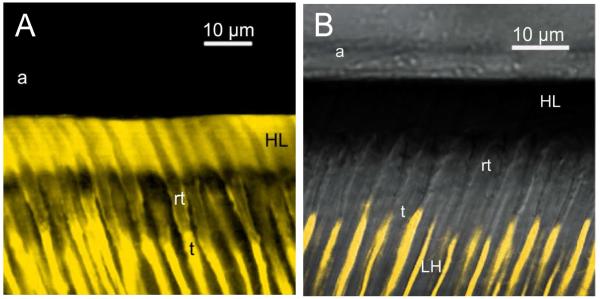
A&BA: Confocal laser scanning microscropy images of resin-dentin bonds made to crown segments. After polymerizing the resin, the pulp chamber was filled with lucifer yellow and place under 20 cm H2O pressure to allow the fluorescent tracer to seep wherever there were water-filled submicron channels from the pulp to the hybrid layer. A: resin-dentin bond made to acid-etched water-saturated dentin. Note that there is a fluorescence continuum from dentinal tubules (t), around resin tags (rt), into the hybrid layer. Note that the entire hybrid layer was fluorescent B: When the same resin was bonded to etched dentin saturated with ethanol, the lucifer yellow in the dentinal tubules (t) stopped when it encountered the 10 μm thick zone of well-hybridized resin tags (rt), just below the hybrid layer. No lucifer yellow passed around any resin tags, leaving the hybrid layer free of fluorescence.
Figure 11
Figure 11
A&BA: Stained TEM of acid-etched specimen bonded with BisGMA/TEGDMA resin under ethanolwet bonding conditions. A = adhesive resin; H = hybrid layer occupies space above the two open arrow heads. Appearance of bond after 1 yr of water storage. B: Stained TEM of Scotchbond MultiPurpose Plus bond made to acid-etched dentin saturated with water, after 1 yr of storage in water. C = hybrid composite; A = adhesive; Hδ = hybrid layer; D = underlying mineralized dentin that was demineralized during TEM processing; T = resin tags in tubules. Note how much stain was taken up by laboratory demineralized dentin and how little was taken up by hybrid layer due to degradation of collagen by endogenous MMPs. (Reproduced from Sadek et al., Dent Mater 2010;26:380-386, with permission)
Figure 12
Figure 12
A&BA: Unstained TEM of 1 yr old resin-dentin bond made with BisGMA/TEGDMA resin to acid-etched, ethanol-saturated dentin. After immersion of the specimen in silver nitrate for 24 h, the hybrid layer (H) was seen to take up very little silver grains. B: Unstained TEM of 1 yr old resin dentin bond made with Scotchbond MultiPurpose to water-saturated dentin. After immersion in silver nitrate, the hybrid layer (Hδ) took up massive amounts of silver indicating that the collagen fibrils with the hybrid layer had been completely destroyed by endogenous MMPs and replaced with water. (Reproduced from Sadek et al., Dent Mater 2010;26:380-386, with permission)
Figure 13
Figure 13
A and B – Schematic of theoretical relationships between resin in interfibrillar spaces and collagen fibrils. A: Interface model, the presence of a layer of water on the collagen limits the molecular level interaction between resin and collagen to a sharp interface. When strained, the collagen stains more than the resin, carrying most of the stress. B: Interphase model, the presence of ethanol in and around the collagen allows comonomers to dissolve into intimate contact with collagen creating 3-D interphase zone rather than a 2-D interface. When strained, both collagen and resin share stress, thereby improving stress distribution. (Modified from Nakabayashi and Pashley, Hybridization of Dental Hard Tissues, Quintessence Publishing Co., with permission)

References

    1. Buoncore MG. A simple method of increasing the adhesion of acrylic filling materials to enamel surfaces. J Dent Res. 1955;34:849–853. - PubMed
    1. Gwinnett AJ, Matsui A. A study of enamel adhesives. The physical relationship between enamel and adhesives. Arch Oral Biol. 1967;12:1615–1619. - PubMed
    1. Nakabayashi N, Kojima K, Masuhara E. The promotion of adhesion by the infiltration of monomers into tooth substrates. J Biomed Mater Sci. 1982;16:265–273. - PubMed
    1. Inokoshi S, Hosoda H, Harnirattisai C, Shimida Y, Tatsumi T. A study on the resin-impregnated layer of dentin. Part I. A comparative study on the decalcified and undecalcified sections and the application of argon ion beam etching to disclose the resin-impregnated layer of dentin. Jpn J Conserv Dent. 1990;33:427–442.
    1. Fusayama T. New Concepts in Operative Dentistry. Quitessence Publishing Co., Inc.; Tokyo: 1980. pp. 61–156.

Publication types