Review
. 2011 Jan 12;366(1561):76-84.
doi: 10.1098/rstb.2010.0291.

Telomeres in cancer and ageing

Affiliations
Review

Telomeres in cancer and ageing

Luis E Donate et al. Philos Trans R Soc Lond B Biol Sci. .

Abstract

Telomeres protect the chromosome ends from unscheduled DNA repair and degradation. Telomeres are heterochromatic domains composed of repetitive DNA (TTAGGG repeats) bound to an array of specialized proteins. The length of telomere repeats and the integrity of telomere-binding proteins are both important for telomere protection. Furthermore, telomere length and integrity are regulated by a number of epigenetic modifications, thus pointing to higher order control of telomere function. In this regard, we have recently discovered that telomeres are transcribed generating long, non-coding RNAs, which remain associated with the telomeric chromatin and are likely to have important roles in telomere regulation. In the past, we showed that telomere length and the catalytic component of telomerase, Tert, are critical determinants for the mobilization of stem cells. These effects of telomerase and telomere length on stem cell behaviour anticipate the premature ageing and cancer phenotypes of telomerase mutant mice. Recently, we have demonstrated the anti-ageing activity of telomerase by forcing telomerase expression in mice with augmented cancer resistance. Shelterin is the major protein complex bound to mammalian telomeres; however, its potential relevance for cancer and ageing remained unaddressed to date. To this end, we have generated mice conditionally deleted for the shelterin proteins TRF1, TPP1 and Rap1. The study of these mice demonstrates that telomere dysfunction, even if telomeres are of a normal length, is sufficient to produce premature tissue degeneration, acquisition of chromosomal aberrations and initiation of neoplastic lesions. These new mouse models, together with the telomerase-deficient mouse model, are valuable tools for understanding human pathologies produced by telomere dysfunction.


Figures
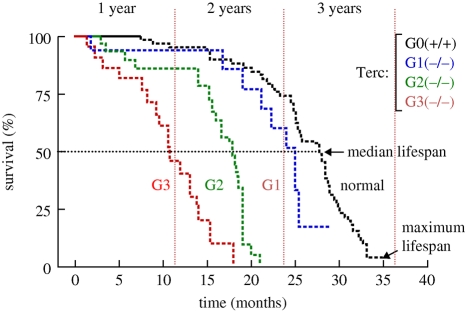
Figure 1.
Figure 1.
Progressive decrease in median and maximum lifespans along successive generations of telomerase-null mice. Cohorts of successive generations of telomerase-deficient mice (wild-type, black dashed line; first generation G1 Terc−/−, blue dashed line; second generation G2 Terc−/−, green dashed line; third generation G3 Terc−/−, red dashed line) were followed up for a period of 32 months. The figure shows a Kaplan–Meier representation of the survival of the following groups of mice: Terc+/+, n = 68; G1 Terc−/−, n = 17; G2 Terc−/−, n = 31; G3 Terc−/−, n = 22. Telomerase-deficient mice have a shorter lifespan than the telomerase-proficient mice, which is further shortened with increasing mouse generations.
Figure 2.
Figure 2.
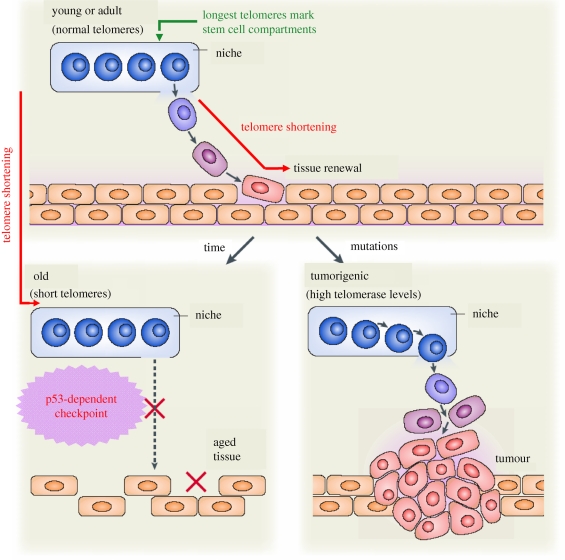
A stem cell-based model for the role of telomeres in cancer and ageing. The longest telomeres mark the stem cell compartments (niches). In young or adult organisms, stem cells (blue rounded cells) repopulate tissues as needed: they exit from the niche, proliferate and differentiate (square orange cells). During this process, stem cells undergo telomere shortening, which is partially counterbalanced by the action of telomerase. In old organisms, stem cell telomeres are too short. Critically short telomeres are recognized as DNA damage, activating a p53-mediated DNA damage signalling response that impairs stem cell mobilization and, as a consequence, the tissue regeneration is suboptimal leading ultimately to organ failure. A decreased stem cell mobilization reduces the probability of accumulating abnormal cells in tissues, providing a mechanism for cancer protection. If the stem cells express aberrantly high levels of telomerase (by acquisition of tumorigenic, telomerase-reactivating mutations), stem cell mobilization is more efficient than normal. Under these higher mobilization conditions, tissue fitness would be maintained for a longer time, increasing lifespan and also the probabilities of initiating a tumour.
Figure 3.
Figure 3.
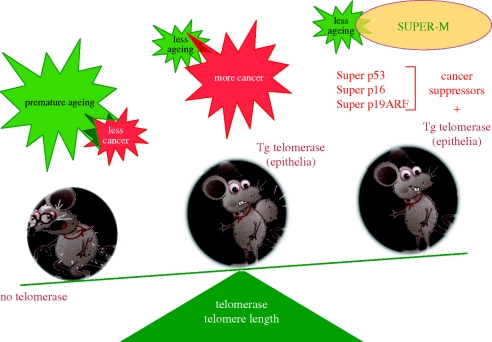
Lifespan extension by telomerase. To address whether telomerase over-expression had an effect on mouse longevity, we first took into account that the absence of telomerase (the Terc knock-out mice) results in premature ageing and also in a lesser incidence of cancer. Second, the constitutive over-expression of telomerase in the epithelia, while attenuating the ageing phenotypes, also increased the incidence of cancer in the epithelia. We generated SUPER-M mice, a mouse model in which the constitutive over-expression of telomerase takes place in a genetic background of increased resistance to cancer achieved by means of over-expression of the tumour suppressors p53, p16 and p19ARF. In the SUPER-M mice, the effects of telomerase on cancer and ageing will be dissociated.
Figure 4.
Figure 4.
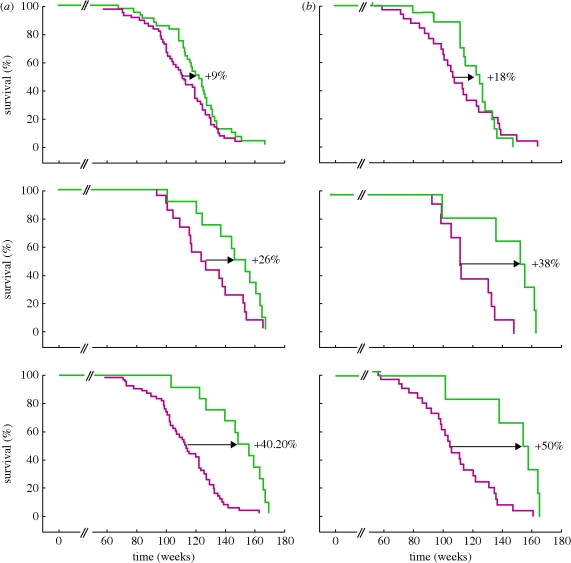
Increased longevity of Sp53/Sp16/SArf/TgTert (SUPER-M) mice. (a) Overall survival. Kaplan–Meier representation of the survival curves of the indicated mouse cohorts. Only mice that reached at least up to 50 weeks of age were included. The increase in the median lifespan is indicated. n = number of mice per genotype. Statistical significance was assessed using the log-rank test. (b) Cancer-free survival. Kaplan–Meier representation of the survival curves of mice of the indicated genotype living for more than 50 weeks excluding those mice that presented malignant tumours at the time of their death (cancer-free survival). The increase in the median lifespan is indicated. n = number of mice included in the analysis. Statistical significance was assessed using the log-rank test. (a) pink trace, Sp53 (n = 68); green trace, Sp53/TgTert (p = 0.05; n = 56); red trace, Sp53/Sp16/SArf (n = 39); green trace, Sp53/Sp16/SArf/TgTert (p = 0.05; n = 27)(SUPER-M); pink trace, Sp53 (n = 68); green trace, Sp53/Sp16/SArf/TgTert (p < 0.001; n = 27)(SUPER-M). (b) pink trace, Sp53 (n = 44); green trace, Sp53/TgTert (p = 0.47; n = 35); pink trace, Sp53/Sp16/SArf (n = 33); green trace, Sp53/Sp16/SArf/TgTert (p = 0.001; n = 22)(SUPER-M); pink trace, Sp53 (n = 44); green trace, Sp53/Sp16/SArf/TgTert (p = 0.001; n = 22) (SUPER-M).
Figure 5.
Figure 5.
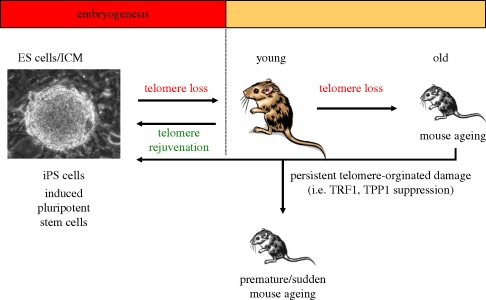
Telomeres and longevity. The mouse embryonic stem cells have very long telomeres which shorten during embryogenesis. Telomere shortening continues during adult life, and is proposed to be a major cause of organism ageing through impairing the regenerative capacity of tissues. Nuclear reprogramming of differentiated cells derived from both young and old mice into induced pluripotent stem (iPS) cells is accompanied by telomerase-dependent telomere elongation. Telomere function is highly dependent on functional shelterin components. Suppression of some shelterins (such as TRF1 and TPP1) results in rapid onset of degenerative pathologies in newborn mice.

References

    1. de Lange T.2005Shelterin: the protein complex that shapes and safeguards human telomeres. Genes Dev. 19, 2100–2110 10.1101/gad.1346005 (doi:10.1101/gad.1346005) - DOI - PubMed
    1. Blasco M. A.2007The epigenetic regulation of mammalian telomeres. Nat. Rev. Genet. 8, 299–309 10.1038/nrg2047 (doi:10.1038/nrg2047) - DOI - PubMed
    1. Greider C. W., Blackburn E. H.1985Identification of a specific telomere terminal transferase activity in Tetrahymena extracts. Cell 43, 405–413 10.1016/0092-8674(85)90170-9 (doi:10.1016/0092-8674(85)90170-9) - DOI - PubMed
    1. Blasco M. A.2005Telomeres and human disease: aging, cancer and beyond. Nat. Rev. Genet. 6, 611–622 10.1038/nrg1656 (doi:10.1038/nrg1656) - DOI - PubMed
    1. Armanios M. Y., et al. 2007Telomerase mutations in families with idiopathic pulmonary fibrosis. N. Engl. J. Med. 356, 1317–1326 10.1056/NEJMoa066157 (doi:10.1056/NEJMoa066157) - DOI - PubMed

Substances