


Rituximab-associated hepatitis B virus (HBV) reactivation in lymphoproliferative diseases: meta-analysis and examination of FDA safety reports
- PMID: 21115603
- PMCID: PMC3082161
- DOI: 10.1093/annonc/mdq583
Rituximab-associated hepatitis B virus (HBV) reactivation in lymphoproliferative diseases: meta-analysis and examination of FDA safety reports
Abstract
Background: Rituximab has been associated with hepatitis B virus reactivation (HBV-R). However, the characteristics and scope of this association remain largely undefined.
Methods: We completed a comprehensive literature search of all published rituximab-associated HBV-R cases and from the Food and Drug Administration (FDA) Adverse Event Reporting System (AERS) MedWatch database. Literature and FDA cases were compared for completeness, and a meta-analysis was completed.
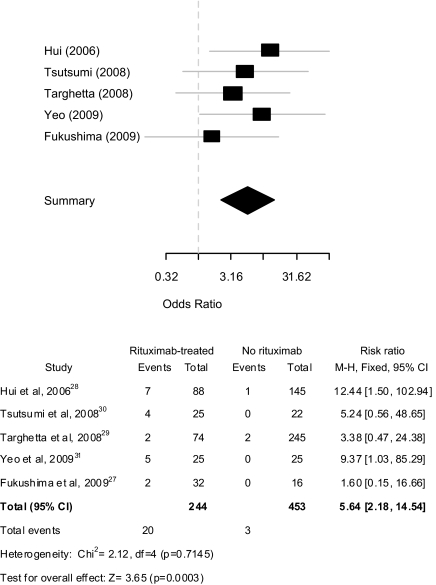
Results: One hundred and eighty-three unique cases of rituximab-associated HBV-R were identified from the literature (n = 27 case reports, n = 156 case series). The time from last rituximab to reactivation was 3 months (range 0-12), although 29% occurred >6 months after last rituximab. Within FDA data (n = 118 cases), there was a strong signal for rituximab-associated HBV-R [proportional reporting ratio = 28.5, 95% confidence interval (CI) 23.9-34.1; Empiric Bayes Geometric Mean = 26.4, 95% CI 21.4-31.1]. However, the completeness of data in FDA reports was significantly inferior compared with literature cases (P < 0.0001). Among HBV core antibody (HBcAb(+)) series, the pooled effect of rituximab-based therapy showed a significantly increased risk of HBV-R compared with nonrituximab-treated patients (odds ratio 5.73, 95% CI 2.01-16.33; Z = 3.33, P = 0.0009) without heterogeneity (χ(2) = 2.12, P = 0.5473).
Conclusions: The FDA AERS provided strong HBV-R safety signals; however, literature-based cases provided a significantly more complete description. Furthermore, meta-analysis of HBcAb(+) series identified a more than fivefold increased rate of rituximab-associated HBV-R.
Figures
Comment in
-
Different hepatitis B carrier categories need different management strategies in case of immunosuppressive chemotherapeutic regimens.Ann Oncol. 2011 Jun;22(6):1462-1463. doi: 10.1093/annonc/mdr257. Epub 2011 Apr 27. Ann Oncol. 2011. PMID: 21525405 No abstract available.
References
-
- Lee WM. Hepatitis B virus infection. N Engl J Med. 1997;337:1733–1745. - PubMed
-
- Alter MJ. Epidemiology of hepatitis B in Europe and worldwide. J Hepatol. 2003;39(Suppl 1):S64–S69. - PubMed
-
- Cheng AL, Hsiung CA, Su IJ, et al. Steroid-free chemotherapy decreases risk of hepatitis B virus (HBV) reactivation in HBV-carriers with lymphoma. Hepatology. 2003;37:1320–1328. - PubMed
-
- Markovic S, Drozina G, Vovk M, Fidler-Jenko M. Reactivation of hepatitis B but not hepatitis C in patients with malignant lymphoma and immunosuppressive therapy. A prospective study in 305 patients. Hepatogastroenterology. 1999;46:2925–2930. - PubMed
-
- Liang R, Lau GK, Kwong YL. Chemotherapy and bone marrow transplantation for cancer patients who are also chronic hepatitis B carriers: a review of the problem. J Clin Oncol. 1999;17:394–398. - PubMed
Publication types
MeSH terms
Substances
Grants and funding
LinkOut - more resources
Full Text Sources
Medical
