


Microbial excavation of solid carbonates powered by P-type ATPase-mediated transcellular Ca2+ transport
- PMID: 21115827
- PMCID: PMC3003062
- DOI: 10.1073/pnas.1011884108
Microbial excavation of solid carbonates powered by P-type ATPase-mediated transcellular Ca2+ transport
Abstract
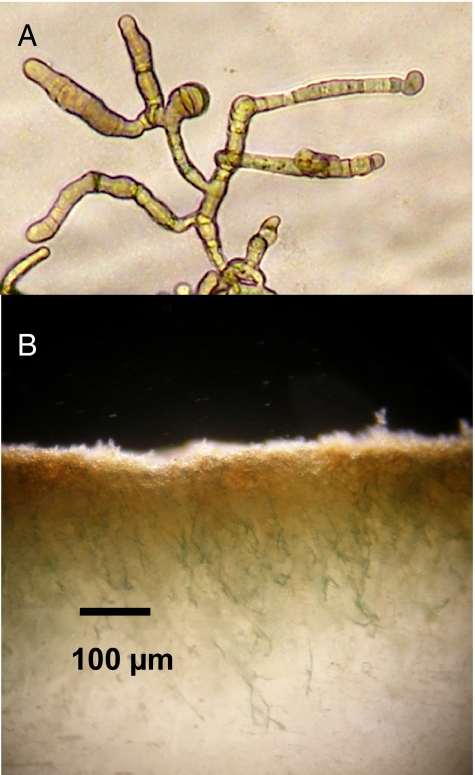
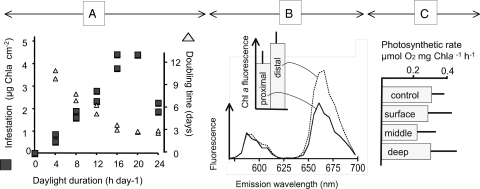
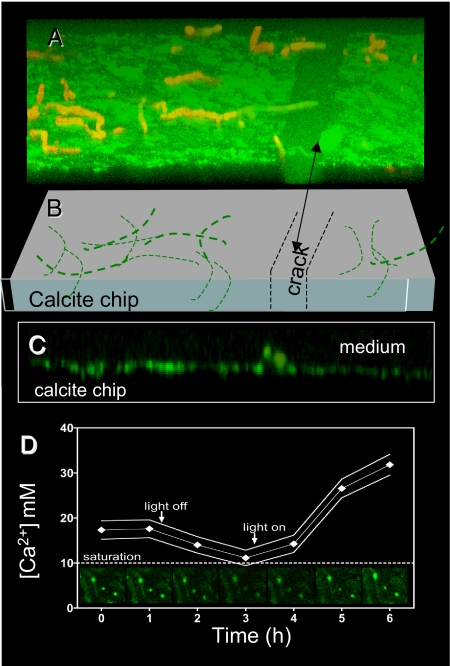
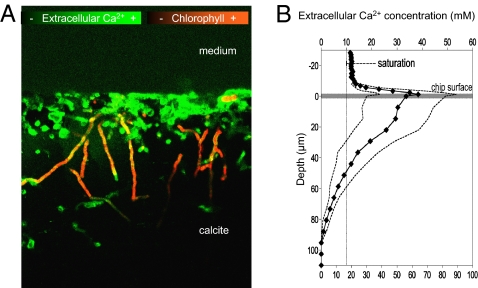
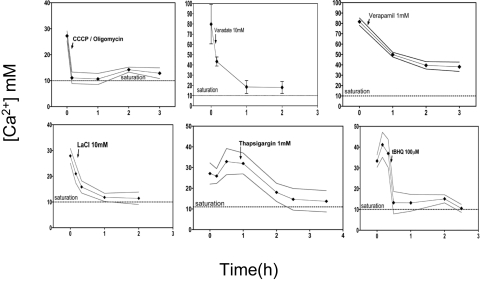
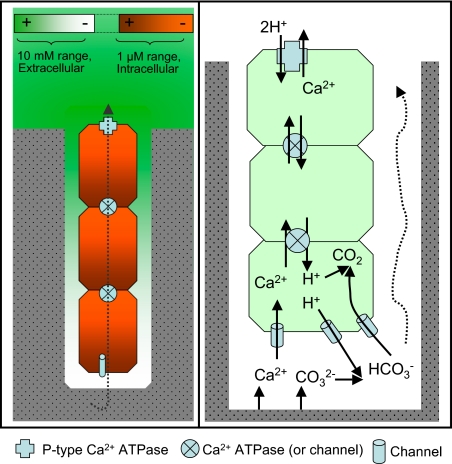
Some microbes, among them a few species of cyanobacteria, are able to excavate carbonate minerals, from limestone to biogenic carbonates, including coral reefs, in a bioerosive activity that directly links biological and geological parts of the global carbon cycle. The physiological mechanisms that enable such endolithic cyanobacteria to bore, however, remain unknown. In fact, their boring constitutes a geochemical paradox, in that photoautotrophic metabolism will tend to precipitate carbonates, not dissolve them. We developed a stable microbe/mineral boring system based on a cyanobacterial isolate, strain BC008, with which to study the process of microbial excavation directly in the laboratory. Measurements of boring into calcite under different light regimes, and an analysis of photopigment content and photosynthetic rates along boring filaments, helped us reject mechanisms based on the spatial or temporal separation of alkali versus Acid-generating metabolism (i.e., photosynthesis and respiration). Instead, extracellular Ca(2+) imaging of boring cultures in vivo showed that BC008 was able to take up Ca(2+) at the excavation front, decreasing the local extracellular ion activity product of calcium carbonate enough to promote spontaneous dissolution there. Intracellular Ca(2+) was then transported away along the multicellular cyanobacterial trichomes and excreted at the distal borehole opening into the external medium. Inhibition assays and gene expression analyses indicate that the uptake and transport was driven by P-type Ca(2+)-ATPases. We believe such a chemically simple and biologically sophisticated mechanism for boring to be unparalleled among bacteria.
Conflict of interest statement
The authors declare no conflict of interest.
Figures

References
-
- Golubic S, Friedmann EI, Schneider J. The lithobiontic ecological niche, with special reference to microorganisms. J Sediment Res. 1981;51:475–478.
-
- Trudgill ST. Bioerosion of intertidal limestone, Co. Clare, Eire- 3: Zonation, process and form. Mar Geol. 1987;74:111–121.
-
- Shachak M, Jones CG, Granot Y. Herbivory in rocks and the weathering of a desert. Science. 1987;236:1098–1099. - PubMed
-
- Le Campion-Alsumard T, Golubic S, Hutchings P. Microbial endoliths in skeletons of live and dead corals: Porites Lobata (Moorea, French Polynesia) Mar Ecol Prog Ser. 1995;117:149–157.
-
- Aline T. Dissolution of dead corals by euendolithic microorganisms across the northern Great Barrier Reef (Australia) Microb Ecol. 2008;55:569–580. - PubMed
Publication types
MeSH terms
Substances
LinkOut - more resources
Full Text Sources
Miscellaneous
