


Global capacity for emerging infectious disease detection
- PMID: 21115835
- PMCID: PMC3003006
- DOI: 10.1073/pnas.1006219107
Global capacity for emerging infectious disease detection
Abstract
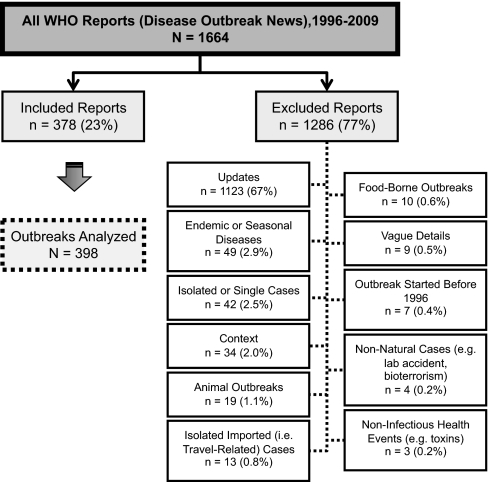
The increasing number of emerging infectious disease events that have spread internationally, such as severe acute respiratory syndrome (SARS) and the 2009 pandemic A/H1N1, highlight the need for improvements in global outbreak surveillance. It is expected that the proliferation of Internet-based reports has resulted in greater communication and improved surveillance and reporting frameworks, especially with the revision of the World Health Organization's (WHO) International Health Regulations (IHR 2005), which went into force in 2007. However, there has been no global quantitative assessment of whether and how outbreak detection and communication processes have actually changed over time. In this study, we analyzed the entire WHO public record of Disease Outbreak News reports from 1996 to 2009 to characterize spatial-temporal trends in the timeliness of outbreak discovery and public communication about the outbreak relative to the estimated outbreak start date. Cox proportional hazards regression analyses show that overall, the timeliness of outbreak discovery improved by 7.3% [hazard ratio (HR) = 1.073, 95% CI (1.038; 1.110)] per year, and public communication improved by 6.2% [HR = 1.062, 95% CI (1.028; 1.096)] per year. However, the degree of improvement varied by geographic region; the only WHO region with statistically significant (α = 0.05) improvement in outbreak discovery was the Western Pacific region [HR = 1.102 per year, 95% CI (1.008; 1.205)], whereas the Eastern Mediterranean [HR = 1.201 per year, 95% CI (1.066; 1.353)] and Western Pacific regions [HR = 1.119 per year, 95% CI (1.025; 1.221)] showed improvement in public communication. These findings provide quantitative historical assessment of timeliness in infectious disease detection and public reporting of outbreaks.
Conflict of interest statement
The authors declare no conflict of interest.
Figures

References
-
- Heymann DL, Rodier GR WHO Operational Support Team to the Global Outbreak Alert and Response Network. Hot spots in a wired world: WHO surveillance of emerging and re-emerging infectious diseases. Lancet Infect Dis. 2001;1:345–353. - PubMed
-
- Morse SS. Factors and determinants of disease emergence. Rev Sci Tech. 2004;23:443–451. - PubMed
-
- Khan K, et al. Spread of a novel influenza A (H1N1) virus via global airline transportation. N Engl J Med. 2009;361:212–214. - PubMed
Publication types
MeSH terms
Grants and funding
LinkOut - more resources
Full Text Sources
Medical
Miscellaneous
