


Inadequate symptom control in advanced cancer patients across Europe
- PMID: 21116653
- PMCID: PMC3204099
- DOI: 10.1007/s00520-010-1051-2
Inadequate symptom control in advanced cancer patients across Europe
Abstract
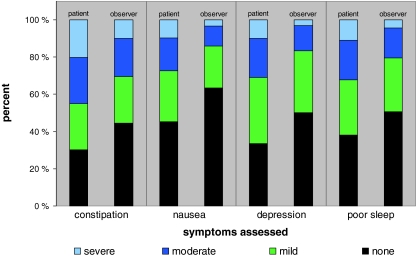
Purpose: The purpose of this study is to examine the adequacy of treatment for constipation, nausea, depression and poor sleep and the factors associated with inadequate symptom control in cancer patients receiving opioids.
Methods: Patients receiving strong opioids for cancer pain were recruited from 17 centres in 11 European countries. By using the European Organization for Research and Treatment of Cancer Core Quality of Life Questionnaire C30, 1,938 patients reported their symptoms at four-point scales. Health care providers assessed symptoms at corresponding four-point scales and registered use of medications, demographic and disease-related variables. Symptomatic treatment was scored as 1 if not administered during the past 24 h and as 2 if administered. Adequacy of treatment was evaluated by subtracting the patients' symptom score from the treatment score. Negative scores, caused by either no treatment or ineffective treatment of a symptom, were interpreted as inadequate treatment.
Results: Approximately 60% of patients with constipation, depression or poor sleep and 45% of nauseated patients were inadequately treated. Numbers of inadequately treated patients varied between countries. In general, underestimation of symptom intensity by health care providers (p < 0.001), low performance status (p < 0.05) and recent initiation of opioids (p < 0.05) increased the risk of inadequate treatment. The subset of demographic- and disease-related factors associated with inadequate treatment varied between the symptoms investigated.
Conclusions: Inadequate treatment, either no treatment or ineffective treatment, was frequent in cancer patients. There were subgroups of patients at particular risk for inadequate treatment, which might need additional attention from health care providers for achievement of adequate symptom control.
Figures

References
-
- Laugsand E, Kaasa S, de Conno F, Hanks G, Klepstad P. Intensity and treatment of symptoms in 3,030 palliative care patients: a cross-sectional survey of the EAPC Research Network. J Opioid Manag. 2009;5:11–21. - PubMed
Publication types
MeSH terms
Substances
LinkOut - more resources
Full Text Sources
Medical
Miscellaneous
