


RNAi-mediated resistance to diverse isolates belonging to two virus species involved in Cassava brown streak disease
- PMID: 21118347
- PMCID: PMC6640250
- DOI: 10.1111/j.1364-3703.2010.00650.x
RNAi-mediated resistance to diverse isolates belonging to two virus species involved in Cassava brown streak disease
Abstract
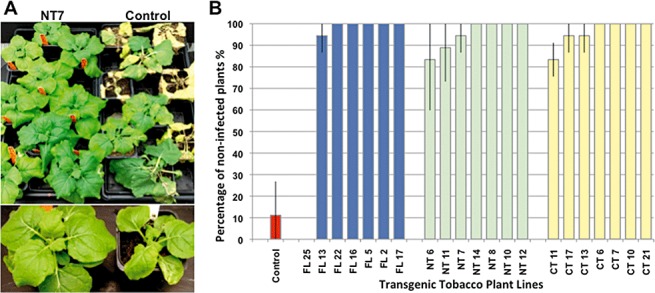
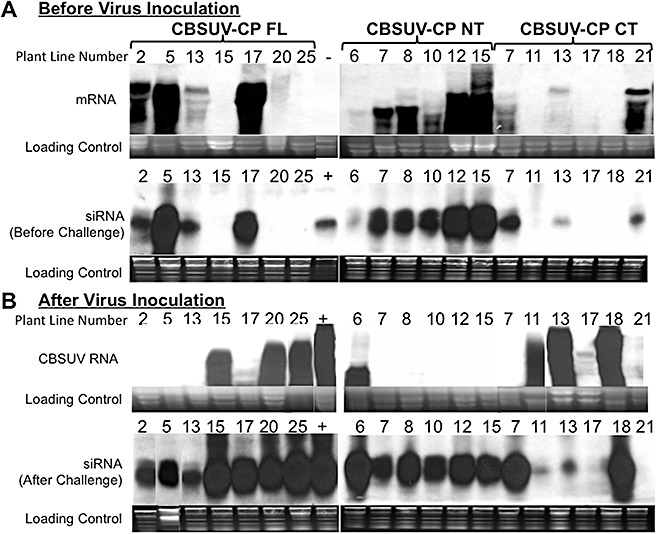
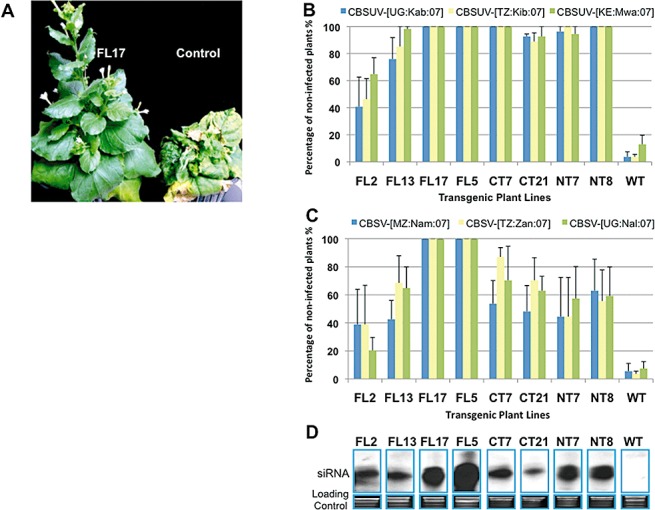
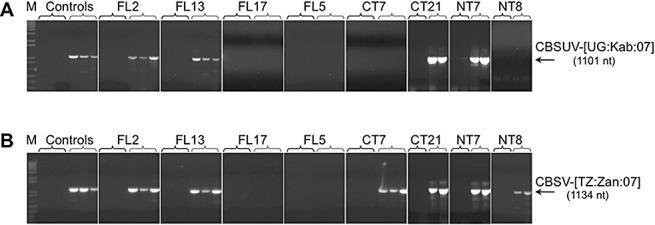
Cassava brown streak disease (CBSD) is emerging as one of the most important viral diseases of cassava (Manihot esculenta) and is considered today as the biggest threat to cassava cultivation in East Africa. The disease is caused by isolates of at least two phylogenetically distinct species of single-stranded RNA viruses belonging to the family Potyviridae, genus Ipomovirus. The two species are present predominantly in the coastal lowland [Cassava brown streak virus (CBSV); Tanzania and Mozambique] and highland [Cassava brown streak Uganda virus (CBSUV); Lake Victoria Basin, Uganda, Kenya and Malawi] in East Africa. In this study, we demonstrate that CBSD can be efficiently controlled using RNA interference (RNAi). Three RNAi constructs targeting the highland species were generated, consisting of the full-length (FL; 894 nucleotides), 397-nucleotide N-terminal and 491-nucleotide C-terminal portions of the coat protein (CP) gene of a Ugandan isolate of CBSUV (CBSUV-[UG:Nam:04]), and expressed constitutively in Nicotiana benthamiana. After challenge with CBSUV-[UG:Nam:04], plants homozygous for FL-CP showed the highest resistance, followed by the N-terminal and C-terminal lines with similar resistance. In the case of FL, approximately 85% of the transgenic plant lines produced were completely resistant. Some transgenic lines were also challenged with six distinct isolates representing both species: CBSV and CBSUV. In addition to nearly complete resistance to the homologous virus, two FL plant lines showed 100% resistance and two C-terminal lines expressed 50-100% resistance, whereas the N-terminal lines succumbed to the nonhomologous CBSV isolates. Northern blotting revealed a positive correlation between the level of transgene-specific small interfering RNAs detected in transgenic plants and the level of virus resistance. This is the first demonstration of RNAi-mediated resistance to CBSD and protection across very distant isolates (more than 25% in nucleotide sequence) belonging to two different species: Cassava brown streak virus and Cassava brown streak Uganda virus.
© 2010 The Authors. Molecular Plant Pathology © 2010 BSPP and Blackwell Publishing Ltd.
Figures
References
-
- Akbergenov, R. , Si‐Ammour, A. , Blevins, T. , Amin, I. , Kutter, C. , Vanderschuren, H. , Zhang, P. , Gruissem, W. , Meins, F. Jr , Hohn, T. and Pooggin, M.M. (2006) Molecular characterization of geminivirus‐derived small RNAs in different plant species. Nucleic Acids Res. 34, 462–471. - PMC - PubMed
-
- Alicai, T. , Omongo, C.A. , Maruthi, M.N. , Hillocks, R.J. , Baguma, Y. , Kawuki, R. , Bua, A. , Otim‐Nape, G.W. and Colvin, J. (2007) Re‐emergence of cassava brown streak disease in Uganda. Plant Dis. 91, 24–29. - PubMed
-
- Callaway, A. , Giesman‐Cookmeyer, D. , Gillock, E.T. , Sit, T.L. and Lommel, S.A. (2001) The multifunctional capsid proteins of plant RNA viruses. Annu. Rev. Phytopathol. 39, 419–460. - PubMed
-
- Chellappan, P. , Masona, M.V. , Vanitharani, R. , Taylor, N.J. and Fauquet, C.M. (2004) Broad spectrum resistance to ssDNA viruses associated with transgene‐induced gene silencing in cassava. Plant Mol. Biol. 56, 601–611. - PubMed
Publication types
MeSH terms
Substances
LinkOut - more resources
Full Text Sources
Other Literature Sources
Molecular Biology Databases
Miscellaneous
