. 2010 Nov 30:10:656.
doi: 10.1186/1471-2407-10-656.

Recurrence and mortality according to estrogen receptor status for breast cancer patients undergoing conservative surgery. Ipsilateral breast tumour recurrence dynamics provides clues for tumour biology within the residual breast

Affiliations

Recurrence and mortality according to estrogen receptor status for breast cancer patients undergoing conservative surgery. Ipsilateral breast tumour recurrence dynamics provides clues for tumour biology within the residual breast

Romano Demicheli et al. BMC Cancer. .

Abstract

Background: The study was designed to determine how tumour hormone receptor status affects the subsequent pattern over time (dynamics) of breast cancer recurrence and death following conservative primary breast cancer resection.

Methods: Time span from primary resection until both first recurrence and death were considered among 2825 patients undergoing conservative surgery with or without breast radiotherapy. The hazard rates for ipsilateral breast tumour recurrence (IBTR), distant metastasis (DM) and mortality throughout 10 years of follow-up were assessed.

Results: DM dynamics displays the same bimodal pattern (first early peak at about 24 months, second late peak at the sixth-seventh year) for both estrogen receptor (ER) positive (P) and negative (N) tumours and for all local treatments and metastatic sites. The hazard rates for IBTR maintain the bimodal pattern for ERP and ERN tumours; however, each IBTR recurrence peak for ERP tumours is delayed in comparison to the corresponding timing of recurrence peaks for ERN tumours. Mortality dynamics is markedly different for ERP and ERN tumours with more early deaths among patients with ERN than among patients with ERP primary tumours.

Conclusion: DM dynamics is not influenced by the extent of conservative primary tumour resection and is similar for both ER phenotypes across different metastatic sites, suggesting similar mechanisms for tumour development at distant sites despite apparently different microenvironments. The IBTR risk peak delay observed in ERP tumours is an exception to the common recurrence risk rhythm. This suggests that the microenvironment within the residual breast tissue may enforce more stringent constraints upon ERP breast tumour cell growth than other tissues, prolonging the latency of IBTR. This local environment is, however, apparently less constraining to ERN cells, as IBTR dynamics is similar to the corresponding recurrence dynamics among other distant tissues.


Figures
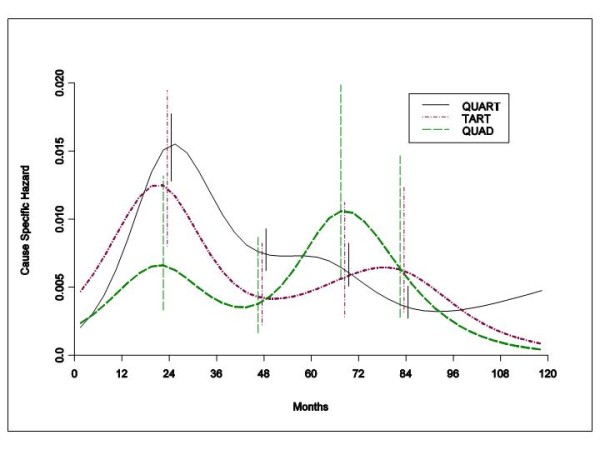
Figure 1
Figure 1
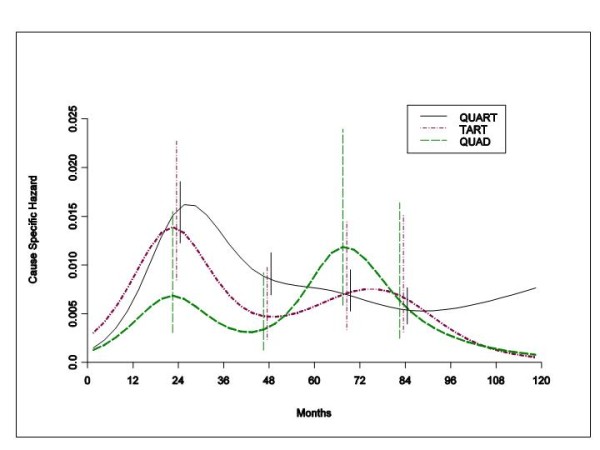
Hazard rate estimates for distant metastasis in 2204 patients undergoing QuaRT, 348 patients receiving TaRT and 273 patients given Quad. The ubiquitous bimodal distant recurrence dynamics described previously following mastectomy are present when much smaller operations are employed. Radiation of the chest wall clearly does not eliminate or even delay the first early recurrence peak. Vertical lines represent point-wise confidence interval for the model estimated hazards, according to standard asymptotic theory.
Figure 2
Figure 2
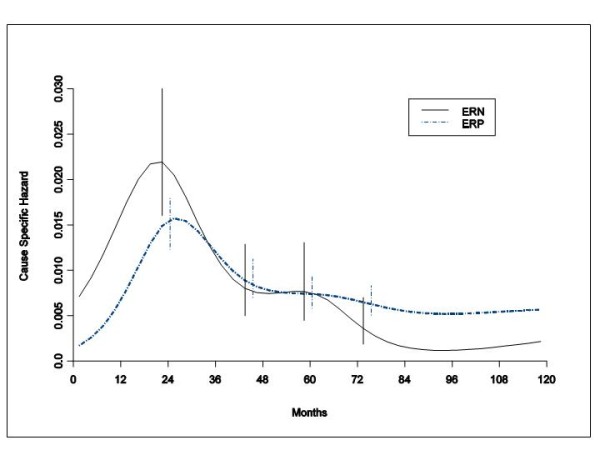
Hazard rate estimates for distant metastasis in patients with ERP tumours undergoing QuaRT (1354 patients), TaRT (261 patients) and Quad (196 patients). There is virtual identity of distant recurrence dynamics for each conservative local treatment modality among ERP tumours. Vertical lines represent point-wise confidence interval for the model estimated hazards, according to standard asymptotic theory.
Figure 3
Figure 3
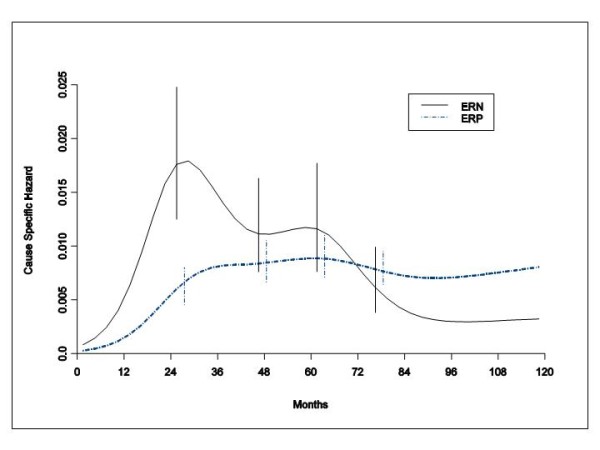
Hazard rate estimates for distant metastasis in 1615 ERP tumours 427 ERN tumours from patients undergoing conservative surgery (quadrantectomy or tumourectomy) plus RT. These data show that the recurrence peak timing after conservative resection is maintained regardless of tumour hormonal receptor status. Patients with ERN tumours do worse during early years and better later. Vertical lines represent point-wise confidence interval for the model estimated hazards, according to standard asymptotic theory.
Figure 4
Figure 4
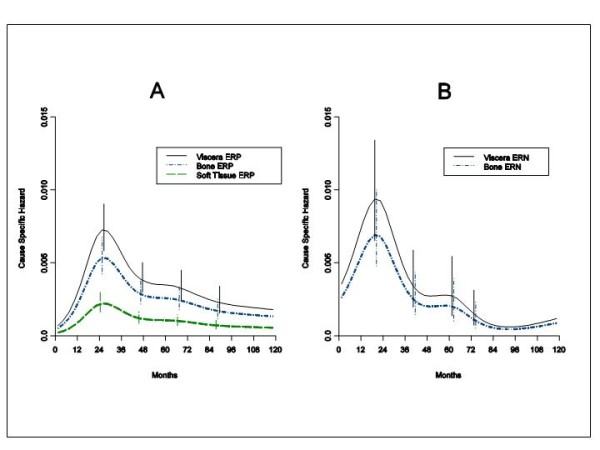
Hazard rate estimates for distant metastasis by metastatic site in 1528 ERP tumours (A) and in 391 ERN tumours (B) from patients undergoing conservative surgery (quadrantectomy or tumourectomy) plus RT. The similarity of recurrence dynamics provides evidence that recurrence timing is generated by factors influencing the metastatic development, regardless of the seeded organ. Vertical lines represent point-wise confidence interval for the model estimated hazards, according to standard asymptotic theory.
Figure 5
Figure 5
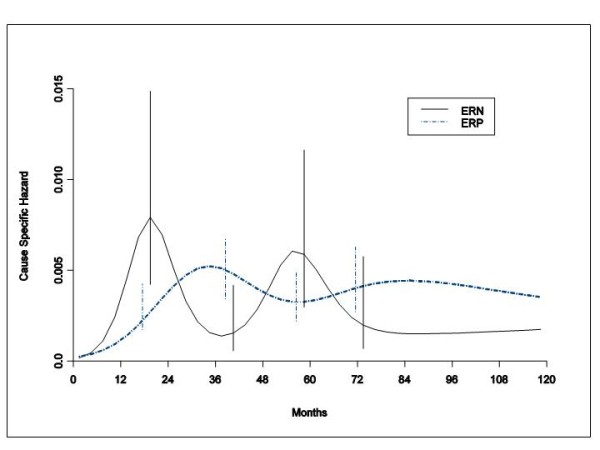
Hazard rate estimates for IBTR in 1615 ERP tumours and in 427 ERN tumours from patients undergoing conservative surgery (quadrantectomy or tumourectomy) plus RT. The dynamics of recurrence within the same breast irradiated following tumourectomy or quadrantectomy is quite distinct and different depending upon whether the resected tumor does or does not bear sex hormone receptors. Vertical lines represent point-wise confidence interval for the model estimated hazards, according to standard asymptotic theory.
Figure 6
Figure 6
Hazard rate estimates for mortality in 1615 ERP tumours and 427 ERN tumours from patients undergoing conservative surgery (quadrantectomy or tumourectomy) plus RT. The mortality risk patterns reveal differences between ERP and ERN tumours in the clinical course of the disease during the critical period spanning from clinical recurrence to death. Vertical lines represent point-wise confidence interval for the model estimated hazards, according to standard asymptotic theory.

References

    1. Demicheli R, Ardoino I, Biganzoli E, Boracchi P, Coradini D, Greco M, Moliterni A, Zambetti M, Valagussa P, Gukas ID, Bonadonna G. Recurrence and mortality for breast cancer patients undergoing mastectomy according to Estrogen Receptor status: different mortality pattern but comparable recurrence dynamics. Cancer Sci. 2010;101:826–830. doi: 10.1111/j.1349-7006.2009.01472.x. - DOI - PMC - PubMed

    1. Hilsenbeck SG, Ravdin PM, de Moor CA, Chamness GC, Osborne CK, Clark GM. Time-dependence of hazard ratios for prognostic factors in primary breast cancer. Breast Cancer Res Treat. 1998;52:227–237. doi: 10.1023/A:1006133418245. - DOI - PubMed
    1. Dignam JJ, Dukic V, Anderson SJ, Mamounas EP, Wickerham DL, Wolmark N. Hazard of recurrence and adjuvant treatment effects over time in lymph node-negative breast cancer. Breast Cancer Res Treat. 2009;116:595–602. doi: 10.1007/s10549-008-0200-5. - DOI - PMC - PubMed
    1. Demicheli R, Biganzoli E, Boracchi P, Greco M, Retsky MW. Recurrence dynamics does not depend on the recurrence site. Breast Cancer Res. 2008;10:R83. doi: 10.1186/bcr2152. - DOI - PMC - PubMed
    1. Hess KR, Pustzai L, Buzdar AU, Hortobagyi GN. Estrogen receptors and distinct patterns of breast cancer relapse. Breast Cancer Res Treat. 2003;78:105–118. doi: 10.1023/A:1022166517963. - DOI - PubMed

MeSH terms