. 2010 Nov 30;11(1):166.
doi: 10.1186/1465-9921-11-166.

Estrogen aggravates inflammation in Pseudomonas aeruginosa pneumonia in cystic fibrosis mice

Affiliations

Estrogen aggravates inflammation in Pseudomonas aeruginosa pneumonia in cystic fibrosis mice

Yufa Wang et al. Respir Res. .

Abstract

Background: Among patients with cystic fibrosis (CF), females have worse pulmonary function and survival than males, primarily due to chronic lung inflammation and infection with Pseudomonas aeruginosa (P. aeruginosa). A role for gender hormones in the causation of the CF "gender gap" has been proposed. The female gender hormone 17β-estradiol (E2) plays a complex immunomodulatory role in humans and in animal models of disease, suppressing inflammation in some situations while enhancing it in others. Helper T-cells were long thought to belong exclusively to either T helper type 1 (Th1) or type 2 (Th2) lineages. However, a distinct lineage named Th17 is now recognized that is induced by interleukin (IL)-23 to produce IL-17 and other pro-inflammatory Th17 effector molecules. Recent evidence suggests a central role for the IL-23/IL-17 pathway in the pathogenesis of CF lung inflammation. We used a mouse model to test the hypothesis that E2 aggravates the CF lung inflammation that occurs in response to airway infection with P. aeruginosa by a Th17-mediated mechanism.

Results: Exogenous E2 caused adult male CF mice with pneumonia due to a mucoid CF clinical isolate, the P. aeruginosa strain PA508 (PA508), to develop more severe manifestations of inflammation in both lung tissue and in bronchial alveolar lavage (BAL) fluid, with increased total white blood cell counts and differential and absolute cell counts of polymorphonuclear leukocytes (neutrophils). Inflammatory infiltrates and mucin production were increased on histology. Increased lung tissue mRNA levels for IL-23 and IL-17 were accompanied by elevated protein levels of Th17-associated pro-inflammatory mediators in BAL fluid. The burden of PA508 bacteria was increased in lung tissue homogenate and in BAL fluid, and there was a virtual elimination in lung tissue of mRNA for lactoferrin, an antimicrobial peptide active against P. aeruginosa in vitro.

Conclusions: Our data show that E2 increases the severity of PA508 pneumonia in adult CF male mice, and suggest two potential mechanisms: enhancement of Th17-regulated inflammation and suppression of innate antibacterial defences. Although this animal model does not recapitulate all aspects of human CF lung disease, our present findings argue for further investigation of the effects of E2 on inflammation and infection with P. aeruginosa in the CF lung.


Figures
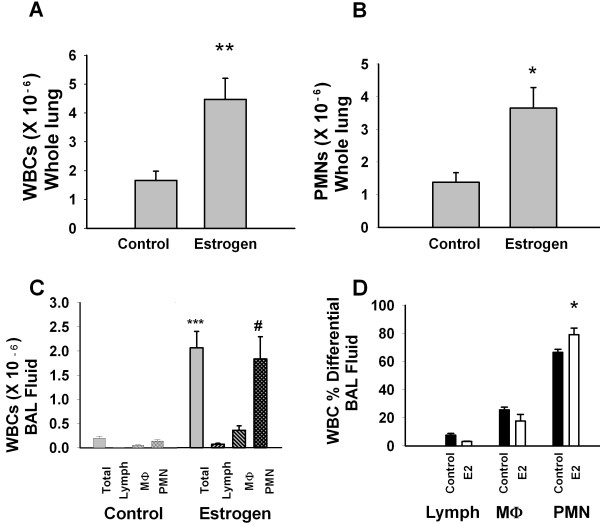
Figure 1
Figure 1
Estrogen (E2) treatment is correlated with an increase in inflammatory cells. In whole lung homogenate, (A) Total white blood cells (WBCs), ** p <0.01 vs control, n = 5; and (B) neutrophils (PMNs), * p < 0.05 vs control, n = 5. In bronchoalveolar lavage (BAL) fluid, (C) Absolute cell counts of total WBCs, lymphocytes (lymph), macrophages (M Φ) and PMNs, ** p < 0.0005, # p <0.005, vs control, n = 5; and (D) PMN differential percentage, * p < 0.05 vs control, n = 5.
Figure 2
Figure 2
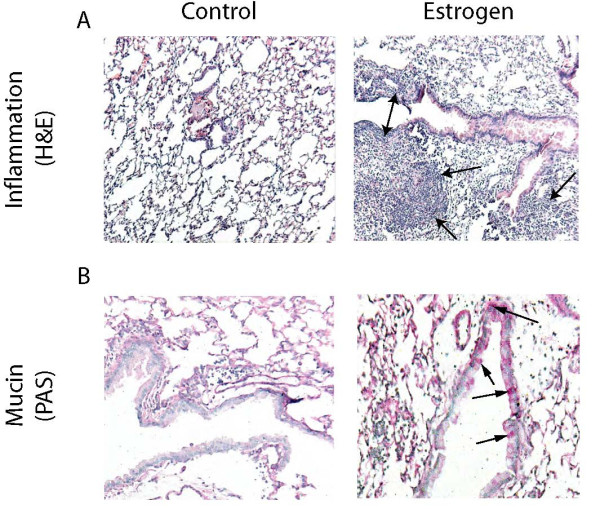
E2 treatment is correlated with an increase in inflammatory infiltrate and mucin in lung tissue sections. In lung tissue sections, E2 treated mice had (A) H&E stain: inflammatory infiltrate (arrows) and (B) PAS stain: mucin producing airway lining cells (Pink, arrows). Controls showed much less inflammatory infiltrates or mucin producing cells. Light microscopy, original magnification X 100, n = 4.
Figure 3
Figure 3
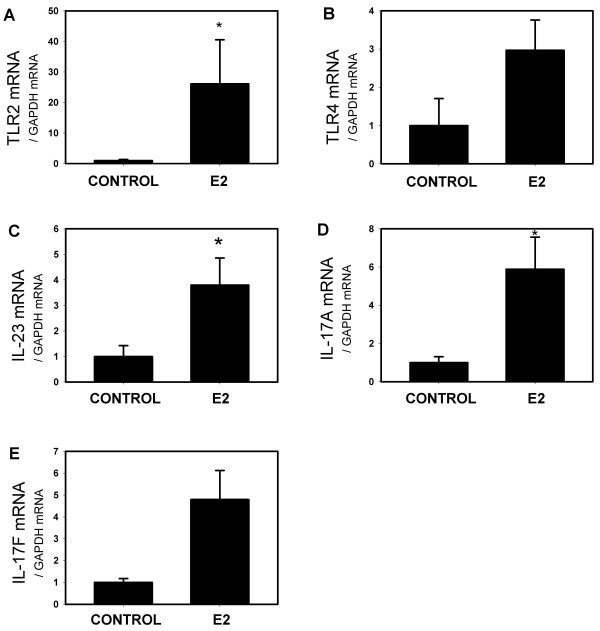
E2 treatment is correlated with an increase in Toll Like Receptor (TLR) 2 and IL-23/IL17A mRNA levels. E2 increased (A) TLR2 (* p < 0.05), but not (B) TLR4 mRNA levels (p ns, n = 5). E2 also increased (C) IL-23 and (D) IL-17A (p < 0.05), but not (E) IL-17F (p > 0.05, n = 5)
Figure 4
Figure 4
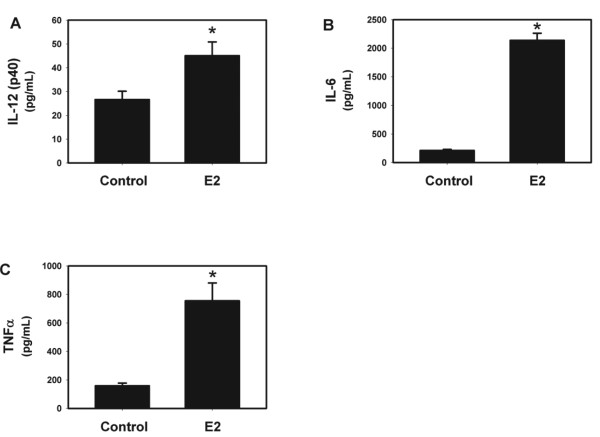
E2 treatment is correlated with an increase in upstream regulators of Th17 Cells. E2 increased (A) IL-12(p40), one of two heteromers making up the IL-23 protein, (B) IL-6, and (C) TNFα, important early mediators of acute lung inflammation that induce IL-17. * p < 0.05 vs control, n = 4.
Figure 5
Figure 5
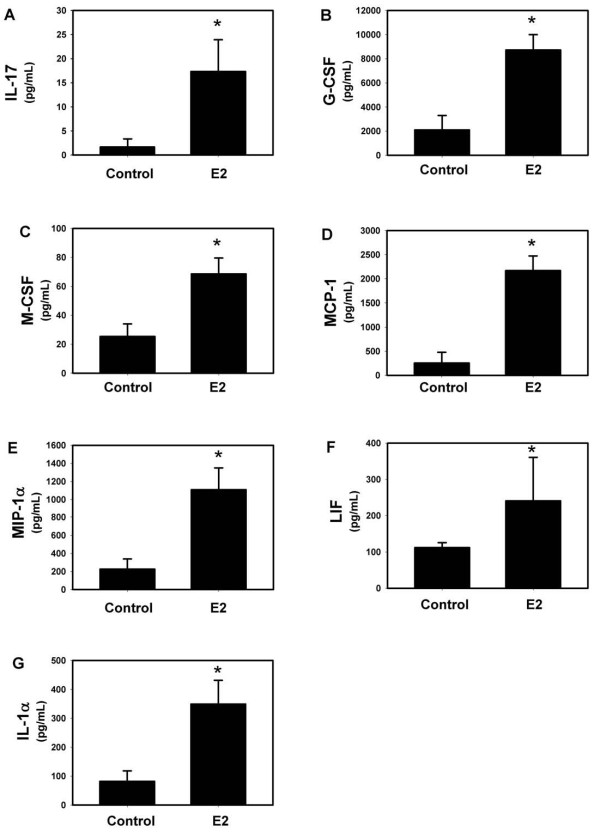
E2 treatment is correlated with an increase in downstream effectors of Th17 cells. E2 increased (A) IL-17A, the prototype pro-inflammatory Th17 effector molecule, and a series of downstream effectors known to be modulated by IL-17A, including (B) G-CSF, (C) MCP-1, (D) IL-1α, (E) MIP-1α, (F) LIF, and (G) M-CSF. * p < 0.05 vs control, n = 4.
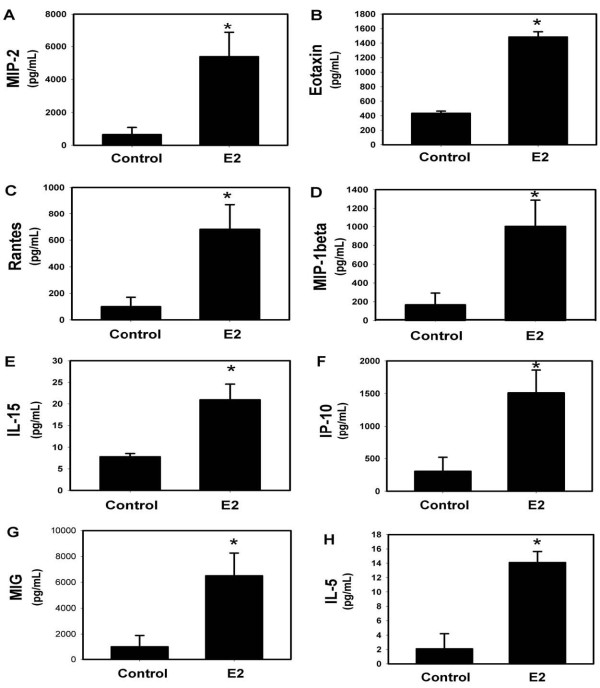
Figure 6
Figure 6
E2 treatment is correlated with an increase in chemoattractant chemokines. (A) MIP-2 (recruits neutrophils), (B) eotaxin and (C) RANTES (eosinophils), (D) MIP-1β (macrophages) and (E) IL-15 (mast cells); in CXCR3 chemokines that regulate Th1 cell proliferation, (F) IP-10 and (G) MIG, and the Th2 effector (H) IL-5. * p < 0.05 vs control, n = 4.
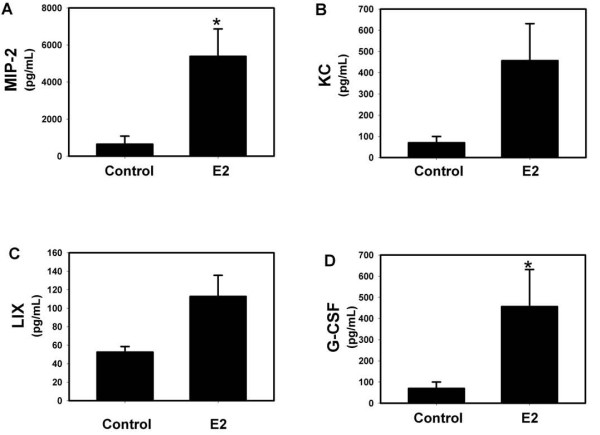
Figure 7
Figure 7
E2 treatment is correlated with an increase in a murine IL-8 homolog that recruits neutrophils, and in the growth factor G-CSF that stimulates production of neutrophils. Protein levels of (A) MIP-2, but not (B) KC or (C) LIX, were increased, * p < 0.05, n = 4; (D) G-CSF protein levels were increased, * p < 0.05, n = 4.
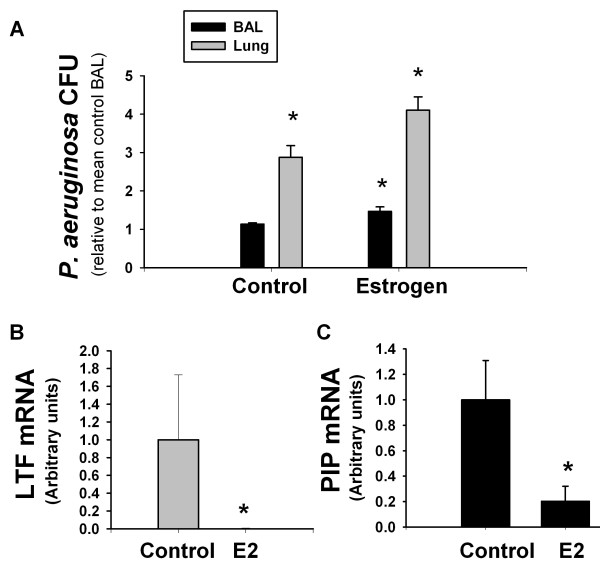
Figure 8
Figure 8
E2 treatment is correlated with (A) an increase in bacterial burden in whole lung and in BAL fluid, and with a decrease in antimicrobial peptide mRNA levels for (B) LTF and (C) PIP. * p < 0.05 vs control, n = 5.

References

    1. Davis PB. Cystic fibrosis since 1938. Am J Respir Crit Care Med. 2006;173:475–482. doi: 10.1164/rccm.200505-840OE. - DOI - PubMed
    1. Corey M, Farewell V. Determinants of mortality from cystic fibrosis in Canada, 1970-1989. Am J Epidemiol. 1996;143:1007–1017. - PubMed
    1. Chmiel JF, Konstan MW. Inflammation and anti-inflammatory therapies for cystic fibrosis. Clin Chest Med. 2007;28:331–346. doi: 10.1016/j.ccm.2007.02.002. - DOI - PubMed
    1. Henry RL, Mellis CM, Petrovic L. Mucoid Pseudomonas aeruginosa is a marker of poor survival in cystic fibrosis. Pediatr Pulmonol. 1992;12:158–161. doi: 10.1002/ppul.1950120306. - DOI - PubMed
    1. Li Z, Kosorok MR, Farrell PM, Laxova A, West SE, Green CG, Collins J, Rock MJ, Splaingard ML. Longitudinal development of mucoid Pseudomonas aeruginosa infection and lung disease progression in children with cystic fibrosis. JAMA. 2005;293:581–588. doi: 10.1001/jama.293.5.581. - DOI - PubMed

Publication types