Effect of integrated care for sick listed patients with chronic low back pain: economic evaluation alongside a randomised controlled trial
- PMID: 21118874
- PMCID: PMC2995018
- DOI: 10.1136/bmj.c6414
Effect of integrated care for sick listed patients with chronic low back pain: economic evaluation alongside a randomised controlled trial
Abstract
Objective: To evaluate the cost effectiveness, cost utility, and cost-benefit of an integrated care programme compared with usual care for sick listed patients with chronic low back pain.
Design: Economic evaluation alongside a randomised controlled trial with 12 months' follow-up.
Setting: Primary care (10 physiotherapy practices, one occupational health service, one occupational therapy practice) and secondary care (five hospitals) in the Netherlands, 2005-9.
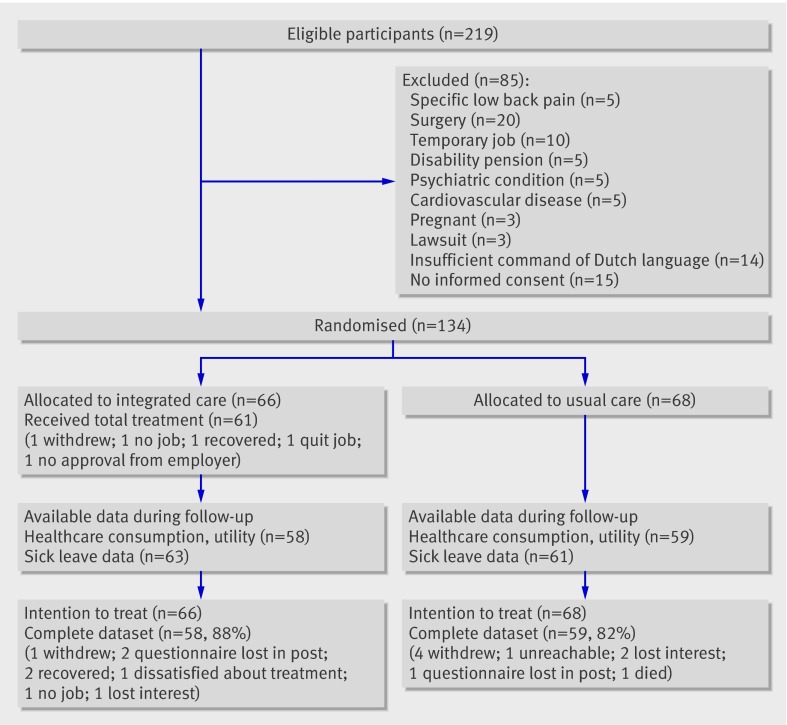
Participants: 134 adults aged 18-65 sick listed because of chronic low back pain: 66 were randomised to integrated care and 68 to usual care.
Interventions: Integrated care consisted of a workplace intervention based on participatory ergonomics, with involvement of a supervisor, and a graded activity programme based on cognitive behavioural principles. Usual care was provided by general practitioners and occupational physicians according to Dutch guidelines.
Main outcome measures: The primary outcome was duration until sustainable return to work. The secondary outcome was quality adjusted life years (QALYs), measured using EuroQol.
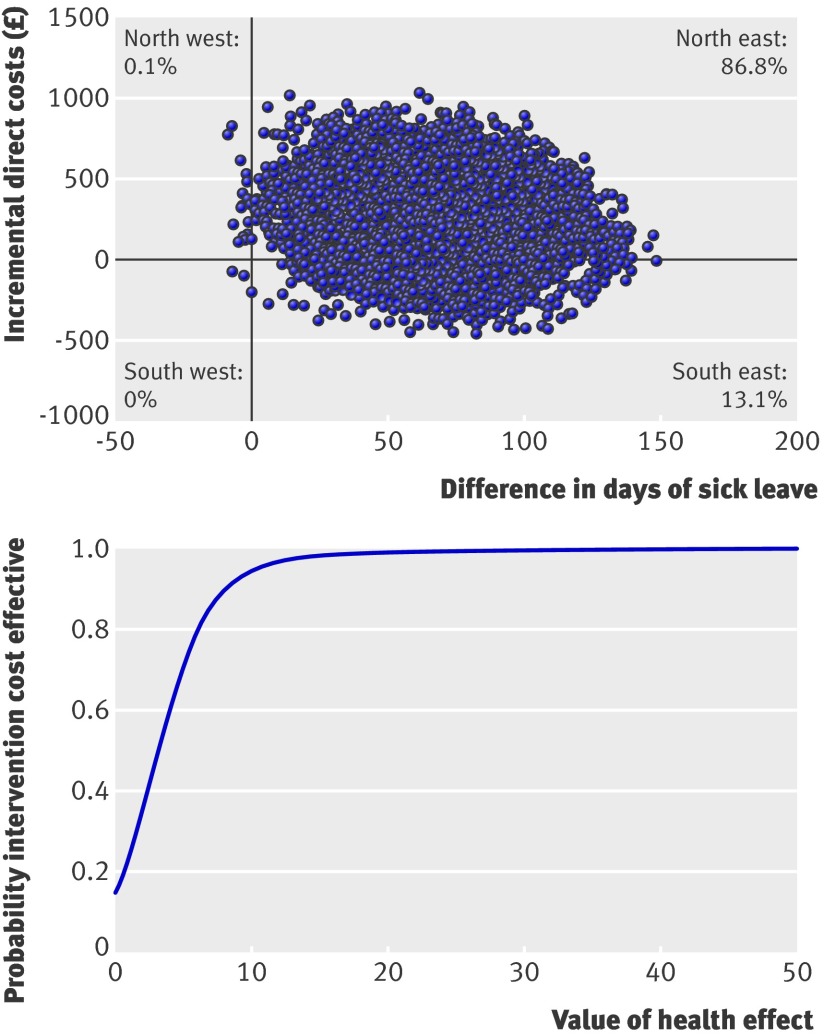
Results: Total costs in the integrated care group (£13 165, SD £13 600) were significantly lower than in the usual care group (£18 475, SD £13 616). Cost effectiveness planes and acceptability curves showed that integrated care was cost effective compared with usual care for return to work and QALYs gained. The cost-benefit analyses showed that every £1 invested in integrated care would return an estimated £26. The net societal benefit of integrated care compared with usual care was £5744.
Conclusions: Implementation of an integrated care programme for patients sick listed with chronic low back pain has a large potential to significantly reduce societal costs, increase effectiveness of care, improve quality of life, and improve function on a broad scale. Integrated care therefore has large gains for patients and society as well as for employers.
Conflict of interest statement
Competing interests: All authors have completed the Unified Competing Interest form at
Figures
Comment in
-
For sick-listed people with chronic low back pain, an integrated care programme costs society less and returns participants to work faster than usual management.Evid Based Med. 2011 Aug;16(4):105-6. doi: 10.1136/ebm1206. Epub 2011 Jun 20. Evid Based Med. 2011. PMID: 21693457 No abstract available.
References
-
- Andersson GB. Epidemiological features of chronic low-back pain. Lancet 1999;354:581-5. - PubMed
-
- Maniadakis N, Gray A. The economic burden of back pain in the UK. Pain 2000;84:95-103. - PubMed
-
- Van Tulder MW, Koes BW, Bouter LM. A cost of illness study of back pain in the Netherlands. Pain 1995;62:233-40. - PubMed
-
- Pai S, Sundaram LJ. Low back pain: an economic assessment in the United States. Orthop Clin North Am 2004;35:1-5. - PubMed
-
- Maetzel A, Li L. The economic burden of low back pain: a review of studies published between 1996 and 2001. Best Pract Res Clin Rheumatol 2002;16:23-30. - PubMed
Publication types
MeSH terms
LinkOut - more resources
Full Text Sources