Case Reports
. 2010 Summer;43(2):333-9.
doi: 10.1901/jaba.2010.43-333.

Evaluation of stimulus control over a communication response as an intervention for stereotypical responding

Affiliations
Case Reports

Evaluation of stimulus control over a communication response as an intervention for stereotypical responding

Cynthia M Anderson et al. J Appl Behav Anal. 2010 Summer.

Abstract

Stereotypical behavior maintained by automatic reinforcement often does not result in harm but may be undesirable in some situations. In the current investigation, participants were 2 individuals who engaged in nonharmful stereotypical responses shown in an analogue functional analysis to be insensitive to social contingencies. After bringing these responses under stimulus control using differential punishment, both participants learned a mand to terminate punishment for stereotypy. We also assessed whether the mand could be brought under stimulus control.

Keywords: developmental disabilities; differential reinforcement; function-based intervention; punishment; stereotypy; stimulus control.


Figures
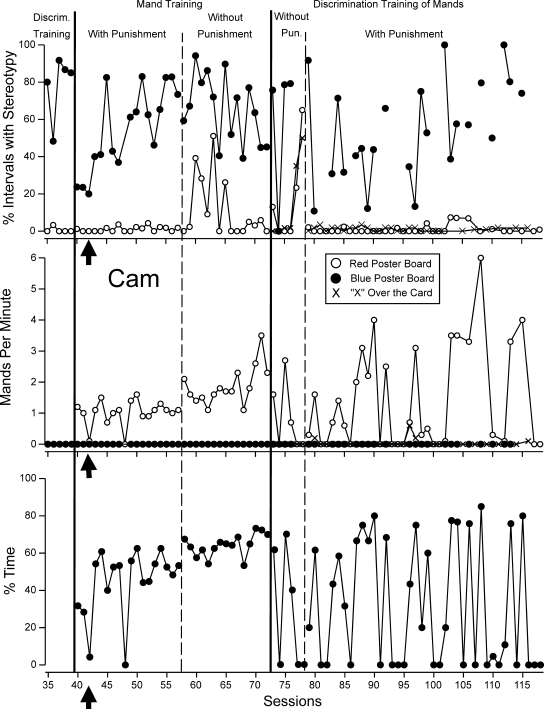
Figure 1
Figure 1
For Cam, percentage of intervals of stereotypy is depicted in the top panel and mands per minute in the middle panel. The bottom panel depicts the percentage of session spent in the blue poster board component (the component correlated with no punishment). The arrow indicates a change in duration of access to the no-punishment conditions, following a mand, from 20 s to 1 min. In all panels, responding in the presence of stimuli correlated historically with delivery of punishment (red poster board), no punishment (blue poster board), and communication extinction (X over the communication card) are depicted by open circles, filled circles, and asterisks, respectively.
Figure 2
Figure 2
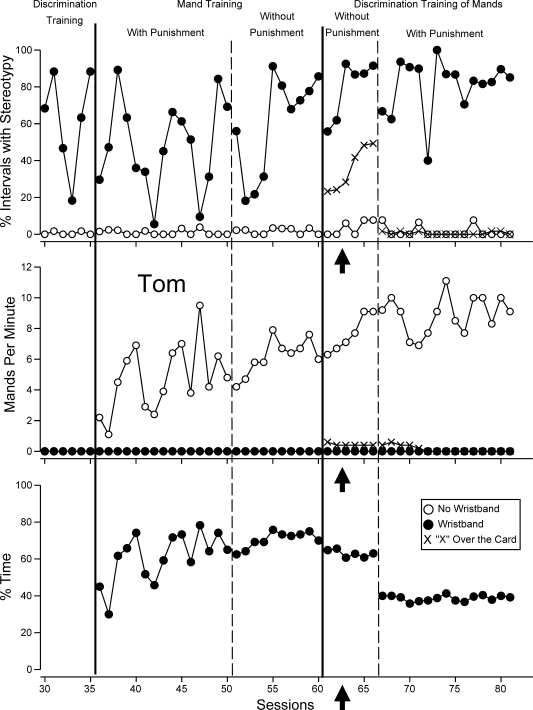
For Tom, percentage of intervals with stereotypy is depicted in the top panel and mands per minute in the middle panel. The bottom panel depicts the percentage of session time spent in the wristband component (the component correlated with no punishment). The arrow indicates when the communication card was moved to a new location. In all panels, responding in the presence of stimuli correlated historically with delivery of punishment (no wristband), no punishment (wristband), and communication extinction (X over the communication card) are depicted by open circles, filled circles, and asterisks, respectively.

References

    1. Athens E.S, Vollmer T.R, Sloman K.N, Pipkin C.S. An analysis of vocal stereotypy and therapist fading. Journal of Applied Behavior Analysis. 2008;41:291–297. - PMC - PubMed
    1. Bodfish J.W, Lewis M.H. Self-injury and comorbid behaviors in developmental, neurological, psychiatric, and genetic disorders. In: Schroeder S.R, Oster-Granite M.L, Thompson T, editors. Self-injurious behavior: Gene-brain-behavior relationships. Washington, DC: American Psychological Association; 2002. pp. 23–40.
    1. Doughty S.S, Anderson C.M, Doughty A.H, Williams D.C, Saunders K.J. Discriminative control of punished stereotypical behavior in humans. Journal of the Experimental Analysis of Behavior. 2007;87:325–336. - PMC - PubMed
    1. Piazza C.C, Hanley G.P, Fisher W.W. Functional analysis and treatment of cigarette pica. Journal of Applied Behavior Analysis. 1996;29:437–449. - PMC - PubMed

Publication types