


Eastern equine encephalitis virus in mosquitoes and their role as bridge vectors
- PMID: 21122215
- PMCID: PMC3294553
- DOI: 10.3201/eid1612.100640
Eastern equine encephalitis virus in mosquitoes and their role as bridge vectors
Abstract
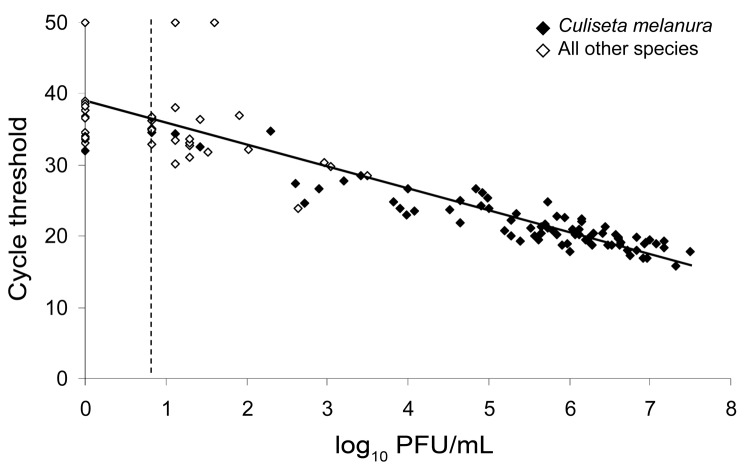
Eastern equine encephalitis virus (EEEV) is maintained in an enzootic cycle involving Culiseta melanura mosquitoes and avian hosts. Other mosquito species that feed opportunistically on mammals have been incriminated as bridge vectors to humans and horses. To evaluate the capacity of these mosquitoes to acquire, replicate, and potentially transmit EEEV, we estimated the infection prevalence and virus titers in mosquitoes collected in Connecticut, USA, by cell culture, plaque titration, and quantitative reverse transcription-PCR. Cs. melanura mosquitoes were the predominant source of EEEV (83 [68%] of 122 virus isolations) and the only species to support consistently high virus titers required for efficient transmission. Our findings suggest that Cs. melanura mosquitoes are primary enzootic and epidemic vectors of EEEV in this region, which may explain the relative paucity of human cases. This study emphasizes the need for evaluating virus titers from field-collected mosquitoes to help assess their role as vectors.
Figures
References
-
- Centers for Disease Control and Prevention. Eastern equine encephalitis—New Hampshire and Massachusetts, August–September 2005. MMWR Morb Mortal Wkly Rep. 2006;55:697–700. - PubMed
-
- Crans WJ. The status of Aedes sollicitans as an epidemic vector of eastern equine encephalitis virus in New Jersey. Mosq News. 1977;37:85–9.
-
- Hayes RO, Beadle LD, Hess AD, Sussman O, Bonese MJ. Entomological aspects of the 1959 outbreak of eastern encephalitis in New Jersey. Am J Trop Med Hyg. 1962;11:115–21. - PubMed
Publication types
MeSH terms
Substances
Grants and funding
LinkOut - more resources
Full Text Sources
Medical