


Offspring viability benefits but no apparent costs of mating with high quality males
- PMID: 21123248
- PMCID: PMC3097854
- DOI: 10.1098/rsbl.2010.0976
Offspring viability benefits but no apparent costs of mating with high quality males
Abstract
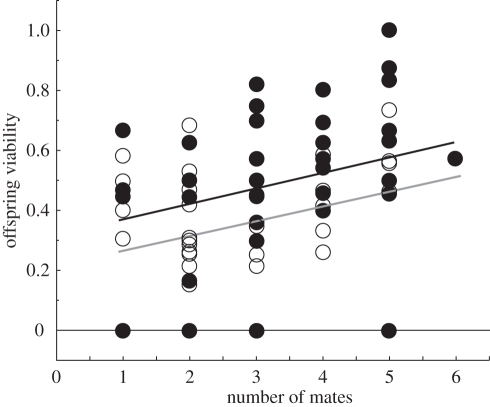
Traditional models of sexual selection posit that male courtship signals evolve as indicators of underlying male genetic quality. An alternative hypothesis is that sexual conflict over mating generates antagonistic coevolution between male courtship persistence and female resistance. In the scarabaeine dung beetle Onthophagus taurus, females are more likely to mate with males that have high courtship rates. Here, we examine the effects of exposing females to males with either high or low courtship rates on female lifetime productivity and offspring viability. Females exposed to males with high courtship rates mated more often and produced offspring with greater egg-adult viability. Female productivity and lifespan were unaffected by exposure to males with high courtship rates. The data are consistent with models of sexual selection based on indirect genetic benefits, and provide little evidence for sexual conflict in this system.
Figures
References
-
- Andersson M. 1994. Sexual selection. Princeton, NJ: Princeton University Press
-
- Kokko H., Jennions M. D., Brooks R. 2006. Unifying and testing models of sexual selection. Annu. Rev. Ecol. Evol. Syst. 37, 43–6610.1146/annurev.ecolsys.37.091305.110259 (doi:10.1146/annurev.ecolsys.37.091305.110259) - DOI - DOI
-
- Partridge L., Fowler K. 1990. Non-mating costs of exposure to males in female Drosophila melanogaster. J. Insect Physiol. 36, 419–42510.1016/0022-1910(90)90059-O (doi:10.1016/0022-1910(90)90059-O) - DOI - DOI
-
- Chapman T., Liddle L. F., Kalb J. M., Wolfner M. F., Partridge L. 1995. Cost of mating in Drosophila melanogaster females is mediated by male accessory gland products. Nature 373, 241–24410.1038/373241a0 (doi:10.1038/373241a0) - DOI - DOI - PubMed
-
- Parker G. A. 1979. Sexual selection and sexual conflict. In Sexual selection and reproductive competition in insects (eds Blum M. S., Blum N. A.), pp. 123–166 London, UK: Academic Press
Publication types
MeSH terms
LinkOut - more resources
Full Text Sources
