. 2011 Feb;85(4):1563-72.
doi: 10.1128/JVI.02231-10. Epub 2010 Dec 1.

Pathogenesis and transmission of triple-reassortant swine H1N1 influenza viruses isolated before the 2009 H1N1 pandemic

Affiliations

Pathogenesis and transmission of triple-reassortant swine H1N1 influenza viruses isolated before the 2009 H1N1 pandemic

Jessica A Belser et al. J Virol. 2011 Feb.

Abstract

The 2009 H1N1 pandemic influenza virus represents the greatest incidence of human infection with an influenza virus of swine origin to date. Moreover, triple-reassortant swine (TRS) H1N1 viruses, which share similar host and lineage origins with 2009 H1N1 viruses, have been responsible for sporadic human cases since 2005. Similar to 2009 H1N1 viruses, TRS viruses are capable of causing severe disease in previously healthy individuals and frequently manifest with gastrointestinal symptoms; however, their ability to cause severe disease has not been extensively studied. Here, we evaluated the pathogenicity and transmissibility of two TRS viruses associated with disease in humans in the ferret model. TRS and 2009 H1N1 viruses exhibited comparable viral titers and histopathologies following virus infection and were similarly unable to transmit efficiently via respiratory droplets in the ferret model. Utilizing TRS and 2009 H1N1 viruses, we conducted extensive hematologic and blood serum analyses on infected ferrets to identify lymphohematopoietic parameters associated with mild to severe influenza virus infection. Following H1N1 or H5N1 influenza virus infection, ferrets were found to recapitulate several laboratory abnormalities previously documented with human disease, furthering the utility of the ferret model for the assessment of influenza virus pathogenicity.


Figures
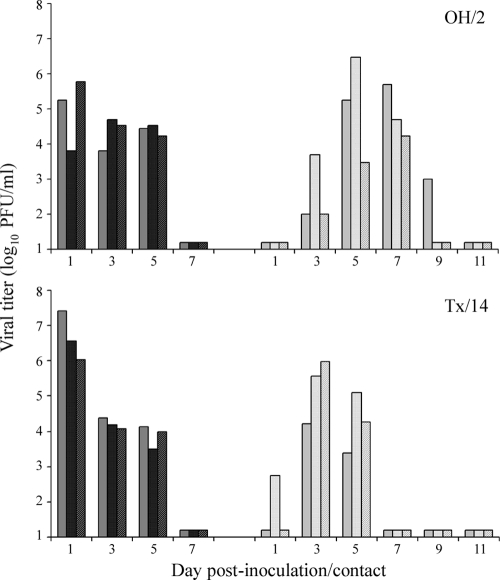
FIG. 1.
FIG. 1.
Direct contact transmissibility of triple-reassortant swine influenza viruses. Three ferrets were inoculated i.n. with 106 PFU of OH/2 (A) or Tx/14 (B) virus, and a naïve ferret was placed in the same cage at 24 h p.i. Nasal washes were collected from inoculated (dark bars) and contact (light bars) ferrets on alternate days p.i. or p.c., respectively, and titrated for the presence of infectious virus. Results from individual ferrets are presented. The limit of virus detection was 10 PFU.
FIG. 2.
FIG. 2.
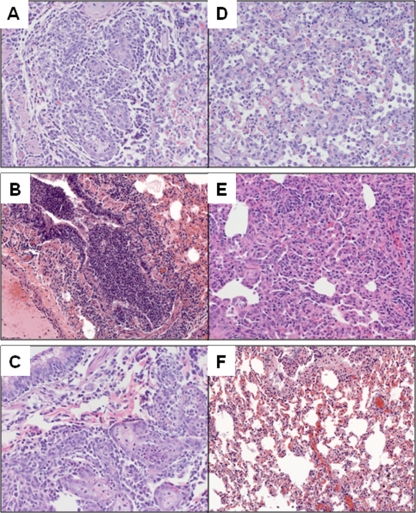
Histopathology in large airway and parenchyma. Ferrets were inoculated i.n. with 106 PFU of each virus, and tissues were collected on day 3 p.i. for analysis. Inflammation and epithelial necrosis is seen in the large airways (A to C) and interstitial and intraalveolar inflammation in the parenchyma (D to F) of ferrets inoculated with Mx/4482 virus (representative of 2009 H1N1 viruses) (A, D), OH/2 virus (B, E), or TX/14 virus (C, F).
FIG. 3.
FIG. 3.
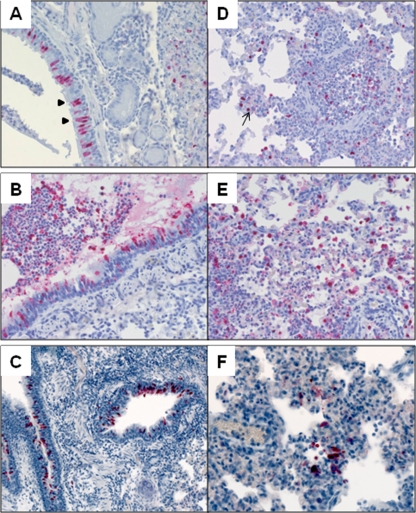
Immunohistochemistry in the lungs. Ferrets were inoculated i.n. with 106 PFU of each virus, and tissues were collected on day 3 p.i. for analysis. Viral antigen was present in the nuclei of bronchial epithelial cells (arrowheads in panel A) present in large airways (A to C) and in bronchioles and pneumocytes (arrows in panel D) in lung parenchyma (D to F) of ferrets inoculated with Mx/4482 virus (representative of 2009 H1N1 viruses) (A, D), OH/2 virus (B, E), or TX/14 virus (C, F).
FIG. 4.
FIG. 4.
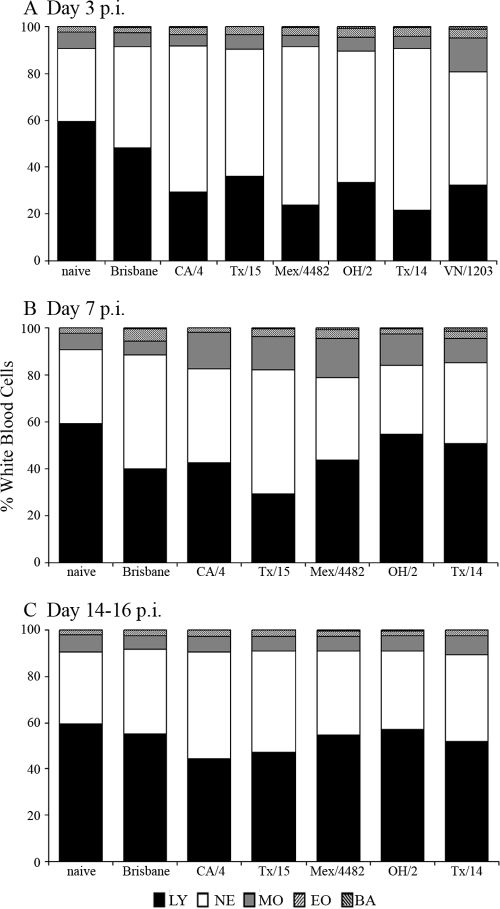
Kinetic analysis of circulating lymphocytes following influenza virus infection. Three ferrets each were inoculated i.n. with 106 PFU of virus. Blood was collected on days 3 (A), 7 (B), and 14 to 16 (C) p.i. in EDTA Vacutainer tubes and analyzed with a hematology scanner. Blood collected immediately prior to inoculation was included as a baseline control (naïve). The average percentages of lymphocytes (LY), neutrophils (NE), monocytes (MO), eosinophils (EO), and basophils (BA) in whole blood are shown. Ferrets inoculated with VN/1203 virus did not survive to day 7 or 14 p.i.

References

    1. Abdel-Ghafar, A. N., et al. 2008. Update on avian influenza A (H5N1) virus infection in humans. N. Engl. J. Med. 358:261-273. - PubMed
    1. Belser, J. A., et al. 2010. Pathogenesis of pandemic influenza A (H1N1) and triple-reassortant swine influenza A (H1) viruses in mice. J. Virol. 84:4194-4203. - PMC - PubMed
    1. CDC. 2010. 2009 H1N1 flu: international situation update. Centers for Disease Control and Prevention, Atlanta, GA.
    1. Darnell, M. E., et al. 2007. Severe acute respiratory syndrome coronavirus infection in vaccinated ferrets. J. Infect. Dis. 196:1329-1338. - PMC - PubMed
    1. Dawood, F. S., et al. 2009. Emergence of a novel swine-origin influenza A (H1N1) virus in humans. N. Engl. J. Med. 360:2605-2615. - PubMed

MeSH terms

LinkOut - more resources