Comment
doi: 10.1101/gad.2000610.
Deterioration without replenishment--the misery of oocyte cohesin
Affiliations
- PMID: 21123645
- PMCID: PMC2994032
- DOI: 10.1101/gad.2000610
Item in Clipboard
Comment
Deterioration without replenishment--the misery of oocyte cohesin
Genes Dev.
.
Abstract
Humans suffer a steep increase in aneuploidies when oocytes age, and deterioration of cohesin was suggested recently as a prominent cause. In the November 15, 2010, issue of Genes & Development, Tachibana-Konwalski and colleagues (pp. 2505-2516) answered a question central to this hypothesis: Can cohesin be reloaded onto mouse oocyte chromosomes long after birth? They found that it cannot, or at least not with an efficiency adequate to rescue cohesin deficiency. With no chance for sufficient replenishment, age-related loss of sister chromatid cohesion seems unavoidable.
Figures
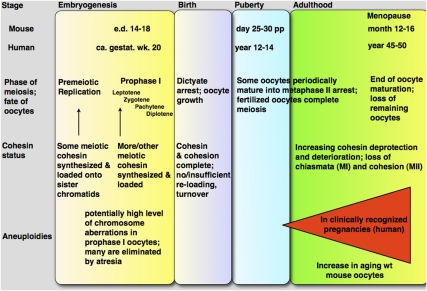
Summary of oocyte development, cohesin status, and aneuploidies. (Top) Stages of human and mouse life are correlated with phases of meiosis, the status of cohesin, and the level of aneuploidies. A red triangle illustrates the rapid increase in aneuploidies during human female aging, particularly beyond 35 yr of age. Timing of embryonic prophase I, puberty, and menopause is approximate, and, in mice, depends on the particular mouse strain. The exact timing of onset of expression of each individual cohesin protein has not yet been determined, but indications exist for post-replicative loading of some cohesin in early prophase I. It is also unknown when after or even before birth cohesin deterioration starts. (Gestat. wk.) Gestational week; (e.d.) embryonic day.
Comment on
-
Rec8-containing cohesin maintains bivalents without turnover during the growing phase of mouse oocytes.Genes Dev. 2010 Nov 15;24(22):2505-16. doi: 10.1101/gad.605910. Epub 2010 Oct 22. Genes Dev. 2010. PMID: 20971813 Free PMC article.
References
-
- Bannister LA, Reinholdt LG, Munroe RJ, Schimenti JC 2004. Positional cloning and characterization of mouse mei8, a disrupted allelle of the meiotic cohesin Rec8. Genesis 40: 184–194 - PubMed
-
- Bickel SE 2005. Aging (not so) gracefully. Nat Genet 37: 1303–1304 - PubMed
-
- Eijpe M, Heyting C, Gross B, Jessberger R 2000. Association of mammalian SMC1 and SMC3 proteins with meiotic chromosomes and synaptonemal complexes. J Cell Sci 113: 673–682 - PubMed
Publication types
MeSH terms
Substances
LinkOut - more resources
Full Text Sources
Other Literature Sources
Miscellaneous