. 2010 Dec 2;468(7324):713-6.
doi: 10.1038/nature09547.

Head swivel on the ribosome facilitates translocation by means of intra-subunit tRNA hybrid sites

Affiliations

Head swivel on the ribosome facilitates translocation by means of intra-subunit tRNA hybrid sites

Andreas H Ratje et al. Nature. .

Abstract

The elongation cycle of protein synthesis involves the delivery of aminoacyl-transfer RNAs to the aminoacyl-tRNA-binding site (A site) of the ribosome, followed by peptide-bond formation and translocation of the tRNAs through the ribosome to reopen the A site. The translocation reaction is catalysed by elongation factor G (EF-G) in a GTP-dependent manner. Despite the availability of structures of various EF-G-ribosome complexes, the precise mechanism by which tRNAs move through the ribosome still remains unclear. Here we use multiparticle cryoelectron microscopy analysis to resolve two previously unseen subpopulations within Thermus thermophilus EF-G-ribosome complexes at subnanometre resolution, one of them with a partly translocated tRNA. Comparison of these substates reveals that translocation of tRNA on the 30S subunit parallels the swivelling of the 30S head and is coupled to unratcheting of the 30S body. Because the tRNA maintains contact with the peptidyl-tRNA-binding site (P site) on the 30S head and simultaneously establishes interaction with the exit site (E site) on the 30S platform, a novel intra-subunit 'pe/E' hybrid state is formed. This state is stabilized by domain IV of EF-G, which interacts with the swivelled 30S-head conformation. These findings provide direct structural and mechanistic insight into the 'missing link' in terms of tRNA intermediates involved in the universally conserved translocation process.


Figures
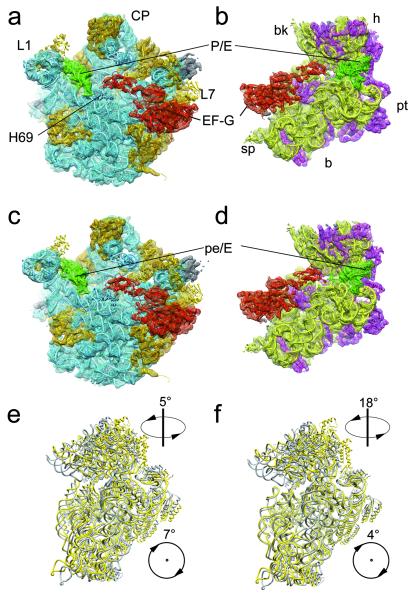
Fig. 1
Fig. 1. Sub-states I (TIPRE) and II (TIPOST) of the 70S•EF-G•GDP•FA complex
a, b, c, d, The cryo-EM maps of sub-state I (TIPRE) (a, b) and sub-state II (TIPOST) (c , d) of the 70S•EF-G•GDP•FA complex are shown as mesh with docked models in ribbons representation: EF-G (red), tRNA (green), 23S/5S rRNA (blue), 50S ribosomal proteins (orange), 16S rRNA (yellow), and the 30S ribosomal proteins (magenta). The maps are shown from the 30S side with the 30S subunit computationally removed (a, c) and from the 50S side with the 50S subunit computationally removed (b, d). e, f, The 30S subunit of TIPRE (e) and TIPOST (f) (yellow) is compared with the 30S subunit of the POST state (grey) by aligning the respective 50S subunits. Arrows with numbers indicate the direction and magnitude (supp. Table 1) of the inter-subunit rotation and the head-swivel from the un-rotated state to TIPRE or TIPOST, respectively.
Fig. 2
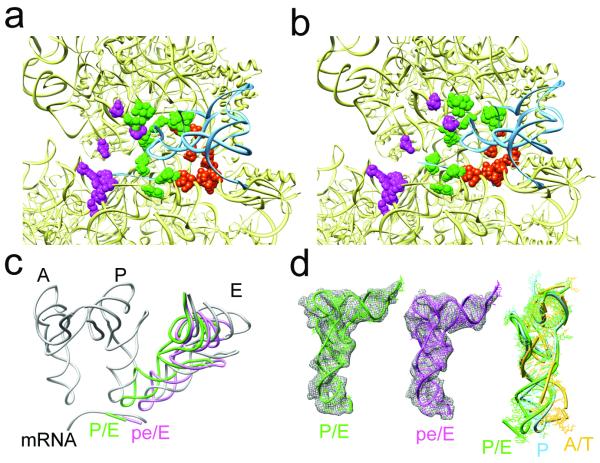
Fig. 2. Localization and conformation of the tRNA of sub-states I (TIPRE) and II (TIPOST)
a, b, Close-up of the tRNA binding regions of the 30S subunit of TIPRE (a) and TIPOST (b). The 30S and tRNAs are shown as yellow and blue ribbons, respectively, whereas ribosomal residues that contact A-, P- and E-tRNAs (magenta, green and orange) are shown as spheres. c, In a common 50S alignment, the P/E-tRNA (green) of TIPRE and the pe/E-tRNA (magenta) of TIPOST together with their respective mRNA codons are compared to mRNA and classical A-, P- and E-tRNA positions (grey). d, Density for the tRNAs (wire-mesh) with molecular models for the P/E-tRNA of TIPRE (left, green) and the pe/E tRNA of TIPOST (middle, magenta). On the right, the model for the P/E-tRNA (green), that is essentially the same as the pe/E-tRNA model (RMSD = 1.5 Å), is compared to a classical P-tRNA (blue) and a A/T-tRNA (yellow) by aligning the acceptor stem, D- and T-stem loops.
Fig. 3
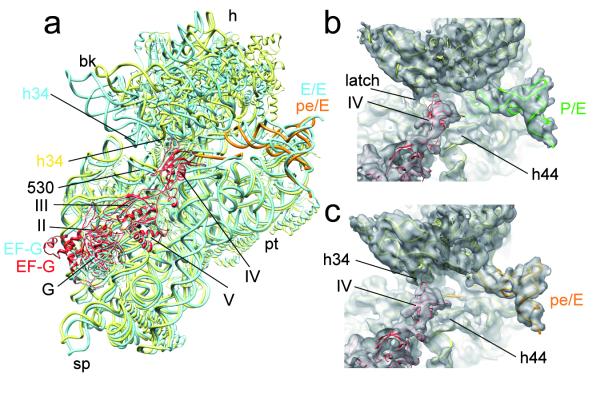
Fig. 3. EF-G stabilizes the swiveled head movement in the TIPOST state
a, Comparison of the position of FA-stalled EF-G and the 30S subunit between TIPOST and the POST state 70S•EF-G•GDP•FA. All shown components of the POST state 70S•EF-G•GDP•FA are depicted as blue ribbons. The 30S, EF-G and pe/E-tRNA of the TIPOST are represented by yellow, red and orange ribbons, respectively. b, c, Close-up on the decoding region and domain IV of EF-G in the same orientation as in (a). The surfaces of TIPRE (b) and TIPOST (c) are transparent with molecular models in ribbons representation (30S subunit, yellow; EF-G, red, P/E-tRNA, green and pe/E-tRNA, orange). The arrows mark the closed latch between h34 and the 530 region of TIPRE (b) and the interaction between h34 and domain IV of EF-G within TIPOST.
Fig. 4
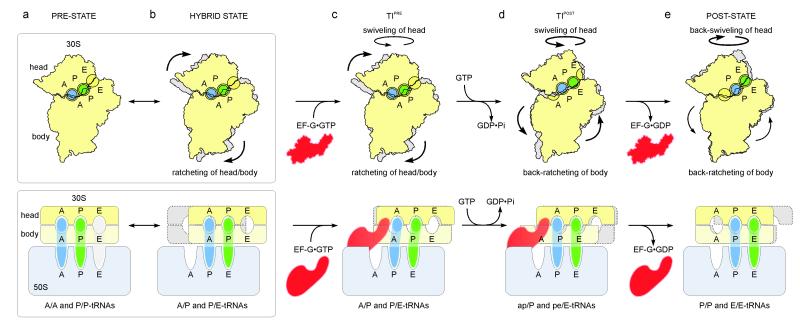
Fig. 4. Model for translocation
a, b, The PRE ribosome exists in a dynamic equilibrium between (a) base states with classical A/A- and P/P-tRNAs and (b) rotated states with hybrid A/P- and P/E-tRNAs,,-. c, Binding of EF-G•GTP to (a) PRE- or (b) hybrid-states stabilizes the ratcheted state as observed in the TIPRE. d, Fast GTP hydrolysis by EF-G accelerates translocation via an unlocking step on the 30S subunit. Domain IV of EF-G uncouples un-ratcheting from the reverse movement of the A/P- and P/E-tRNAs back into classical states i.e. a doorstop function. Through head-swiveling and un-ratcheting motion, the tRNAs move from aa/P and pp/E into the 30S intra-subunit ap/P and pe/E hybrid states. e, Complete un-ratcheting of the 30S subunit leads to the POST state 70S•EF-G complex. Back-swiveling of the 30S-head re-establishes tRNAs in the classical (pp/P) P- and E- (ee/E) states. Translocation is completed by dissociation of EF-G•GDP.

References

    1. Frank J, Spahn CM. The ribosome and the mechanism of protein synthesis. Rep Prog Phys. 2006;69:1383.
    1. Schmeing TM, Ramakrishnan V. What recent ribosome structures have revealed about the mechanism of translation. Nature. 2009;461:1234. - PubMed
    1. Shoji S, Walker SE, Fredrick K. Ribosomal Translocation: One Step Closer to the Molecular Mechanism. ACS Chem Biol. 2009 - PMC - PubMed
    1. Ramakrishnan V. Ribosome structure and the mechanism of translation. Cell. 2002;108:557. - PubMed
    1. Moazed D, Noller HF. Intermediate states in the movement of transfer RNA in the ribosome. Nature. 1989;342:142. - PubMed

Publication types

MeSH terms