. 2010 Nov 29;5(11):e15042.
doi: 10.1371/journal.pone.0015042.

Surface properties of Helicobacter pylori urease complex are essential for persistence

Affiliations

Surface properties of Helicobacter pylori urease complex are essential for persistence

Tobias D Schoep et al. PLoS One. .

Abstract

The enzymatic activity of Helicobacter pylori's urease neutralises stomach acidity, thereby promoting infection by this pathogen. Urease protein has also been found to interact with host cells in vitro, although this property's possible functional importance has not been studied in vivo. To test for a role of the urease surface in the host/pathogen interaction, surface exposed loops that display high thermal mobility were targeted for inframe insertion mutagenesis. H. pylori expressing urease with insertions at four of eight sites tested retained urease activity, which in three cases was at least as stable as was wild-type urease at pH 3. Bacteria expressing one of these four mutant ureases, however, failed to colonise mice for even two weeks, and a second had reduced bacterial titres after longer term (3 to 6 months) colonisation. These results indicate that a discrete surface of the urease complex is important for H. pylori persistence during gastric colonisation. We propose that this surface interacts directly with host components important for the host-pathogen interaction, immune modulation or other actions that underlie H. pylori persistence in its special gastric mucosal niche.


Conflict of interest statement

Competing Interests: In the name of Ondek, Mohammed Benghezal, Doug E. Berg, Alma Fulurija, Tobias D. Schoep and Barry J. Marshall filed, in June 2010, an Australian Provisional Patent Application No. 2010902818 entitled 'Means Of Controlling Infection Persistence Of Helicobacter Pylori'. Their competing interests are as follows: Tobias D. Schoep: ownership of shares, paid employment, Australian Provisional Patent Application No. 2010902818. Alma Fulurija: ownership of shares, paid employment, Australian Provisional Patent Application No. 2010902818. Fayth Good: paid employment. Wei Lu: ownership of shares, paid employment. Robyn P. Himbeck: ownership of shares, paid employment. Carola Schwan: ownership of shares, paid employment. Douglas E. Berg: ownership of shares, consultant, Australian Provisional Patent Application No. 2010902818. Peer R. E. Mittl: ownership of shares, consultant. Mohammed Benghezal: ownership of shares, paid employment, Australian Provisional Patent Application No. 2010902818 Barry J. Marshall: ownership of shares, Australian Provisional Patent Application No. 2010902818. The authors confirm that the above mentioned conflicts do not alter their adherence to all PLoS ONE policies on sharing data and materials as detailed online in the PLoS One guide for authors.

Figures

Figure 1
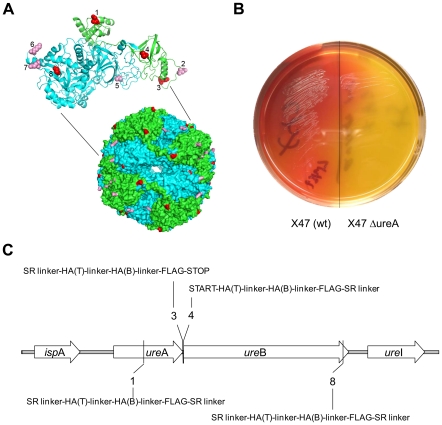
Figure 1. Recombinant regions of urease and selection for enzyme function.
a) Molecular structure of urease showing insertion sites on the surface of urease. Urease subunit A (green) and subunit B (blue) associate to form a dodecameric supramolecular molecule , . Sites 1 to 8 correspond to residues 102, 231 and 238 from UreA and residues 1, 66, 326, 541 and 549 from UreB, respectively. Insertion sites 1, 3, 4, and 8 are indicated in red. Urease activity could not be retained when altered at sites 2, 5, 6, and 7 (pink). b) Selection of bacteria producing functional urease on acidified media supplemented with the urease substrate, urea. Left side: X47 wild type; the colour change observed on the left side indicated that bacterial colonies were producing functional urease and growing. Right side: X47 ΔureA: there was no colour (X47 wild-type). Colour change did not occur on the right side, indicating that inoculated colonies were unable to grow or functional urease was not being produced (X47 ΔureA). c) A schematic showing insertion sites at the urease locus of DNA coding epitopes and linkers. Insertions were made in DNA corresponding to insertion after amino positions 102 (site 1) and 238 (site 3) of UreA (GenBank AAD07144.1), and amino acid positions 1 (site 4) and 549 (site 8) of UreB (GenBank AAD07143.1). Insertions at sites 3 and 4 correspond to the C- and N-termini of UreA and UreB, respectively. DNA coded HA(T): hemagglutinin T cell eptitope; HA(B) hemagglutinin B cell epitope; SR linker: semi-random linker; linker: GPSL linker; FLAG: FLAG epitope; STOP: STOP codon.
Figure 2
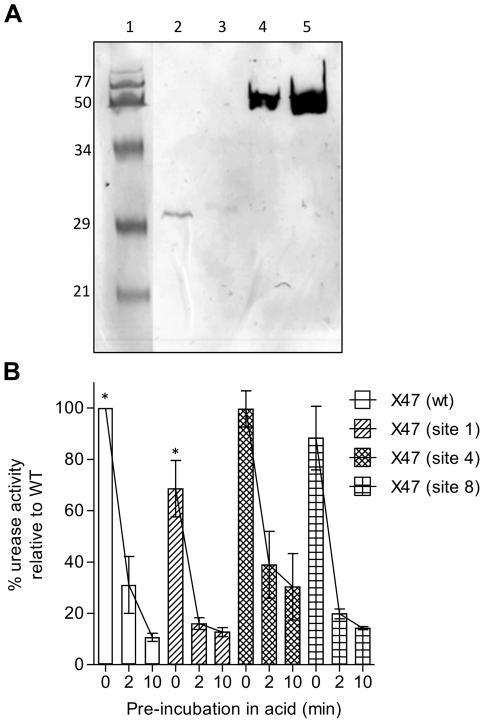
Figure 2. Recombinant urease activity and acid stability.
a) Western Blot analysis of H. pylori producing urease with insertions at sites 1, 3, 4 or 8. Lanes 1: Maker (MW: KDa shown); Lane 2: X47 (site 1); Lane 3: X47 (site 3); Lane 4: X47 (site 4); Lane 5: X47 (site 8). Mutant urease was detected using anti-FLAG antibody, directed against UreA (lanes 2 and 3) or UreB (lanes 4 and 5) mutants. b) Ability of permeabilised bacteria expressing wild-type or mutant urease to neutralise acid after incubation at pH 3 in the presence of urea. To determine acid stability and activity of wild-type and mutant ureases, bacteria were incubated at pH 3 for 0, 2 or 10 min prior to assay of urease activity. After pre-incubation the solution pH was adjusted to pH 7, neutralised, urea was added as substrate and urease activity was measured by a change in pH, as indicated by a change in the colour of phenol red. Significantly reduced urease activities independent of pre-incubation at pH 3 are annotated “ * ” (Student's T-test, 2 tailed, equal variance). SEM displayed (n = 3).
Figure 3
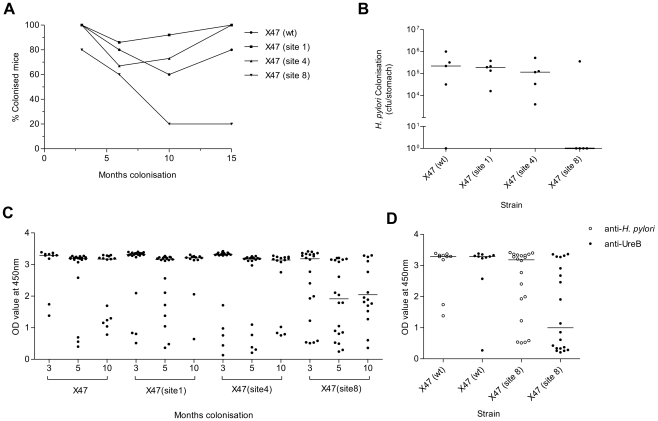
Figure 3. Insertion mutant but active urease can affect bacterial colonisation.
a) Persistence over 15 months expressed as percentage of colonised mice at each time point (n = 5–15). b) Colonisation level of mice infected with H. pylori expressing mutant urease after 15 months (n = 5; median displayed). c) Persistence of H. pylori expressing mutant urease as indicated by anti-H. pylori IgG levels (n = 12–20; median displayed). Strains were recombinant at either sites 1, 4 or 8 in urease. d) Comparison of anti-H. pylori IgG and anti-UreB IgG levels resulting from colonisation of mice for 3 months with X47 expressing wild-type urease, X47 (wt), or urease mutant at site 8, X47 (site8), (n = 10–20; median displayed).
Figure 4
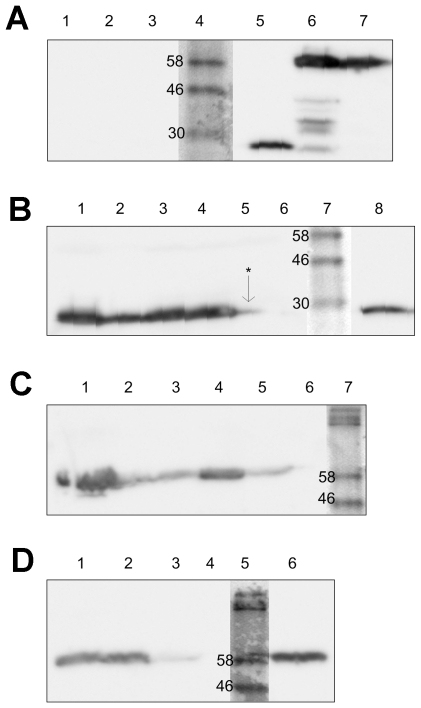
Figure 4. Insertion mutant ureases are stable during persistent infection.
Western Blot analysis of H. pylori cultured from mice after 10 months colonisation, probed with anti-FLAG antibody. Where described, each lane represents protein extracted from a pool of bacteria harvested from an individual mouse. a) lanes 1–3: pools of X47 (wt) from individual mouse; lane 4: molecular size marker (MW: KDa shown); lane 5: X47 (site 1); lane 6: X47 (site 4); lane 7: X47 (site 8). b) lanes 1–5: pools of X47 (site 1) from individual mouse; lane 7: molecular size marker; lane 8: X47 (site 1). c) lanes 1–5: pools of X47 (site 4) from individual mouse; lane 7: molecular size marker. d) lanes 1–3: pools of X47 (site 8) from individual mouse; lane 5: molecular size marker; lane 6: X47 (site 8). To confirm protein sample integrity urease activities were assayed in wild-type X47 and in a pool of X47 insertion (site 1 mutant) from mice in which FLAG expression was not detected (annotated *; data not shown). Molecular of standard proteins (KDa) are shown directly adjacent to the marker.
Figure 5
Figure 5. Proposed multiple roles of Helicobacter pylori urease during infection.
To explain the loss of ability to persist in strains containing an insertion at urease surface site 8, we suggest a model of immune modulation mediated by the urease interaction with host tissue CD74 receptor. This could lead to a reduction of the pro-inflammatory response elicited by the epithelial cells or to an increase in the Th1 bias via the dendritic cells (red boxes). Other non-enzymatic functions of urease that might contribute to persistence include facilitation of resistance to complement mediated opsonisation , decreased uptake of H. pylori cells by granulocytes , increased H. pylori survival in macrophages , , and increased release of nutrients via compromised tight junctions and/or apoptosis of epithelial cells .

References

    1. Suzuki T, Matsuo K, Ito H, Hirose K, Wakai K, et al. A past history of gastric ulcers and Helicobacter pylori infection increase the risk of gastric malignant lymphoma. Carcinogenesis. 2006. - PubMed
    1. Marcus EA, Scott DR. Cell lysis is responsible for the appearance of extracellular urease in Helicobacter pylori. Helicobacter. 2001;6:93–99. - PubMed
    1. Hu LT, Mobley HL. Purification and N-terminal analysis of urease from Helicobacter pylori. Infect Immun. 1990;58:992–998. - PMC - PubMed
    1. Eaton KA, Krakowka S. Effect of gastric pH on urease-dependent colonization of gnotobiotic piglets by Helicobacter pylori. Infect Immun. 1994;62:3604–3607. - PMC - PubMed
    1. Williams CL, Preston T, Hossack M, Slater C, McColl KEL. Helicobacter pylori utilises urease for amino acid synthesis. FEMS Immunol Med Microbiol. 1996;13:87–94. - PubMed

MeSH terms

LinkOut - more resources