


Combined mutation and rearrangement screening by quantitative PCR high-resolution melting: is it relevant for hereditary recurrent Fever genes?
- PMID: 21124859
- PMCID: PMC2990815
- DOI: 10.1371/journal.pone.0014096
Combined mutation and rearrangement screening by quantitative PCR high-resolution melting: is it relevant for hereditary recurrent Fever genes?
Abstract
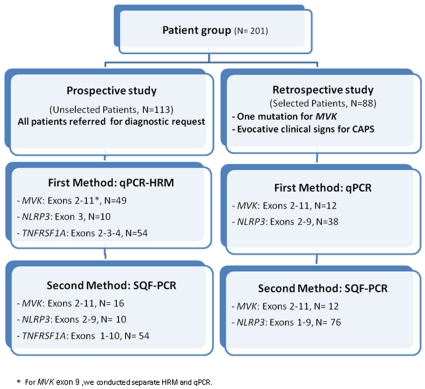
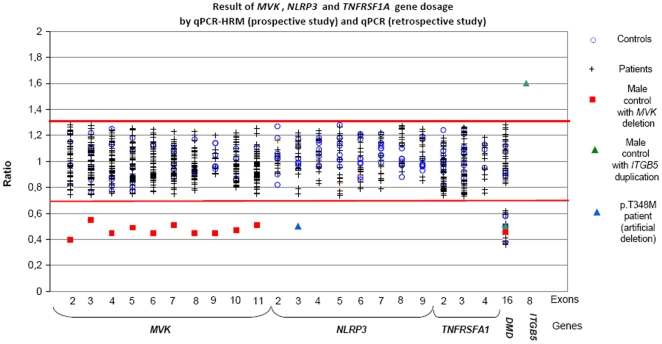
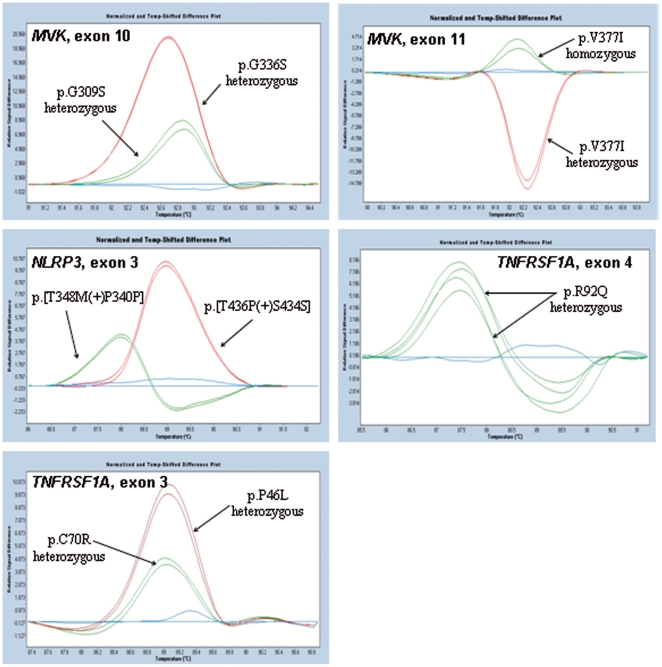
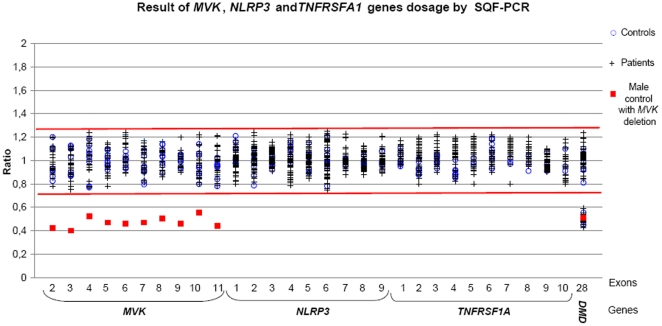
The recent identification of genes implicated in hereditary recurrent fevers has allowed their specific diagnosis. So far however, only punctual mutations have been identified and a significant number of patients remain with no genetic confirmation of their disease after routine molecular approaches such as sequencing. The possible involvement of sequence rearrangements in these patients has only been examined in familial Mediterranean fever and was found to be unlikely. To assess the existence of larger genetic alterations in 3 other concerned genes, MVK (Mevalonate kinase), NLRP3 (Nod like receptor family, pyrin domain containing 3) and TNFRSF1A (TNF receptor superfamily 1A), we adapted the qPCR-HRM method to study possible intragenic deletions and duplications. This single-tube approach, combining both qualitative (mutations) and quantitative (rearrangement) screening, has proven effective in Lynch syndrome diagnosis. Using this approach, we studied 113 unselected (prospective group) and 88 selected (retrospective group) patients and identified no intragenic rearrangements in the 3 genes. Only qualitative alterations were found with a sensitivity similar to that obtained using classical molecular techniques for screening punctual mutations. Our results support that deleterious copy number alterations in MVK, NLRP3 and TNFRSF1A are rare or absent from the mutational spectrum of hereditary recurrent fevers, and demonstrate that a routine combined method such as qPCR-HRM provides no further help in genetic diagnosis. However, quantitative approaches such as qPCR or SQF-PCR did prove to be quick and effective and could still be useful after non contributory punctual mutation screening in the presence of clinically evocative signs.
Conflict of interest statement
Figures
References
-
- Simon A, van der Meer JW. Pathogenesis of familial periodic fever syndromes or hereditary autoinflammatory syndromes. Am J Physiol Regul Integr Comp Physiol. 2007;292:R86–98. - PubMed
-
- van Gijn ME, Soler S, de la Chapelle C, Mulder M, Ritorre C, et al. Search for copy number alterations in the MEFV gene using multiplex ligation probe amplification, experience from three diagnostic centres. Eur J Hum Genet. 2008;16:1404–1406. - PubMed
-
- Giansily-Blaizot M, Thorel D, Khau Van Kien P, Behar C, Romey MC, et al. Characterisation of a large complex intragenic re-arrangement in the FVII gene (F7) avoiding misdiagnosis in inherited factor VII deficiency. Br J Haematol. 2007;138:359–365. - PubMed
-
- Sellner LN, Taylor GR. MLPA and MAPH: new techniques for detection of gene deletions. Hum Mutat. 2004;23:413–419. - PubMed
Publication types
MeSH terms
Substances
LinkOut - more resources
Full Text Sources
