. 2010 Nov 19;5(11):e14061.
doi: 10.1371/journal.pone.0014061.

Different mechanisms for heterogeneity in leprosy susceptibility can explain disease clustering within households

Affiliations

Different mechanisms for heterogeneity in leprosy susceptibility can explain disease clustering within households

Egil Fischer et al. PLoS One. .

Abstract

The epidemiology of leprosy is characterized by heterogeneity in susceptibility and clustering of disease within households. We aim to assess the extent to which different mechanisms for heterogeneity in leprosy susceptibility can explain household clustering as observed in a large study among contacts of leprosy patients.We used a microsimulation model, parameterizing it with data from over 20,000 contacts of leprosy patients in Bangladesh. We simulated six mechanisms producing heterogeneity in susceptibility: (1) susceptibility was allocated at random to persons (i.e. no additional mechanism), (2) a household factor, (3, 4) a genetic factor (dominant or recessive), or (5, 6) half a household factor and half genetic. We further assumed that a fraction of 5%, 10%, and 20% of the population was susceptible, leading to a total of 18 scenarios to be fitted to the data. We obtained an acceptable fit for each of the six mechanisms, thereby excluding none of the possible underlying mechanisms for heterogeneity of susceptibility to leprosy. However, the distribution of leprosy among contacts did differ between mechanisms, and predicted trends in the declining leprosy case detection were dependent on the assumed mechanism, with genetic-based susceptibility showing the slowest decline. Clustering of leprosy within households is partially caused by an increased transmission within households independent of the leprosy susceptibility mechanism. Even a large and detailed data set on contacts of leprosy patients could not unequivocally reveal the mechanism most likely responsible for heterogeneity in leprosy susceptibility.


Conflict of interest statement

Competing Interests: The authors have declared that no competing interests exist.

Figures

Figure 1
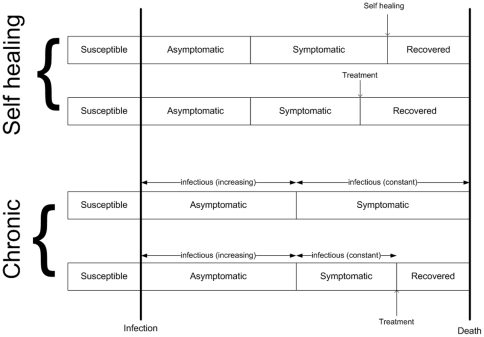
Figure 1. Natural history of infection from birth until death, for self-healing and chronic leprosy in the model.
Both types of leprosy, self-healing and chronic, start in a susceptible state. Self-healing enters an asymptomatic state, progresses to the symptomatic or clinical state, is followed by self-healing or treatment, and finally transitions to the recovered state. The chronic form enters a different asymptomatic state after infection. Here, the infectivity, i.e. the probability of transmission during an adequate contact, increases with the duration in this state. When progressing to the symptomatic state, the infectivity reaches the maximum and remains constant. The individual will stay in this symptomatic state until death unless treatment is provided. Treatment results in a transition to the recovered state, in which the individual is no longer infectious.
Figure 2
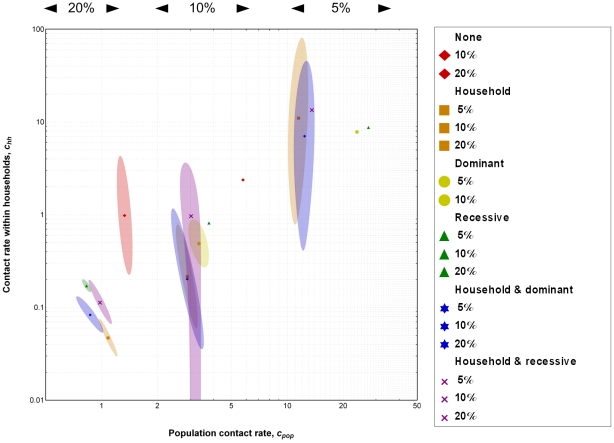
Figure 2. Best-fitting parameter combinations for the rate at which infectious contact is made in the population (contacts per year), cpop, and the contact rate within a household (contact per year), chh, for six mechanisms of heterogeneity in leprosy susceptibility and three fractions of susceptibles.
The within-household transmission is transmission on top of the population level transmission. The markers indicate the best fit for each scenario. The shaded areas in the same color indicate the area in which the fit did not differ from the overall best fitting scenario (P>0.01); not all mechanisms had an area with P>0.01. The mechanisms Random (5% susceptibles) and Dominant (20% susceptibles) could not be fitted to the data, and are thus not shown.
Figure 3
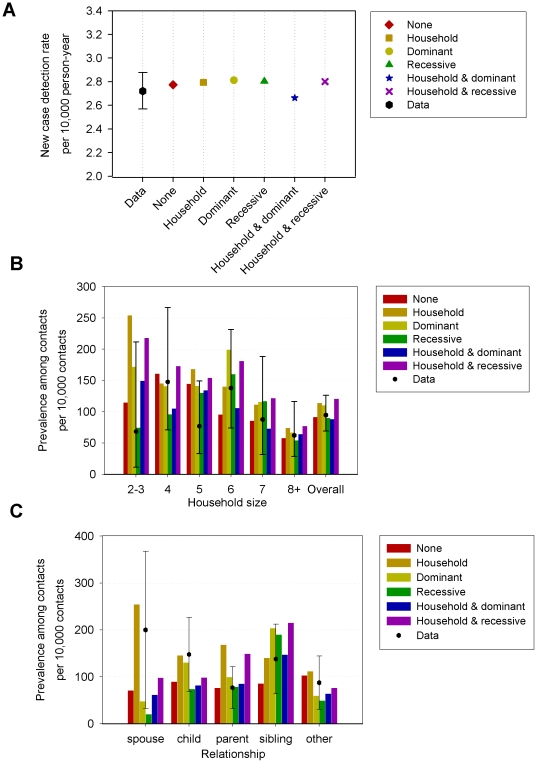
Figure 3. Comparison of model output with observations for six mechanisms of heterogeneity in leprosy susceptibility, assuming 10% susceptibles in the population.
A value of 20% susceptibles provided a much better fit for the Random mechanism. (A) New case detection rate per 10,000 inhabitants. The observed detection rate in 2003 is shown on the left, with 95% confidence interval. In total 1,184 patients in a population of 4.3 million persons. (B) Prevalence of leprosy among previously undiagnosed contacts of leprosy patients by household size. (C) Prevalence of leprosy among previously undiagnosed contacts of leprosy patients by relationship to the index patient. For (B) and (C) were used 43 previously undiagnosed contacts in 1,034 households.
Figure 4
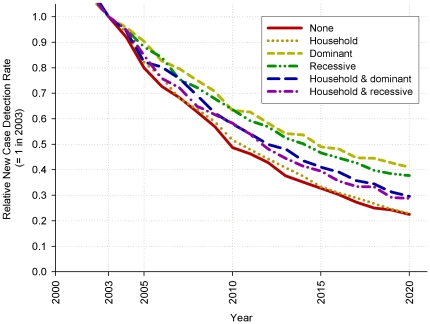
Figure 4. Trend in decline of the leprosy new case detection rate, relative to the new case detection rate in 2003 (value is 1 in 2003).
The assumed fraction of susceptibles is 20% for Random and 10% for the other five mechanisms.

References

    1. WHO. Global leprosy situation, 2009. Weekly Epidemiological Record. 2009;84:333–340.
    1. WHO. WHO Expert Committee on Leprosy. World Health Organ Tech Rep Ser. 1998;874:1–43. - PubMed
    1. Bagshawe A, Scott GC, Russell DA, Wigley SC, Merianos A, et al. Bcg Vaccination in Leprosy - Final Results of the Trial in Karimui, Papua-New-Guinea, 1963-79. Bulletin of the World Health Organization. 1989;67:389–399. - PMC - PubMed
    1. Bakker MI, Hatta M, Kwenang A, Klatser PR, Oskam L. Epidemiology of leprosy on five isolated islands in the Flores Sea, Indonesia. Tropical Medicine & International Health. 2002;7:780–787. - PubMed
    1. Bakker MI, May L, Hatta M, Kwenang A, Klatser PR, et al. Genetic, household and spatial clustering of leprosy on an island in Indonesia: a population-based study. BMC Medical Genetics. 2005;6:40. - PMC - PubMed

Publication types

MeSH terms