Environments that induce synthetic microbial ecosystems
- PMID: 21124952
- PMCID: PMC2987903
- DOI: 10.1371/journal.pcbi.1001002
Environments that induce synthetic microbial ecosystems
Abstract
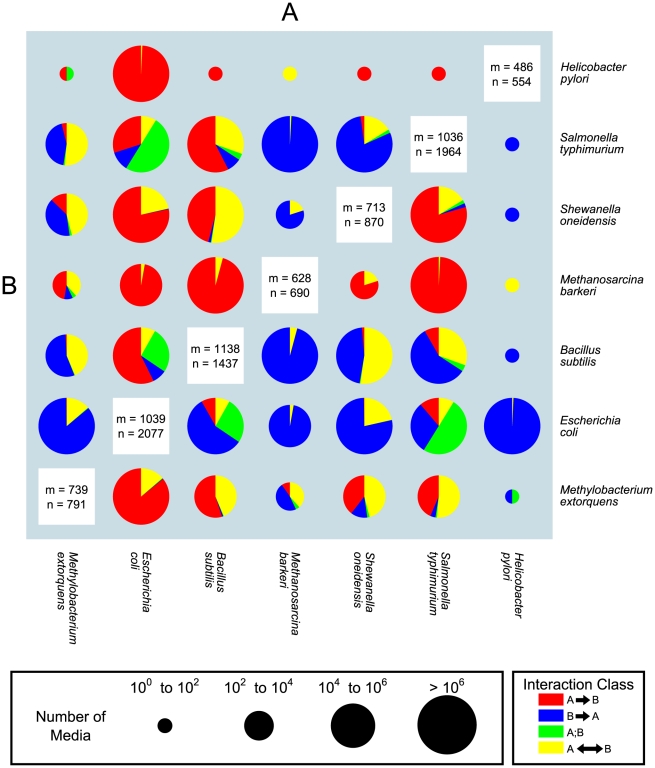
Interactions between microbial species are sometimes mediated by the exchange of small molecules, secreted by one species and metabolized by another. Both one-way (commensal) and two-way (mutualistic) interactions may contribute to complex networks of interdependencies. Understanding these interactions constitutes an open challenge in microbial ecology, with applications ranging from the human microbiome to environmental sustainability. In parallel to natural communities, it is possible to explore interactions in artificial microbial ecosystems, e.g. pairs of genetically engineered mutualistic strains. Here we computationally generate artificial microbial ecosystems without re-engineering the microbes themselves, but rather by predicting their growth on appropriately designed media. We use genome-scale stoichiometric models of metabolism to identify media that can sustain growth for a pair of species, but fail to do so for one or both individual species, thereby inducing putative symbiotic interactions. We first tested our approach on two previously studied mutualistic pairs, and on a pair of highly curated model organisms, showing that our algorithms successfully recapitulate known interactions, robustly predict new ones, and provide novel insight on exchanged molecules. We then applied our method to all possible pairs of seven microbial species, and found that it is always possible to identify putative media that induce commensalism or mutualism. Our analysis also suggests that symbiotic interactions may arise more readily through environmental fluctuations than genetic modifications. We envision that our approach will help generate microbe-microbe interaction maps useful for understanding microbial consortia dynamics and evolution, and for exploring the full potential of natural metabolic pathways for metabolic engineering applications.
Conflict of interest statement
The authors have declared that no competing interests exist.
Figures
References
-
- Little AEF, Robinson CJ, Peterson SB, Raffa KF, Handelsman J. Rules of engagement: interspecies interactions that regulate microbial communities. Annu Rev Microbiol. 2008;62:375–401. - PubMed
-
- Costa E, Pérez J, Kreft J. Why is metabolic labour divided in nitrification? Trends Microbiol. 2006;14:213–219. - PubMed
-
- Katsuyama C, Nakaoka S, Takeuchi Y, Tago K, Hayatsu M, et al. Complementary cooperation between two syntrophic bacteria in pesticide degradation. J Theor Biol. 2009;256:644–654. - PubMed
Publication types
MeSH terms
Substances
LinkOut - more resources
Full Text Sources
Other Literature Sources
Molecular Biology Databases