


Gene coexpression network topology of cardiac development, hypertrophy, and failure
- PMID: 21127201
- PMCID: PMC3324316
- DOI: 10.1161/CIRCGENETICS.110.941757
Gene coexpression network topology of cardiac development, hypertrophy, and failure
Abstract
Background: Network analysis techniques allow a more accurate reflection of underlying systems biology to be realized than traditional unidimensional molecular biology approaches. Using gene coexpression network analysis, we define the gene expression network topology of cardiac hypertrophy and failure and the extent of recapitulation of fetal gene expression programs in failing and hypertrophied adult myocardium.
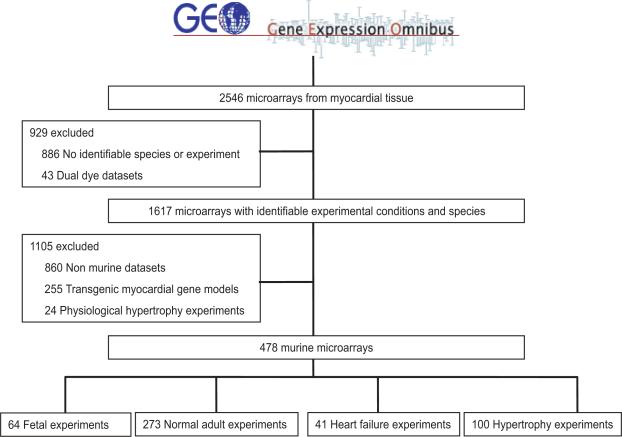
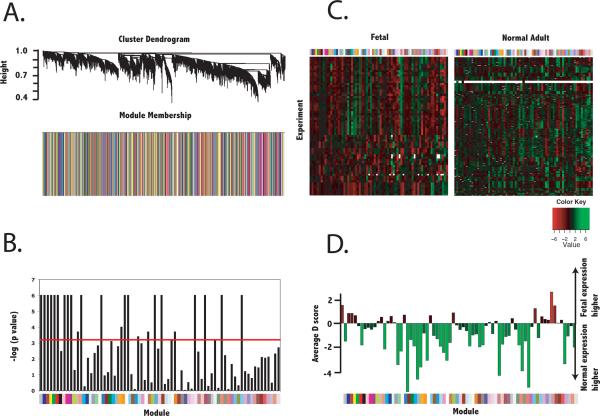
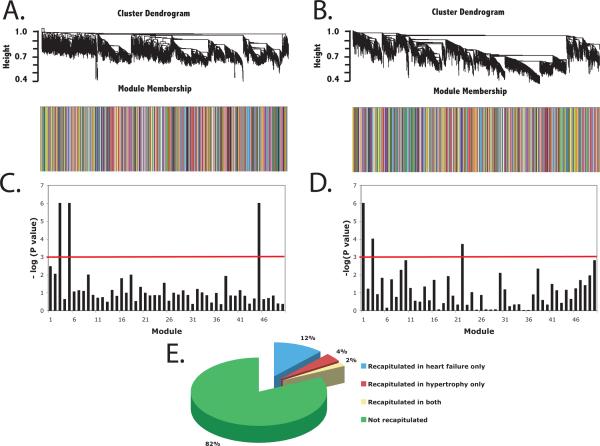
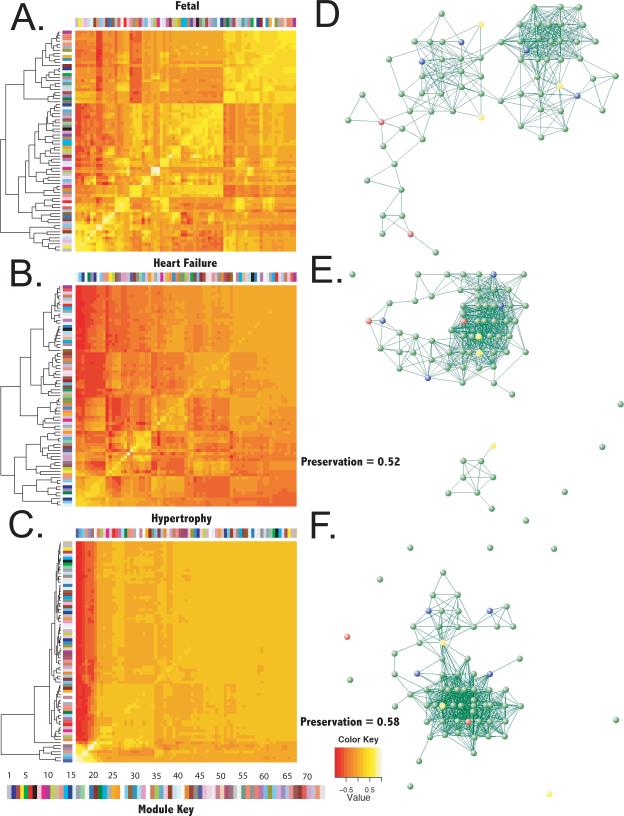
Methods and results: We assembled all myocardial transcript data in the Gene Expression Omnibus (n=1617). Because hierarchical analysis revealed species had primacy over disease clustering, we focused this analysis on the most complete (murine) dataset (n=478). Using gene coexpression network analysis, we derived functional modules, regulatory mediators, and higher-order topological relationships between genes and identified 50 gene coexpression modules in developing myocardium that were not present in normal adult tissue. We found that known gene expression markers of myocardial adaptation were members of upregulated modules but not hub genes. We identified ZIC2 as a novel transcription factor associated with coexpression modules common to developing and failing myocardium. Of 50 fetal gene coexpression modules, 3 (6%) were reproduced in hypertrophied myocardium and 7 (14%) were reproduced in failing myocardium. One fetal module was common to both failing and hypertrophied myocardium.
Conclusions: Network modeling allows systems analysis of cardiovascular development and disease. Although we did not find evidence for a global coordinated program of fetal gene expression in adult myocardial adaptation, our analysis revealed specific gene expression modules active during both development and disease and specific candidates for their regulation.
Figures
Comment in
-
Toward a holistic view of transcriptional regulation.Circ Cardiovasc Genet. 2011 Feb;4(1):2-3. doi: 10.1161/CIRCGENETICS.111.959452. Circ Cardiovasc Genet. 2011. PMID: 21325161 Free PMC article. No abstract available.
References
-
- Jhund PS, Macintyre K, Simpson CR, Lewsey JD, Stewart S, Redpath A, Chalmers JW, Capewell S, McMurray JJ. Long-term trends in first hospitalization for heart failure and subsequent survival between 1986 and 2003: a population study of 5.1 million people. Circulation. 2009;119:515–523. - PubMed
-
- Feldman AM, Weinberg EO, Ray PE, Lorell BH. Selective changes in cardiac gene expression during compensated hypertrophy and the transition to cardiac decompensation in rats with chronic aortic banding. Circ Res. 1993;73:184–192. - PubMed
-
- Lyn D, Liu X, Bennett NA, Emmett NL. Gene expression profile in mouse myocardium after ischemia. Physiol Genomics. 2000;2:93–100. - PubMed
-
- Yue P, Long CS, Austin R, Chang KC, Simpson PC, Massie BM. Post-infarction heart failure in the rat is associated with distinct alterations in cardiac myocyte molecular phenotype. J Mol Cell Cardiol. 1998;30:1615–1630. - PubMed
-
- Rajabi M, Kassiotis C, Razeghi P, Taegtmeyer H. Return to the fetal gene program protects the stressed heart: a strong hypothesis. Heart Fail Rev. 2007;12:331–343. - PubMed
Publication types
MeSH terms
Substances
Grants and funding
LinkOut - more resources
Full Text Sources
Other Literature Sources
Medical
