Review
. 2011 Sep;469(9):2521-30.
doi: 10.1007/s11999-010-1720-y.

Scapular notching: Recognition and strategies to minimize clinical impact

Affiliations
Review

Scapular notching: Recognition and strategies to minimize clinical impact

Gregory P Nicholson et al. Clin Orthop Relat Res. 2011 Sep.

Abstract

Background: Scapular notching is a unique complication of Grammont-style reverse total shoulder arthroplasty. While reverse total shoulder arthroplasty has revolutionized the treatment of pseudoparalysis secondary to cuff tear arthropathy, the implications of scapular notching with regard to patient function and implant stability remain unclear.

Questions/purposes: We reviewed literature to determine the etiology and incidence, radiographic progression and effect on implant stability, relationship with postoperative function, and risk factors for the development of scapular notching.

Methods: We reviewed PubMed, the Cochrane Central Register of Controlled Trials, and EMBASE with the terms "reverse total shoulder arthroplasty" and "scapular notching." Inclusion criteria were a level of evidence of IV (or better). Twenty-four articles were selected after manual review.

Results: Scapular notching after reverse total shoulder arthroplasty is due to repetitive contact between the polyethylene of the humeral component and the inferior scapular neck during adduction, leading to erosion of the scapular neck, polyethylene wear, joint inflammation, and potential implant loosening. Scapular notching appears between 6 and 14 months postoperatively, with an incidence of 44% to 96%. Radiographic progression and effect on patient function remain controversial. Predictors of scapular notching include surgical approach, glenoid wear, preoperative diagnosis, infraspinatus muscle quality, cranial-caudal positioning, and tilt of the glenosphere.

Conclusions: Improved understanding of the etiology and risk factors for scapular notching will lead to refinement in implant technology and surgical technique that may translate into improved patient function and implant longevity for Grammont-style reverse total shoulder arthroplasty.


Figures
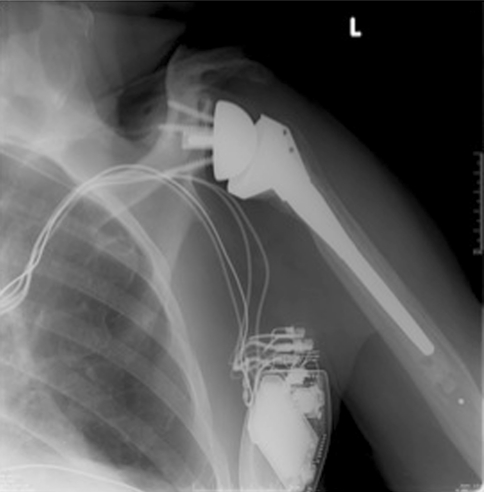
Fig. 1
Fig. 1
An AP view of the left shoulder demonstrates notching of the inferior scapular neck after reverse TSA. Bony erosion of the inferior scapular pillar is evident to the level of the inferior stabilization screw of the glenosphere.
Fig. 2
Fig. 2
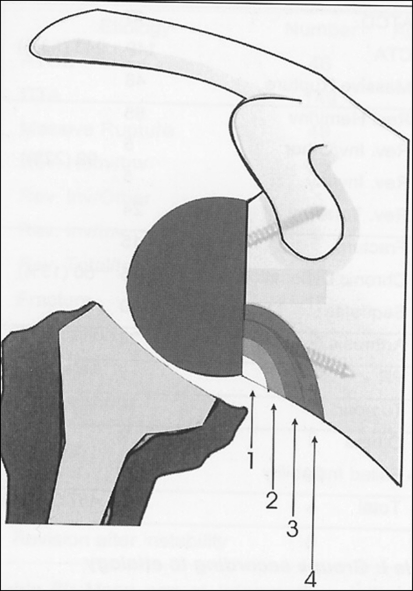
The Nerot-Sirveaux grading system for postoperative scapular notching after reverse TSA is illustrated. A Grade 1 notch is a defect contained within the inferior pillar of the scapular neck. A Grade 2 notch is erosion of the scapular neck to the level of the inferior fixation screw of the glenosphere baseplate. A Grade 3 notch is extension of the bone loss over the lower fixation screw. A Grade 4 notch is progression to the undersurface of the baseplate. Reproduced with permission and copyright © of the British Editorial Society of Bone and Joint Surgery from Sirveaux F, Favard L, Oudet D, Huquet D, Walch G, Mole D. Grammont inverted total shoulder arthroplasty in the treatment of glenohumeral osteoarthritis with massive rupture of the cuff: results of a multicentre study of 80 shoulders. J Bone Joint Surg Br. 2004;86:388–395.
Fig. 3A–B
Fig. 3A–B
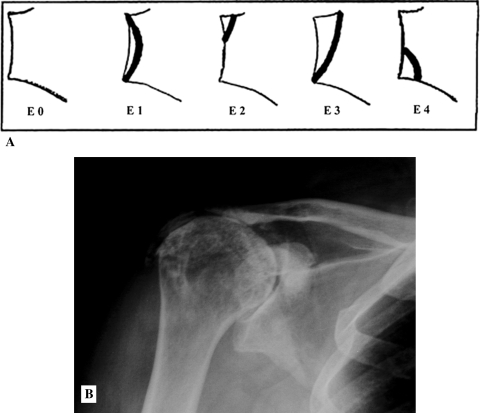
(A) The Favard classification of types of glenoid erosion associated with rotator cuff arthropathy is illustrated: E0 = superior humeral head migration without erosion of the glenoid; E1 = concentric erosion of the glenoid; E2 = erosion limited to the superior part of the glenoid; E3 = erosion extending to the inferior part of the glenoid; and E4 = erosion predominantly located at the inferior part of the glenoid Reprinted from Levigne C, Boileau P, Favard L, Garaud P, Mole D, Sirveaux F, Walch G. Scapular notching in reverse shoulder arthroplasty. J Shoulder Elbow Surg. 2008;17:925–935, with permission from Elsevier. (B) An AP view demonstrates a right shoulder with evidence of a Type E2 glenoid.
Fig. 4
Fig. 4
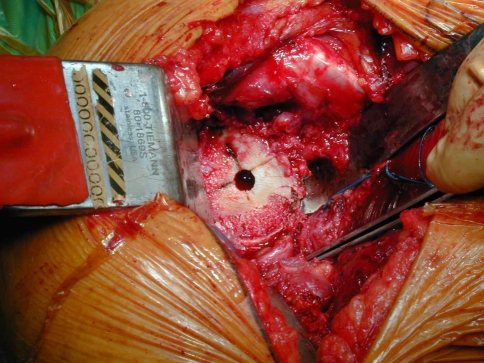
The glenoid is reamed by hand until a “subchondral smile” of cancellous bone is seen on the inferior aspect of the glenoid. Once this level is reached, any superior glenoid defects that remain can be bone grafted to ensure the glenosphere baseplate is not implanted with a superior tilt.
Fig. 5A–B
Fig. 5A–B
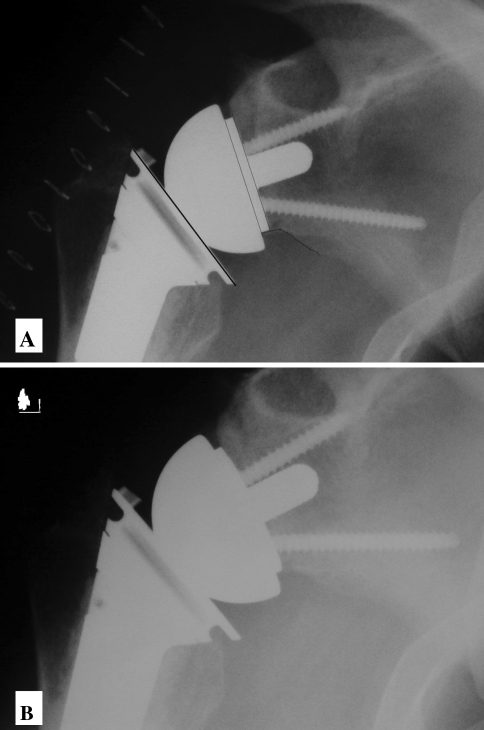
(A) An immediate postoperative AP radiograph shows a TSA using the Trabecular Metal™ Reverse Shoulder System implanted into the right shoulder for treatment of rotator cuff tear arthropathy. Implant design characteristics of the differing neck-shaft angle (thick black line) and the 3-mm Trabecular Metal™ pad on the back of the baseplate (thin parallel lines) to provide a small offset are seen. These characteristics coupled with inferior placement of the glenosphere (thin curved line on scapular pillar) with an inferior tilt help minimize the potential for postoperative scapular notching. (B) An AP radiograph of the same patient at 2 years of followup shows no evidence of scapular notching.

References

    1. Boileau P, Watkinson DJ, Hatzidakis AM, Balg F. Grammont reverse prosthesis: design, rationale, and biomechanics. J Shoulder Elbow Surg. 2005;14(1 Suppl S):147S–161S. doi: 10.1016/j.jse.2004.10.006. - DOI - PubMed
    1. Boulahia A, Edwards TB, Walch G, Baratta RV. Early results of a reverse design prosthesis in the treatment of arthritis of the shoulder in elderly patients with a large rotator cuff tear. Orthopedics. 2002;25:129–133. - PubMed
    1. Cuff D, Pupello D, Virani N, Levy J, Frankle M. Reverse shoulder arthroplasty for the treatment of rotator cuff deficiency. J Bone Joint Surg Am. 2008;90:1244–1251. doi: 10.2106/JBJS.G.00775. - DOI - PubMed
    1. Delloye C, Joris D, Colette A, Eudier A, Dubuc JE. Mechanical complications of total shoulder inverted prosthesis [in French. Rev Chir Orthop Reparatrice Appar Mot. 2002;88:410–414. - PubMed
    1. Edwards TB, Boulahia A, Kempf JF, Boileau P, Nemoz C, Walch G. The influence of rotator cuff disease on the results of shoulder arthroplasty for primary osteoarthritis: results of a multicenter study. J Bone Joint Surg Am. 2002;84:2240–2248. - PubMed

MeSH terms