


Effect of short-term use of a continuous glucose monitoring system with a real-time glucose display and a low glucose alarm on incidence and duration of hypoglycemia in a home setting in type 1 diabetes mellitus
- PMID: 21129341
- PMCID: PMC3005056
- DOI: 10.1177/193229681000400620
Effect of short-term use of a continuous glucose monitoring system with a real-time glucose display and a low glucose alarm on incidence and duration of hypoglycemia in a home setting in type 1 diabetes mellitus
Abstract
Background: The objective of this study was to examine whether setting the low glucose alarm of a Guardian® REAL-Time continuous glucose monitoring system (CGMS) to 80 mg/dl for 3 days and providing instructions to users reduce the risk of hypoglycemia under free-living conditions in individuals with type 1 diabetes mellitus (T1DM).
Methods: Fourteen participants with T1DM aged 26.1±6.0 years (mean±standard deviation) were fitted with a CGMS and assigned for 3 days to either an alarm [low and high blood glucose (BG) alarms set at 80 and 200 mg/dl, respectively] or no alarm condition, with each treatment administered to all participants following a counterbalanced design. All participants were given detailed instructions on how to respond appropriately to low glucose alarms.
Results: The CGMS with alarm reduced the incidence of hypoglycemia (CGMS readings≤65 mg/dl) by 44% as well as the time spent below this hypoglycemic threshold by 64% without increasing average BG levels. However, the CGMS with alarm had no effect on the incidence of symptomatic hypoglycemia.
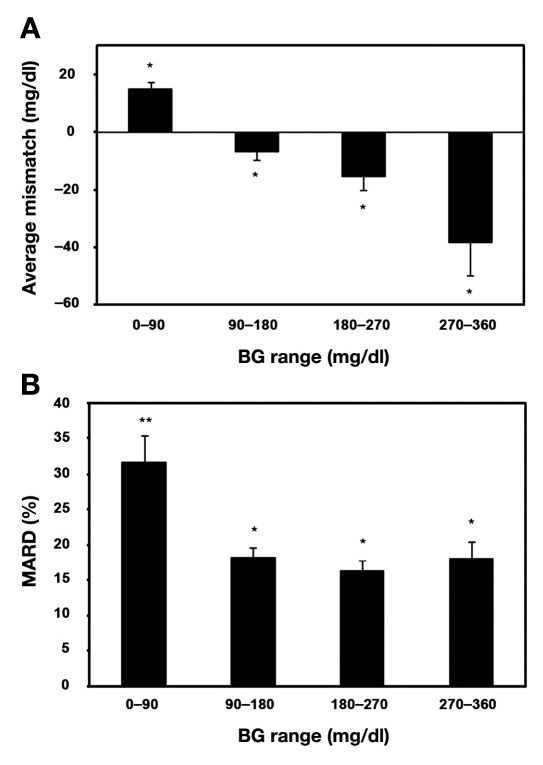
Conclusions: Short-term use of the CGMS with alarm, together with appropriate instructions for users, reduces the incidence and duration of hypoglycemia, but only to a limited extent, in part because it overestimates BG in the low glucose range.
© 2010 Diabetes Technology Society.
Figures
Comment in
-
Analysis: high-tech diabetes technology and the myth of clinical "plug and play".J Diabetes Sci Technol. 2010 Nov 1;4(6):1465-7. doi: 10.1177/193229681000400621. J Diabetes Sci Technol. 2010. PMID: 21129342 Free PMC article.
References
-
- Chase HP, Roberts MD, Wightman C, Klingensmith G, Garg SK, VanWyhe M, Desai S, Harper W, Lopatin M, Bartkowiak M, Tamada J, Eastman RC. Use of the GlucoWatch biographer in children with type 1 diabetes. Pediatrics. 2003;111((4 Pt 1)):790–794. - PubMed
-
- Chico A, Vidal-Rios P, Subira M, Novials A. The continuous glucose monitoring system is useful for detecting unrecognized hypoglycemias in patients with type 1 and type 2 diabetes but is not better than frequent capillary glucose measurements for improving metabolic control. Diabetes Care. 2003;26(4):1153–1157. - PubMed
-
- Deiss D, Bolinder J, Riveline JP, Battelino T, Bosi E, Tubiana-Rufi N, Kerr D, Phillip M. Improved glycemic control in poorly controlled patients with type 1 diabetes using real-time continuous glucose monitoring. Diabetes Care. 2006;29(12):2730–2732. - PubMed
-
- Garg SK, Schwartz S, Edelman SV. Improved glucose excursions using an implantable real-time continuous glucose sensor in adults with type 1 diabetes. Diabetes Care. 2004;27(3):734–738. - PubMed
-
- Juvenile Diabetes Research Foundation Continuous Glucose Monitoring Study Group. Tamborlane WV, Beck RW, Bode BW, Buckingham B, Chase HP, Clemons R, Fiallo-Scharer R, Fox LA, Gilliam LK, Hirsch IB, Huang ES, Kollman C, Kowalski AJ, Laffel L, Lawrence JM, Lee J, Mauras N, O’Grady M, Ruedy KJ, Tansey M, Tsalikian E, Weinzimer S, Wilson DM, Wolpert H, Wysocki T, Xing D. Continuous glucose monitoring and intensive treatment of type 1 diabetes. N Engl J Med. 2008;359(14):1464–1476. - PubMed
Publication types
MeSH terms
Substances
LinkOut - more resources
Full Text Sources
Medical
