


Prenatal interaction of mutant DISC1 and immune activation produces adult psychopathology
- PMID: 21130225
- PMCID: PMC3026608
- DOI: 10.1016/j.biopsych.2010.09.022
Prenatal interaction of mutant DISC1 and immune activation produces adult psychopathology
Erratum in
- Biol Psychiatry. 2011 Feb 15;69(4):390
Abstract
Background: Gene-environment interactions (GEI) are involved in the pathogenesis of mental diseases. We evaluated interaction between mutant human disrupted-in-schizophrenia 1 (mhDISC1) and maternal immune activation implicated in schizophrenia and mood disorders.
Methods: Pregnant mice were treated with saline or polyinosinic:polycytidylic acid at gestation day 9. Levels of inflammatory cytokines were measured in fetal and adult brains; expression of mhDISC1, endogenous DISC1, lissencephaly type 1, nuclear distribution protein nudE-like 1, glycoprotein 130, growth factor receptor-bound protein 2, and glycogen synthase kinase-3beta were assessed in cortical samples of newborn mice. Tissue content of monoamines, volumetric brain abnormalities, dendritic spine density in the hippocampus, and various domains of the mouse behavior repertoire were evaluated in adult male mice.
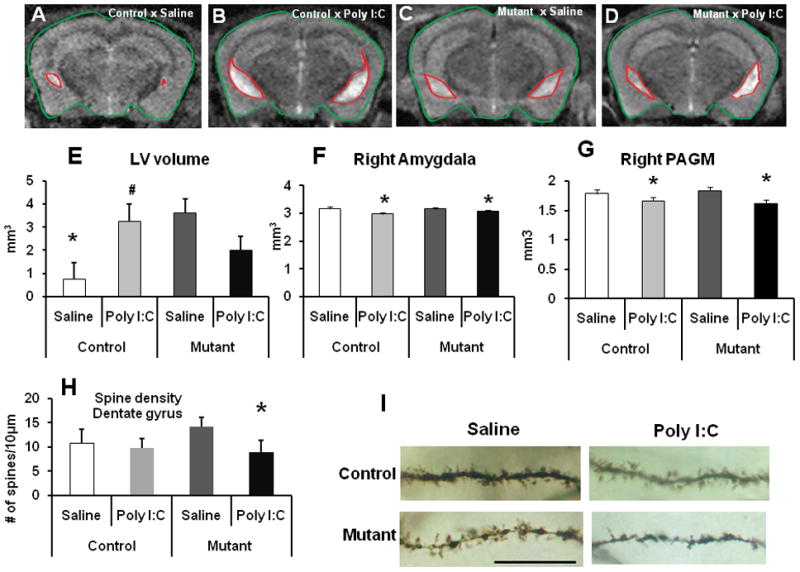
Results: Prenatal interaction produced anxiety, depression-like responses, and altered social behavior that were accompanied by decreased reactivity of the hypothalamic-pituitary-adrenal axis, attenuated serotonin neurotransmission in the hippocampus, reduced enlargement of lateral ventricles, decreased volumes of amygdala and periaqueductal gray matter and density of spines on dendrites of granule cells of the hippocampus. Prenatal interaction modulated secretion of inflammatory cytokines in fetal brains, levels of mhDISC1, endogenous mouse DISC1, and glycogen synthase kinase-3beta. The behavioral effects of GEI were observed only if mhDISC1 was expressed throughout the life span.
Conclusions: Prenatal immune activation interacted with mhDISC1 to produce the neurobehavioral phenotypes that were not seen in untreated mhDISC1 mice and that resemble aspects of major mental illnesses. Our DISC1 mouse model is a valuable system to study GEI relevant to mental illnesses.
Copyright © 2010 Society of Biological Psychiatry. All rights reserved.
Figures




Comment in
-
What happened when the environment met DISC1? Showing the interactive effects of poly I:C and DISC1 on mouse phenotypes related to mood disorders.Biol Psychiatry. 2010 Dec 15;68(12):1080-1. doi: 10.1016/j.biopsych.2010.10.016. Biol Psychiatry. 2010. PMID: 21130220 No abstract available.
References
-
- Rutter M, Moffitt TE, Caspi A. Gene-environment interplay and psychopathology: multiple varieties but real effects. J Child Psychol Psychiatry. 2006;47:226–261. - PubMed
-
- Pletnikov MV, Ayhan Y, Nikolskaia O, Xu Y, Ovanesov MV, Huang H, et al. Inducible expression of mutant human DISC1 in mice is associated with brain and behavioral abnormalities reminiscent of schizophrenia. Mol Psychiatry. 2008;13:173–186. 115. - PubMed
Publication types
MeSH terms
Substances
Grants and funding
LinkOut - more resources
Full Text Sources
Medical
Molecular Biology Databases
Miscellaneous
