


Using confirmatory factor analysis to evaluate construct validity of the Brief Pain Inventory (BPI)
- PMID: 21131166
- PMCID: PMC3062715
- DOI: 10.1016/j.jpainsymman.2010.05.008
Using confirmatory factor analysis to evaluate construct validity of the Brief Pain Inventory (BPI)
Abstract
Context: The Brief Pain Inventory (BPI) is a frequently used instrument designed to assess the patient-reported outcome of pain. The majority of factor analytic studies have found a two-factor (i.e., pain intensity and pain interference) structure for this instrument; however, because the BPI was developed with an a priori hypothesis of the relationship among its items, it follows that construct validity investigations should use confirmatory factor analysis (CFA).
Objectives: The purpose of this work was to establish the construct validity of the BPI using a CFA framework and demonstrate factorial invariance using a range of demographic variables.
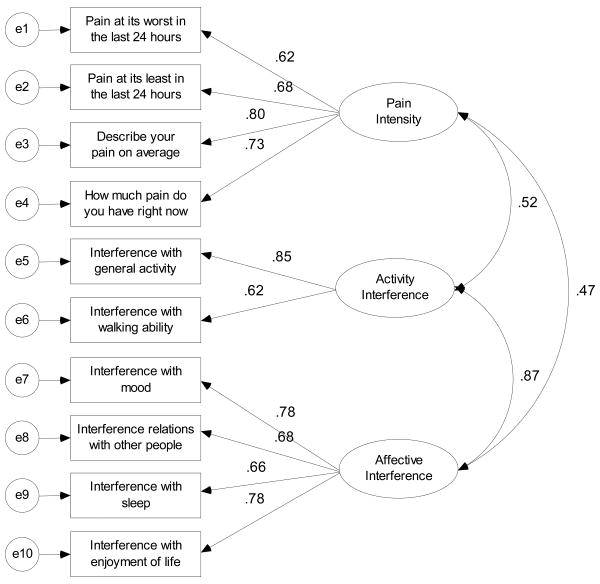
Methods: A retrospective CFA was completed in a sample of individuals diagnosed with HIV/AIDS and cancer (n=364; 63% male; age 21-92 years, M=51.80). A baseline one-factor model was compared against two-factor and three-factor models (i.e., pain intensity, activity interference, and affective interference) that were developed based on the hypothetical design of the instrument.
Results: Fit indices for the three-factor model were statistically superior when compared with the one-factor model and marginally better when compared with the two-factor model. This three-factor structure was found to be invariant across disease, age, and ethnicity groups.
Conclusion: The results of this study provide evidence to support a three-factor representation of the BPI, and the originally hypothesized two-factor structure. Such findings will begin to provide clinical trialists, pharmaceutical sponsors, and regulators with confidence in the psychometric properties of this instrument when considering its inclusion in clinical research.
Copyright © 2011 U.S. Cancer Pain Relief Committee. Published by Elsevier Inc. All rights reserved.
Conflict of interest statement
Figures
References
-
- Cella D, Nichol MB, Eton D, Nelson JB, Mulani P. Estimating clinically meaningful changes for the Functional Assessment of Cancer Therapy - Prostate: results from a clinical trial of patients with metastatic hormone-refractory prostate cancer. Value Health. 2009;12:124–129. - PubMed
-
- Tannock IF, de Wit R, Berry WR, et al. Docetaxel plus prednisone or mitoxantrone plus prednisone for advanced prostate cancer. N Engl J Med. 2004;351:1502–1512. - PubMed
-
- Turk DC, Dworkin RH, McDermott MP, et al. Analyzing multiple endpoints in clinical trials of pain treatments: IMMPACT recommendations. Pain. 2008;139:485–493. - PubMed
-
- US Food and Drug Administration. Guidance for industry. Patient-reported outcome measures: use in medical development to support labeling claims. 2009. [December 9, 2009]. Available from: http://www.fda.gov/downloads/Drugs/GuidanceComplianceRegulatoryInformati.... - PMC - PubMed
Publication types
MeSH terms
Grants and funding
LinkOut - more resources
Full Text Sources
Medical
