. 2011 Mar;24(3):301-9.
doi: 10.1093/protein/gzq110. Epub 2010 Dec 2.

Production of active recombinant eIF5A: reconstitution in E.coli of eukaryotic hypusine modification of eIF5A by its coexpression with modifying enzymes

Affiliations

Production of active recombinant eIF5A: reconstitution in E.coli of eukaryotic hypusine modification of eIF5A by its coexpression with modifying enzymes

Jong Hwan Park et al. Protein Eng Des Sel. 2011 Mar.

Abstract

Eukaryotic translation initiation factor 5A (eIF5A) is the only cellular protein that contains the polyamine-modified lysine, hypusine [N(ε)-(4-amino-2-hydroxybutyl)lysine]. Hypusine occurs only in eukaryotes and certain archaea, but not in eubacteria. It is formed post-translationally by two consecutive enzymatic reactions catalyzed by deoxyhypusine synthase (DHS) and deoxyhypusine hydroxylase (DOHH). Hypusine modification is essential for the activity of eIF5A and for eukaryotic cell proliferation. eIF5A binds to the ribosome and stimulates translation in a hypusine-dependent manner, but its mode of action in translation is not well understood. Since quantities of highly pure hypusine-modified eIF5A is desired for structural studies as well as for determination of its binding sites on the ribosome, we have used a polycistronic vector, pST39, to express eIF5A alone, or to co-express human eIF5A-1 with DHS or with both DHS and DOHH in Escherichia coli cells, to engineer recombinant proteins, unmodified eIF5A, deoxyhypusine- or hypusine-modified eIF5A. We have accomplished production of three different forms of recombinant eIF5A in high quantity and purity. The recombinant hypusine-modified eIF5A was as active in methionyl-puromycin synthesis as the native, eIF5A (hypusine form) purified from mammalian tissue. The recombinant eIF5A proteins will be useful tools in future structure/function and the mechanism studies in translation.


Figures
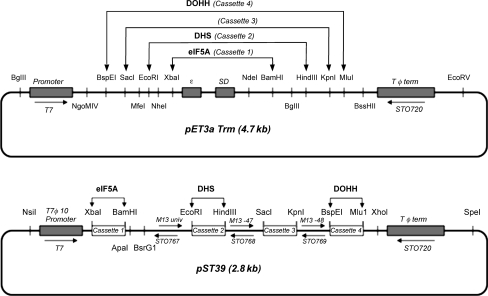
Scheme 1
Scheme 1
Construction of a polycistronic vector encoding eIF5A, DHS and DOHH. Schematic presentations of the cloning of eIF5A, DHS and DOHH in the monocistronic pET3aTrm transfer expression vector (A) and the polycistronic pST39 vector (B). The transcription start and termination sites are indicated. Each ORF of eIF5A, DHS and DOHH was individually subcloned into the pET3aTrm vector at the Nde1/BamH1, Nde1/HinIII and Nde1/Mlu1, to generate three transfer vectors, pET3aTrm/eIF5A, pET3aTrm/DHS, pET3aTrm/DOHH, respectively. The eIF5A cassette 1 was cut from the pET3aTrm/eIF5A and the cassette transferred to pST39 vector at the Xba/BamH1 site. The DHS cassette was inserted in the pST39/eIF5A vector and then the DOHH cassette was subsequently inserted in the pST39/eIF5A/DHS vector at the indicated site (modified from Tan, 2001).
Fig. 1
Fig. 1
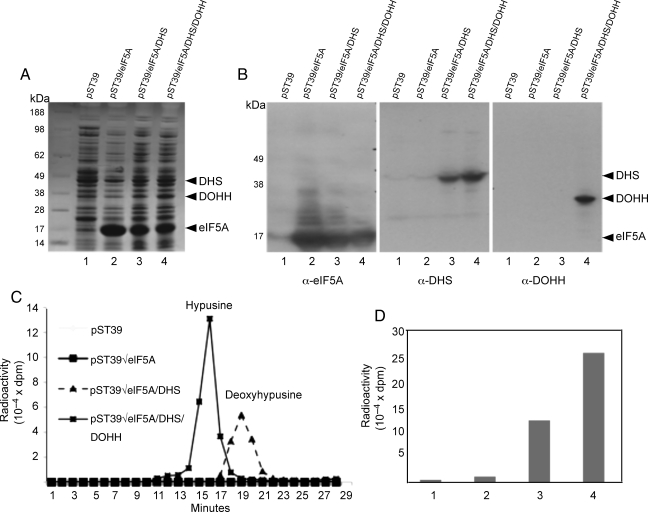
Expression of eIF5A, DHS and DOHH in BL21(DE3)pLysS cells. E.coli cells transformed with the pST39 empty vector (lane 1), pST39/eIF5A (lane 2), pST39/eIF5A/DHS (lane 3) or pST39/eIF5A/DHS/DOHH (lane 4) were induced with 1 mM IPTG for 4 h in the presence or absence of [3H]spermidine (5 μCi/ml). The protein expression was measured after SDS-PAGE by Coomassie-Blue staining (A) or by western blotting (B). Hypusine modification was measured by ion exchange chromatographic separation of radioactive deoxyhypusine or hypusine in the acid hydrolysate of proteins (C) and the total radioactivity in hypusine (lane 4) or deoxyhypusine peak (lane 3) in each sample is shown (D).
Fig. 2
Fig. 2
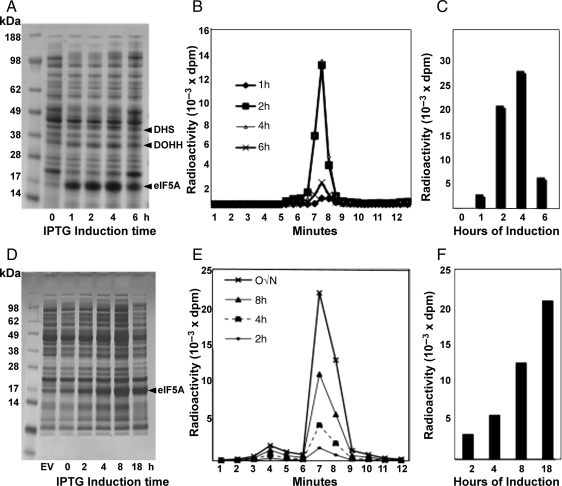
Time course of protein expression and hypusine modification upon IPTG induction at 37°C (AC) and at 18°C (DF). BL21(DE3)pLysS cells transformed with pST39/heIF5A/hDHS/hDOHH were induced with IPTG at 37°C or 18°C in the absence or presence of [3H]spermidine (5 μCi/ml) for the times indicated. Protein expression was examined by Coomassie-Blue staining after SDS-PAGE (A, D) and the extent of the hypusine modification was measured by measuring radioactivity in the hypusine after ion exchange chromatographic separation (B, E). Total amount of hypusine formed at each induction time point is shown as a bar graph (C, F).
Fig. 3
Fig. 3
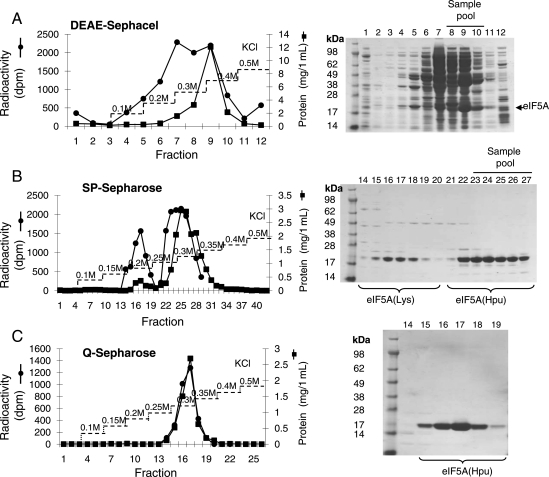
Purification of eIF5A(Hpu) from BL21(DE3)pLysS/pST39/eIF5A/DHS/DOHH cells. eIF5A(Hpu) was purified from E.coli cells induced with IPTG at 37°C for 4 h as described under the section Materials and methods. Chromatography on (A) DEAE Sephacel, (B) SP-Sepharose and (C) Q-Sepharose. Aliquots from each fraction were used for measurement of radioactivity by liquid scintillation counting, for protein content by the BioRad assay and for purity by SDS-PAGE and Coomassie-Blue staining of the gels. Pooled fractions are indicated by a horizontal line on top of fraction numbers of the SDS gels.
Fig. 4
Fig. 4
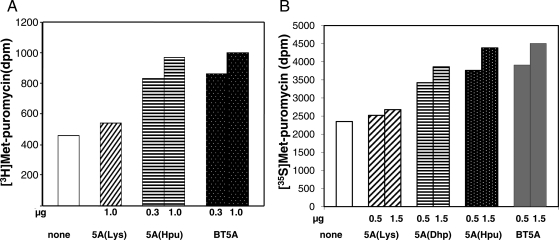
Comparison of activities of recombinant eIF5A proteins and bovine testis eIF5A. The methionyl-puromycin synthesis assay was carried out as described under the section ‘Materials and methods’, using either [3H]methionyl-tRNA (A) or [35S]methionyl-tRNA (B) in two independent experiments. The dpm for [3H]methionyl-puromycin formed is twice that of [35S]methionyl-puromycin, since the specific radioactivity of [3H]methionyl-tRNA is approximately twice that of [35S]methionyl-tRNA. Abbreviations are: 5A(Lys), eIF5A(Lys); 5A(Dhp), eIF5A(Dhp); 5A(Hpu), eIF5A(Hpu); BT5A, bovine testis eIF5A.

References

    1. Barrios A., Selleck W., Hnatkovich B., Kramer R., Sermwittayawong D., Tan S. Methods. 2007;41:271–277. doi:10.1016/j.ymeth.2006.08.007. - DOI - PMC - PubMed
    1. Benne R., Hershey J.W. J. Biol. Chem. 1978;253:3078–3087. - PubMed
    1. Blaha G., Stanley R.E., Steitz T.A. Science. 2009;325:966–970. doi:10.1126/science.1175800. - DOI - PMC - PubMed
    1. Byers T.L., Lakanen J.R., Coward J.K., Pegg A.E. Biochem. J. 1994;303:363–368. - PMC - PubMed
    1. Cano V.S., Jeon G.A., Johansson H.E., Henderson C.A., Park J.H., Valentini S.R., Hershey J.W., Park M.H. FEBS J. 2008;275:44–58. doi:10.1111/j.1742-4658.2007.06172.x. - DOI - PMC - PubMed

Publication types

MeSH terms