


Impact of the implementation of rest days in live bird markets on the dynamics of H5N1 highly pathogenic avian influenza
- PMID: 21131332
- PMCID: PMC3119874
- DOI: 10.1098/rsif.2010.0510
Impact of the implementation of rest days in live bird markets on the dynamics of H5N1 highly pathogenic avian influenza
Abstract
Live bird markets (LBMs) act as a network 'hub' and potential reservoir of infection for domestic poultry. They may therefore be responsible for sustaining H5N1 highly pathogenic avian influenza (HPAI) virus circulation within the poultry sector, and thus a suitable target for implementing control strategies. We developed a stochastic transmission model to understand how market functioning impacts on the transmission dynamics. We then investigated the potential for rest days-periods during which markets are emptied and disinfected-to modulate the dynamics of H5N1 HPAI within the poultry sector using a stochastic meta-population model. Our results suggest that under plausible parameter scenarios, HPAI H5N1 could be sustained silently within LBMs with the time spent by poultry in markets and the frequency of introduction of new susceptible birds' dominant factors determining sustained silent spread. Compared with interventions applied in farms (i.e. stamping out, vaccination), our model shows that frequent rest days are an effective means to reduce HPAI transmission. Furthermore, our model predicts that full market closure would be only slightly more effective than rest days to reduce transmission. Strategies applied within markets could thus help to control transmission of the disease.
Figures
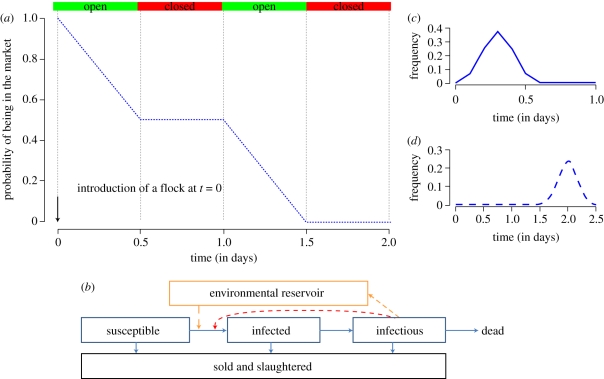
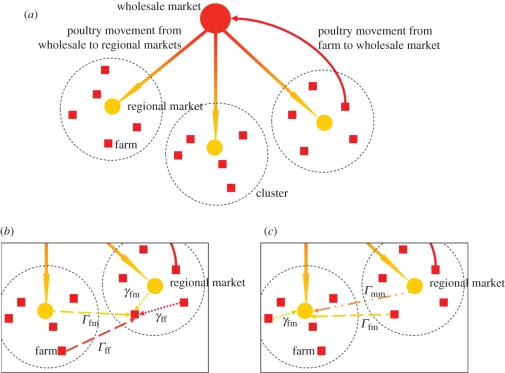
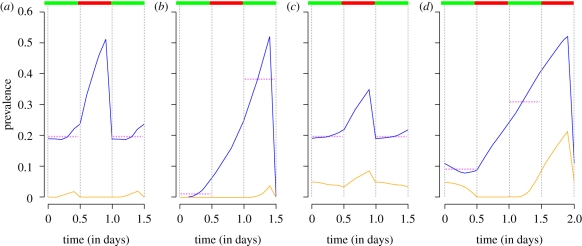
 assuming the same β and η is equal to (a) 16.8, (b) 35.1, (c) 6.4, (d) 9.2. Each graph shows the mean prevalence of infectious birds at each time step (solid blue line), the mean prevalence of infectious birds during the open period (dotted violet line) and the mean prevalence of symptomatic birds for each time step (solid orange line). 95% bounds from the stochastic realizations closely follow the mean and so are not presented.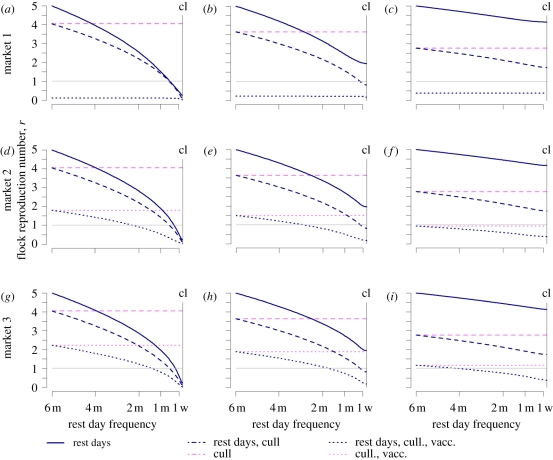
 assuming the same β and η is 16.8. (d,e,f) For market 2, Pm = 37.8% and
  = 40. (g,h,i) For market 3, Pm =43.1% and
  = 80. Cull., culling out; vacc., vaccination; 6m, rest days every six months; 1w, rest days once a week; cl, the market chain is closed.
References
-
- OIE 2009. H5N1 notified in domestic poultry 2003–2009. See http://www.oie.int/fr/info_ev/fr_AI_factoids_3.htm (accessed 08 December 2009).
-
- Peiris J. S., et al. 2004. Re-emergence of fatal human influenza A subtype H5N1 disease. Lancet 363, 617–619 10.1016/S0140-6736(04)15595-5S0140673604155955 (doi:10.1016/S0140-6736(04)15595-5S0140673604155955) - DOI - PMC - PubMed
-
- Martin V., Sims L., Lubroth J., Pfeiffer D., Slingenbergh J., Domenech J. 2006. Epidemiology and ecology of highly pathogenic avian influenza with particular emphasis on Southeast Asia. Dev. Biol. (Basel) 124, 23–36 - PubMed
-
- Sims L. D. 2007. Lessons learned from Asian H5N1 outbreak control. Avian Dis. 51, 174–181 10.1637/7637-042806R.1 (doi:10.1637/7637-042806R.1) - DOI - PubMed
Publication types
MeSH terms
Grants and funding
LinkOut - more resources
Full Text Sources
Medical
