


Sequences at the interface of the fifth immunoglobulin domain and first fibronectin type III repeat of the neural cell adhesion molecule are critical for its polysialylation
- PMID: 21131353
- PMCID: PMC3039361
- DOI: 10.1074/jbc.M110.200386
Sequences at the interface of the fifth immunoglobulin domain and first fibronectin type III repeat of the neural cell adhesion molecule are critical for its polysialylation
Abstract
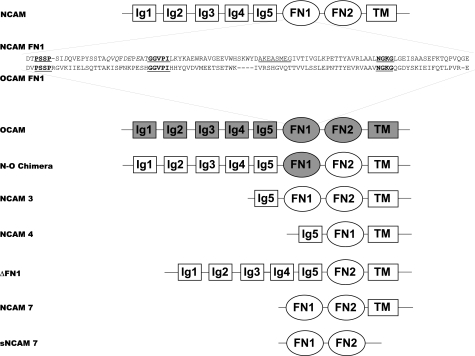
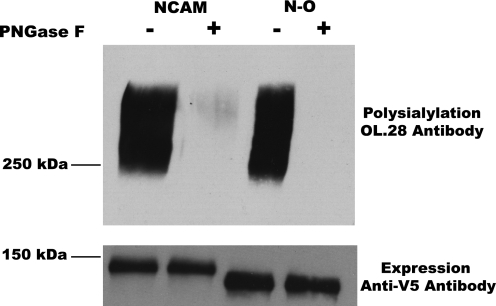
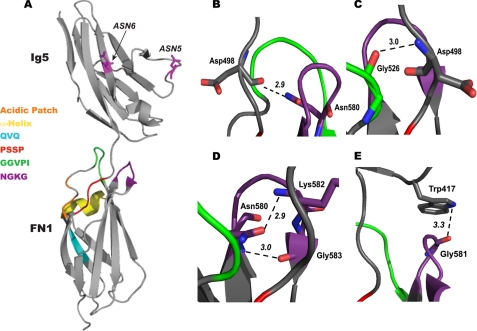
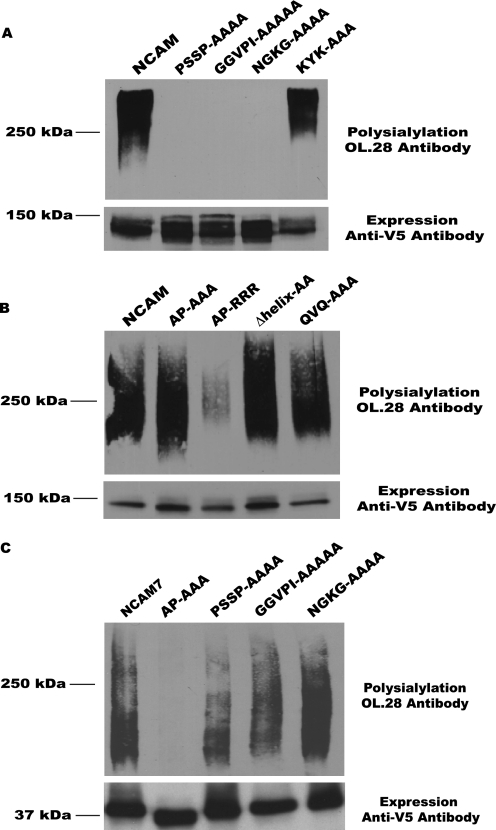
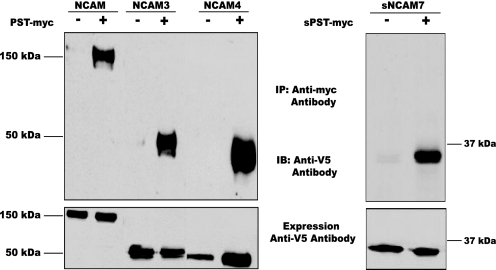
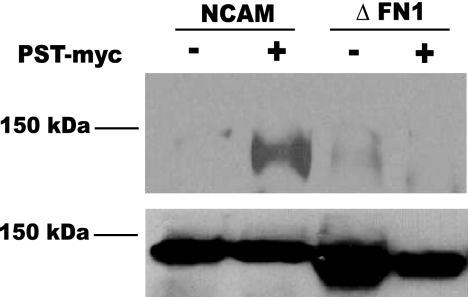
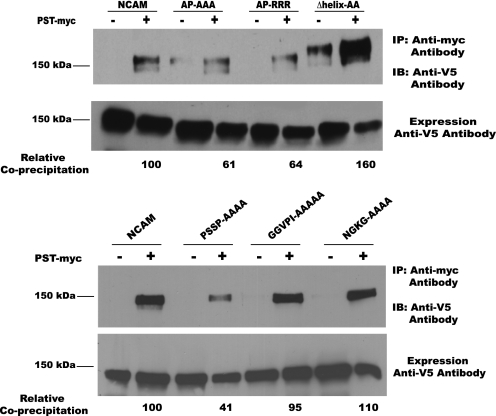
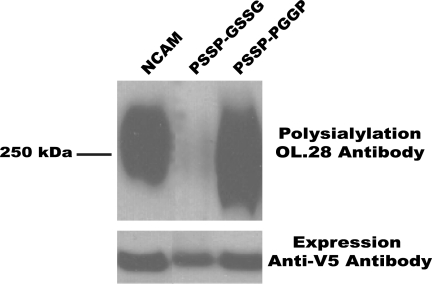
Polysialic acid is an anti-adhesive glycan that modifies a select group of mammalian proteins. The primary substrate of the polysialyltransferases (polySTs) is the neural cell adhesion molecule (NCAM). Polysialic acid negatively regulates cell adhesion, is required for proper brain development, and is expressed in specific areas of the adult brain where it promotes on-going cell migration and synaptic plasticity. The first fibronectin type III repeat (FN1) of NCAM is required for polysialylation of the N-glycans on the adjacent immunoglobulin-like domain (Ig5), and acidic residues on the surface of FN1 play a role in polyST recognition. Recent work demonstrated that the FN1 domain from the unpolysialylated olfactory cell adhesion molecule (OCAM) was able to partially replace NCAM FN1 (Foley, D. A., Swartzentruber, K. G., Thompson, M. G., Mendiratta, S. S., and Colley, K. J. (2010) J. Biol. Chem. 285, 35056-35067). Here we demonstrate that individually replacing three identical regions shared by NCAM and OCAM FN1, (500)PSSP(503) (PSSP), (526)GGVPI(530) (GGVPI), and (580)NGKG(583) (NGKG), dramatically reduces NCAM polysialylation. In addition, we show that the polyST, ST8SiaIV/PST, specifically binds NCAM and that this binding requires the FN1 domain. Replacing the FN1 PSSP sequences and the acidic patch residues decreases NCAM-polyST binding, whereas replacing the GGVPI and NGKG sequences has no effect. The location of GGVPI and NGKG in loops that flank the Ig5-FN1 linker and the proximity of PSSP to this linker suggest that GGVPI and NGKG sequences may be critical for stabilizing the Ig5-FN1 linker, whereas PSSP may play a dual role maintaining the Ig5-FN1 interface and a polyST recognition site.
Figures
References
-
- Cunningham B. A., Hemperly J. J., Murray B. A., Prediger E. A., Brackenbury R., Edelman G. M. (1987) Science 236, 799–806 - PubMed
-
- Walmod P. S., Kolkova K., Berezin V., Bock E. (2004) Neurochem. Res. 29, 2015–2035 - PubMed
-
- Ditlevsen D. K., Povlsen G. K., Berezin V., Bock E. (2008) J. Neurosci. Res. 86, 727–743 - PubMed
-
- Eckhardt M., Mühlenhoff M., Bethe A., Koopman J., Frosch M., Gerardy-Schahn R. (1995) Nature 373, 715–718 - PubMed
-
- Kojima N., Yoshida Y., Tsuji S. (1995) FEBS Lett. 373, 119–122 - PubMed
Publication types
MeSH terms
Substances
Grants and funding
LinkOut - more resources
Full Text Sources
Research Materials
Miscellaneous
