. 2010 Dec 21;107(51):21990-5.
doi: 10.1073/pnas.1006091107. Epub 2010 Dec 3.

Design of small molecules that target metal-A{beta} species and regulate metal-induced A{beta} aggregation and neurotoxicity

Affiliations

Design of small molecules that target metal-A{beta} species and regulate metal-induced A{beta} aggregation and neurotoxicity

Jung-Suk Choi et al. Proc Natl Acad Sci U S A. .

Abstract

The accumulation of metal ions and amyloid-β (Aβ) aggregates found in the brain of patients with Alzheimer's disease (AD) has been suggested to be involved in AD pathogenesis. To investigate metal-Aβ-associated pathways in AD, development of chemical tools to target metal-Aβ species is desired. Only a few efforts, however, have been reported. Here, we report bifunctional small molecules, N-(pyridin-2-ylmethyl)aniline (L2-a) and N(1),N(1)-dimethyl-N(4)-(pyridin-2-ylmethyl)benzene-1,4-diamine (L2-b) that can interact with both metal ions and Aβ species, as determined by spectroscopic methods including high-resolution NMR spectroscopy. Using the bifunctional compound L2-b, metal-induced Aβ aggregation and neurotoxicity were modulated in vitro as well as in human neuroblastoma cells. Furthermore, treatment of human AD brain tissue homogenates containing metal ions and Aβ species with L2-b showed disassembly of Aβ aggregates. Therefore, our studies presented herein demonstrate the value of bifunctional compounds as chemical tools for investigating metal-Aβ-associated events and their mechanisms in the development and pathogenesis of AD and as potential therapeutics.


Conflict of interest statement

The authors declare no conflict of interest.

Figures
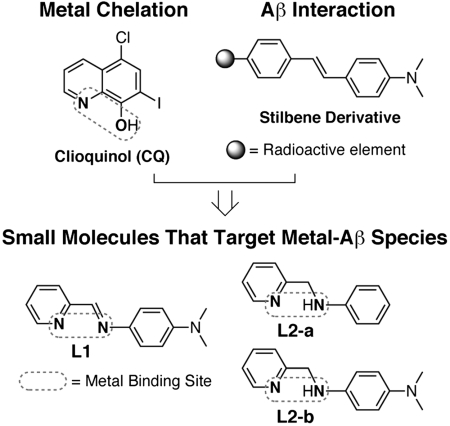
Fig. 1.
Fig. 1.
Chemical structures of small molecules having bifunctionality (metal chelation and Aβ interaction).
Fig. 2.
Fig. 2.
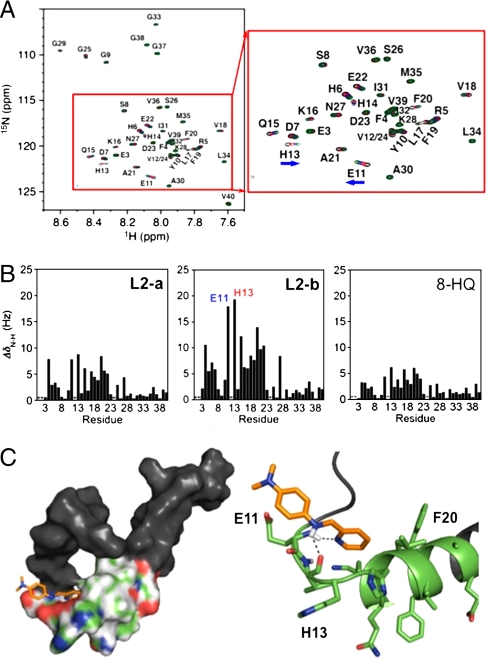
Interaction of small molecules with Aβ by NMR and docking studies. (A) 2D 1H-15N TROSY-HSQC spectrum of ca. 308 μM 15N-labeled Aβ1-40 in black (900 MHz, 200 mM SDS-d25, 20 mM sodium phosphate, 7% D2O (v/v), pH 7.3, 25 °C) and the addition of 5 (red), 10 (blue), and 15 (green) equivalents of L2-b. (B) Combined 1H and 15N chemical shifts of Aβ upon the addition of 10 equivalents of L2-a (left), L2-b (middle), and 8-HQ (right), indicating the significant residues involved in small molecule recognition. *Denotes absent or overlapping peaks. (C) Docking studies of L2-b with Aβ (PDB 1BA4). Surface (left) and cartoon (right) representations of L2-b interacting with Aβ in one possible binding conformation near E11 and H13 (Conformation A, Fig. S4). Residues E11–E22, which are shown to be most affected by NMR analysis, are depicted in color. The dashed lines indicate possible hydrogen-bond contacts (2.1–2.2 Å).
Fig. 3.
Fig. 3.
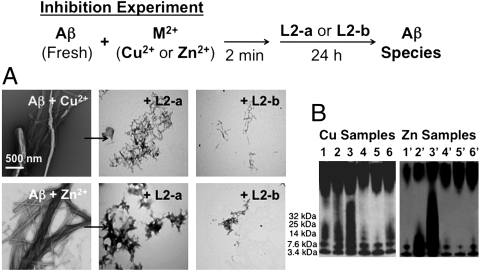
Visualization of Aβ species from inhibition experiments. Top: Scheme of the inhibition experiment. Bottom: (A) TEM images of samples of Cu2+- or Zn2+-treated fresh Aβ incubated with the compound L2-a or L2-b ([Aβ] = 25 μM, [M2+] = 25 μM, [compound] = 50 μM, 24 h, 37 °C, constant agitation). (B) Native gel electrophoresis and Western blot of the Aβ species. All samples were incubated for 24 h at 37 °C with constant agitation and anaylzed by native gel electrophoresis followed by Western blotting using the anti-Aβ antibody 6E10. Left: (1) [Aβ + Cu2+]; (2) [1 + L2-a]; (3) [1 + L2-b]; (4) [1 + CQ]; (5) [1 + phen]; (6) [1 + EDTA]. Right: (1′) [Aβ + Zn2+]; (2′) [1 + L2-a]; (3′) [1 + L2-b]; (4′) [1 + CQ]; (5′) [1 + phen]; (6′) [1 + EDTA].
Fig. 4.
Fig. 4.
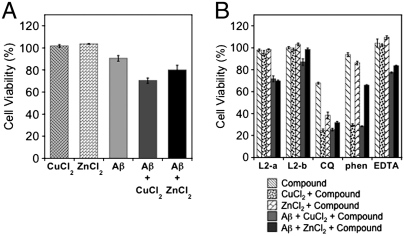
Influence of L2-a and L2-b on metal-Aβ neurotoxicity in living cells. (A) Cell viability (%) upon incubation of CuCl2, ZnCl2, Aβ, Aβ + CuCl2, or Aβ + ZnCl2 with SK-N-BE(2)-M17 cells for 24 h, which was determined by the MTT assay. Values of cell viability depicted in the figure are relative to that of the cells only containing 1% DMSO. (B) Modulation of metal-Aβ neurotoxicity by L2-a and L2-b for 24 h ([Aβ] = 20 μM; [Cu2+ or Zn2+] = 20 μM; [compound] = 40 μM).
Fig. 5.
Fig. 5.
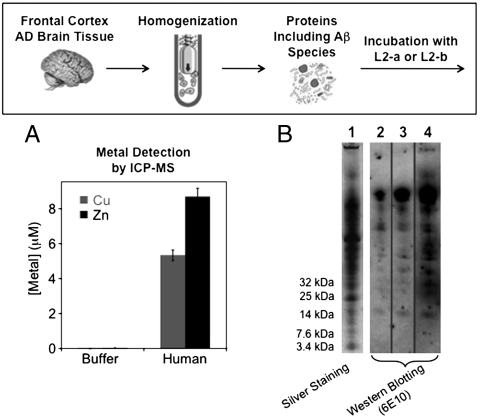
Disaggregation experiments using human AD brain tissue homogenates (frontal cortex). Top: Scheme of disaggregation experiments of AD brain tissue homogenates with L2-a and L2-b. Bottom: (A) Metal concentrations from the supernatant of brain tissue homogenates (100 mg/mL) by ICP-MS. (B) Visualization of proteins including Aβ species by silver staining (lane 1) or native gel electrophoresis using Western blotting with the anti-Aβ antibody 6E10 (lane 2: only the supernatant of human homogenized AD brain tissue samples; lanes 3 and 4: the supernatants of homogenates incubated with L2-a and L2-b for 24 h, respectively).

References

    1. Jakob-Roetne R, Jacobsen H. Alzheimer’s disease: From pathology to therapeutic approaches. Angew Chem Int Ed. 2009;48:3030–3059. - PubMed
    1. Scott LE, Orvig C. Medicinal inorganic chemistry approaches to passivation and removal of aberrant metal ions in disease. Chem Rev. 2009;109:4885–4910. - PubMed
    1. Gaggelli E, Kozlowski H, Valensin D, Valensin G. Copper homeostasis and neurodegenerative disorders (Alzheimer’s, prion, and Parkinson’s diseases and amyotrophic lateral sclerosis) Chem Rev. 2006;106:1995–2044. - PubMed
    1. Rauk A. The chemistry of Alzheimer’s disease. Chem Soc Rev. 2009;38:2698–2715. - PubMed
    1. Haass C, Selkoe DJ. Soluble protein oligomers in neurodegeneration: Lessons from the Alzheimer’s amyloid β-peptide. Nat Rev Mol Cell Biol. 2007;8:101–112. - PubMed

Publication types

LinkOut - more resources