


doi: 10.1038/ng.725.
Epub 2010 Dec 5.
CEP152 is a genome maintenance protein disrupted in Seckel syndrome
Affiliations
- PMID: 21131973
- PMCID: PMC3430850
- DOI: 10.1038/ng.725
Item in Clipboard
CEP152 is a genome maintenance protein disrupted in Seckel syndrome
Nat Genet.
2011 Jan.
Abstract
Functional impairment of DNA damage response pathways leads to increased genomic instability. Here we describe the centrosomal protein CEP152 as a new regulator of genomic integrity and cellular response to DNA damage. Using homozygosity mapping and exome sequencing, we identified CEP152 mutations in Seckel syndrome and showed that impaired CEP152 function leads to accumulation of genomic defects resulting from replicative stress through enhanced activation of ATM signaling and increased H2AX phosphorylation.
Figures
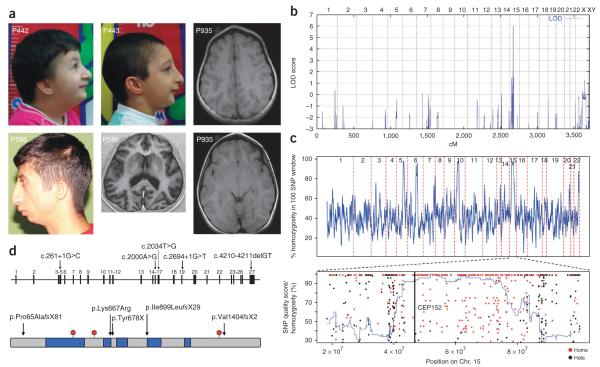
Clinical and molecular characterization of CEP152 Seckel subjects. (a) Clinical characteristics of subjects 442, 443 and 586 presenting with microcephaly, sloping forehead, high nasal bridge, beaked nose and retrognathia. Informed consents to publish the photographs were obtained from the subjects’ parents. Cranial magnetic resonance imaging of subjects 586 and 935 showing simplified gyri. (b) Genome-wide graphical view of LOD scores using SNP array homozygosity mapping in four affected subjects, 442, 443, 586 and 633, indicated significant linkage to chromosome 15q21.1–q21.2. (c) Above, homozygosity (blue line) was measured as the percent of homozygous sites within a sliding window of 100 variant sites, relative to the reference genome, obtained from the exome sequencing data. CEP152 is located on chromosome 15, which harbors one of the longest stretches of homozygosity in this genome. Below, the chromosomal locations of all single nucleotide variants called on chromosome 15 are plotted against the genotype quality for that variant. Homozygous variants are plotted in red, and heterozygous variants are plotted in black. Homozygosity (blue line) is measured as the fraction of homozygous sites within a sliding window of 50 variant sites (relative to the reference genome) called from the exome sequencing data. (d) Above, the genomic structure of human CEP152. The position of each mutation is shown on the coding DNA level. Below, the protein structure of CEP152 with predicted coiled-coil domains (blue boxes) and Thr/Ser-phosphorylation sites (red). The position and the predicted effects of the mutations on CEP152 are marked by arrows.
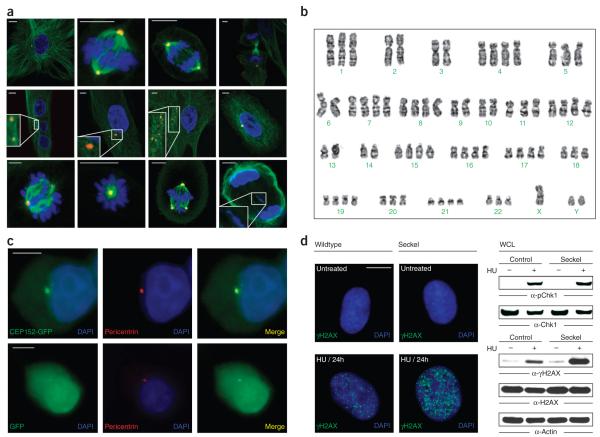
Characterization of CEP152 Seckel cells. (a) Mitotic morphology of CEP152 Seckel fibroblasts. Immunofluorescence staining of CEP152 Seckel fibroblasts carrying the c.261+1G>C mutation with antibodies against α-tubulin (green), pericentrin (red) and DAPI staining of DNA (blue). Above, from left to right, control fibroblasts showing normal mitotic morphology of interphase, metaphase, anaphase and telophase. Middle, Seckel interphase cells containing three equally sized nuclei and two centrosomes without astral microtubules (inset, tenfold magnification), two unseparated centrosomes per nucleus without asters (inset, threefold magnification), fragmented centrosomes without asters and micronuclei (inset, twofold magnification), and partially depolymerized microtubules together with micronuclei in addition to a main nucleus. Below, abnormal Seckel metaphases showing incorrectly aligned chromosomes on the metaphase plate, a monopolar spindle with a large centrosome and reduced spindle, a tripolar spindle with differently sized and structurally compromised centrosomes, and an abnormal Seckel telophase showing defects in cytokinesis (inset, twofold magnification). Scale bars, 5 μm. (b) Aneuploid metaphase karyotype of a CEP152 Seckel lymphocyte. (c) Centrosomal localization of wildtype CEP152 in HEK293T cells expressing either GFP-tagged wildtype CEP152 (above) or GFP as a control (below). Additional staining was with pericentrin (red) and DAPI (blue). (d) DNA-damage response in wildtype and Seckel fibroblasts. H2AX phosphorylation of wildtype and CEP152 Seckel primary fibroblasts after treatment with hydroxyurea (HU) (left). Protein blot analysis of HU-induced phosphorylation of CHK1 (Ser345) and H2AX (Ser139) (right). Equal protein loading was confirmed by re-probing of the membranes with antibodies against CHK1 or H2AX and actin antibodies.
Comment in
-
Step to CEP152: uncovering a new mutation implicated in Seckel syndrome.Clin Genet. 2011 May;79(5):428-30. doi: 10.1111/j.1399-0004.2011.01655.x. Epub 2011 Mar 13. Clin Genet. 2011. PMID: 21395565 No abstract available.
References
Publication types
MeSH terms
Substances
Supplementary concepts
Grants and funding
LinkOut - more resources
Full Text Sources
Molecular Biology Databases
Research Materials
Miscellaneous
