


Activation of group IVC phospholipase A(2) by polycyclic aromatic hydrocarbons induces apoptosis of human coronary artery endothelial cells
- PMID: 21132278
- PMCID: PMC4741309
- DOI: 10.1007/s00204-010-0614-9
Activation of group IVC phospholipase A(2) by polycyclic aromatic hydrocarbons induces apoptosis of human coronary artery endothelial cells
Abstract
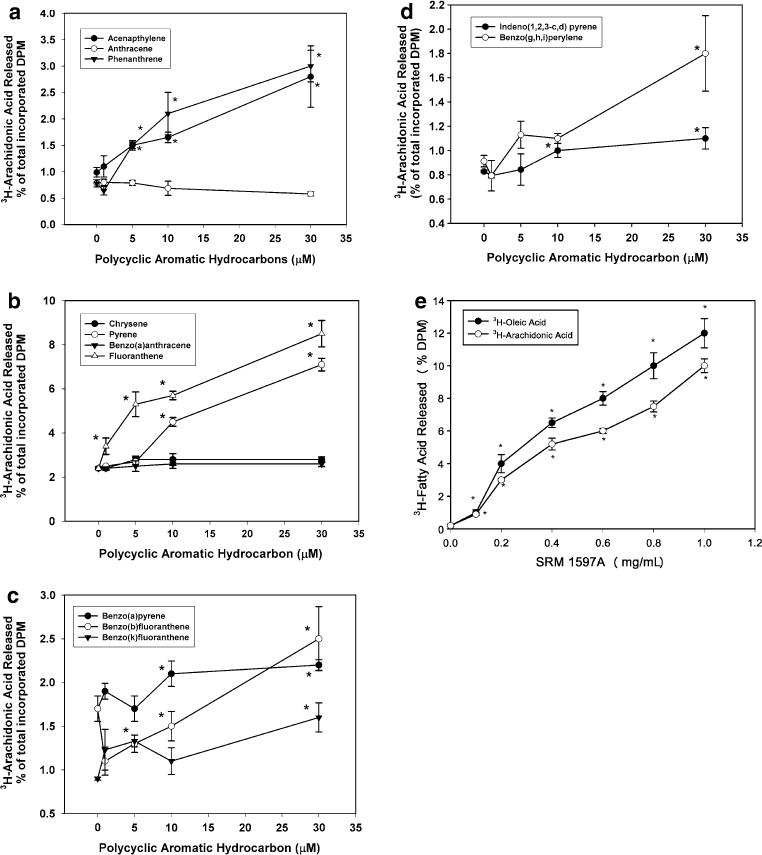
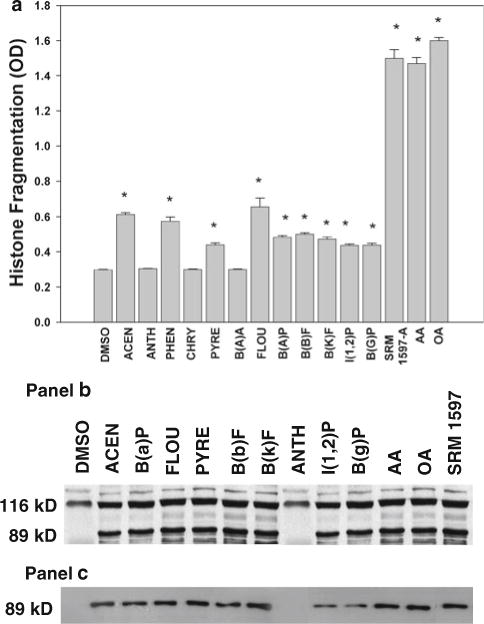
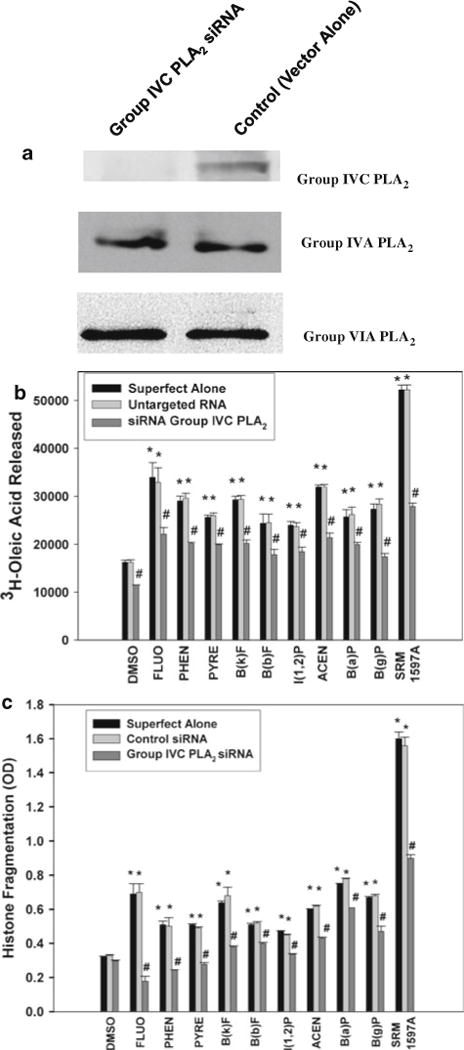
Exposure to environmental pollutants, such as polycyclic aromatic hydrocarbons (PAHs) found in coal tar mixtures and tobacco sources, is considered a significant risk factor for the development of heart disease in humans. The goal of this study was to determine the influence of PAHs present at a Superfund site on human coronary artery endothelial cell (HCAEC) phospholipase A(2) (PLA(2)) activity and apoptosis. Extremely high levels of 12 out of 15 EPA high-priority PAHs were present in both the streambed and floodplain sediments at a site where an urban creek and its adjacent floodplain were extensively contaminated by PAHs and other coal tar compounds. Nine of the 12 compounds and a coal tar mixture (SRM 1597A) activated group IVC PLA(2) in HCAECs, and activation of this enzyme was associated with histone fragmentation and poly (ADP) ribose polymerase (PARP) cleavage. Genetic silencing of group IVC PLA(2) inhibited both (3)H-fatty acid release and histone fragmentation by PAHs and SRM 1597A, indicating that individual PAHs and a coal tar mixture induce apoptosis of HCAECs via a mechanism that involves group IVC PLA(2). Western blot analysis of aortas isolated from feral mice (Peromyscus leucopus) inhabiting the Superfund site showed increased PARP and caspase-3 cleavage when compared to reference mice. These data suggest that PAHs induce apoptosis of HCAECs via activation of group IVC PLA(2).
Figures



References
-
- Asai K, Hirabayashi T, Houjou T, Uozumi N, Taguchi R, Shimizu T. Human group IVC phospholipase A2 (cPLA2gamma). Roles in the membrane remodeling and activation induced by oxidative stress. J Biol Chem. 2003;278:8809–8814. - PubMed
-
- Atsumi G, Tajima M, Hadano A, Nakatani Y, Murakami M, Kudo I. Fas-induced arachidonic acid release is mediated by Ca2+-independent phospholipase A2, but not cytosolic phospholipase A2, which undergoes proteolytic inactivation. J Biol Chem. 1998;273:13870–13877. - PubMed
-
- Atsumi G, Murakami M, Kojima K, Hadano A, Tajima M, Kudo I. Distinct roles of two intracellular phospholipase A2s in fatty acid release in the cell death pathway. J Biol Chem. 2000;275:18248–18258. - PubMed
-
- Bhat R, Bresnick E. Glycine N-methyltransferase is an example of functional diversity: role as a polycyclic aromatic hydrocarbon-binding receptor. J Biol Chem. 1997;272:21221–21226. - PubMed
-
- Blaha L, Machala M, Vondracek J, Breinekova K. Multiple oxidative stress parameters are modulated in vitro by oxygenated polycyclic aromatic hydrocarbons identified in river sediments. Adv Exp Med Biol. 2001;500:225–228. - PubMed
Publication types
MeSH terms
Substances
Grants and funding
LinkOut - more resources
Full Text Sources
Research Materials
