Review
. 2011 Oct;164(3):839-52.
doi: 10.1111/j.1476-5381.2010.01148.x.

EDHF: spreading the influence of the endothelium

Affiliations
Review

EDHF: spreading the influence of the endothelium

Christopher J Garland et al. Br J Pharmacol. 2011 Oct.

Abstract

Our view of the endothelium was transformed around 30 years ago, from one of an inert barrier to that of a key endocrine organ central to cardiovascular function. This dramatic change followed the discoveries that endothelial cells (ECs) elaborate the vasodilators prostacyclin and nitric oxide. The key to these discoveries was the use of the quintessentially pharmacological technique of bioassay. Bioassay also revealed endothelium-derived hyperpolarizing factor (EDHF), particularly important in small arteries and influencing blood pressure and flow distribution. The basic idea of EDHF as a diffusible factor causing smooth muscle hyperpolarization (and thus vasodilatation) has evolved into one of a complex pathway activated by endothelial Ca(2+) opening two Ca(2+) -sensitive K(+) -channels, K(Ca)2.3 and K(Ca)3.1. Combined application of apamin and charybdotoxin blocked EDHF responses, revealing the critical role of these channels as iberiotoxin was unable to substitute for charybdotoxin. We showed these channels are arranged in endothelial microdomains, particularly within projections towards the adjacent smooth muscle, and close to interendothelial gap junctions. Activation of K(Ca) channels hyperpolarizes ECs, and K(+) efflux through them can act as a diffusible 'EDHF' stimulating Na(+) /K(+) -ATPase and inwardly rectifying K-channels. In parallel, hyperpolarizing current can spread from the endothelium to the smooth muscle through myoendothelial gap junctions upon endothelial projections. The resulting radial hyperpolarization mobilized by EDHF is complemented by spread of hyperpolarization along arteries and arterioles, effecting distant dilatation dependent on the endothelium. So the complexity of the endothelium still continues to amaze and, as knowledge evolves, provides considerable potential for novel approaches to modulate blood pressure.


Figures

Figure 1
Figure 1
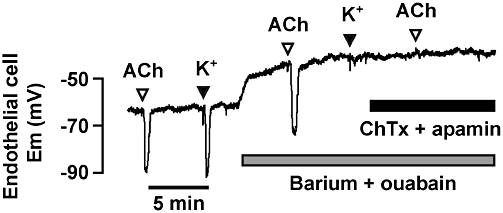
Hyperpolarization of impaled endothelial cells to bolus additions of ACh (10 µM) and K+ (5 mM) in isolated, pinned and superfused rat hepatic arteries. The combination of barium (30 µM, to block KIR channels) and ouabain (1 mM, to inhibit the Na+/K+-ATPase) fully blocked hyperpolarization to K+, but not to ACh. In separate experiments, this combination blocked smooth muscle cell hyperpolarization to ACh (not shown). The KCa channel blockers charybdotoxin (ChTx; 100 nM) and apamin (100 nM), abolished both endothelial cell (shown) and smooth muscle cell (not shown) hyperpolarization to ACh. First published in Edwards et al. (1998).
Figure 2
Figure 2
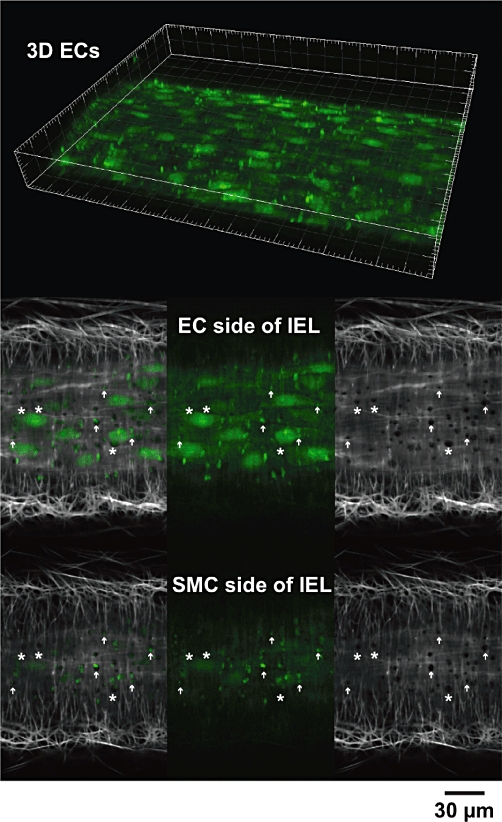
Confocal micrographs of endothelial cells (ECs) in an artery. The fluorescent Ca2+ indicator Oregon Green 488 BAPTA-1 was loaded into ECs (green) of a pressurized rat mesenteric artery. Serial images through the z-axis allowed 3D reconstruction of the artery wall (top) where bright EC projections were clearly visible. Frame major ticks 20 µm. Following visualization of the internal elastic lamina (IEL, grey scale) with Alexa 633 hydrazide, single image planes collected 2 µm apart at the EC and smooth muscle cell (SMC) side of the IEL (lower panels) showed the projections passed towards the SMCs (arrows). These projections are sites where myoendothelial gap junctions may form. Note that not all holes were associated with EC staining (asterisks) (P. Yarova, unpubl. data).
Figure 3
Figure 3
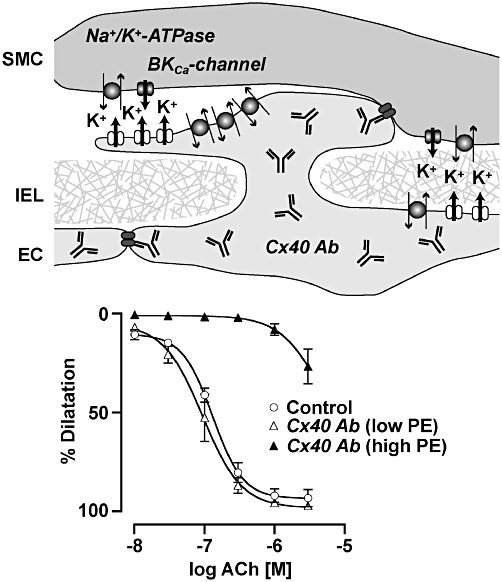
Antibodies targeted to connexin 40 (Cx40 Ab) can inhibit endothelium-dependent hyperpolarization-mediated dilatation responses. Cx40 Abs were loaded into endothelial cells (ECs) of pressurized rat mesenteric arteries and inhibited cell–cell coupling via Cx40 expressed at both EC–EC and myoendothelial gap junctions. An effect against ACh was only observed when the concentration of phenylephrine (PE) used to generate tone was high. This may be due to an ability of a true endothelium-dependent hyperpolarizing factor such as K+ to independently act of electrical coupling via the smooth muscle cell (SMC) Na+/K+-ATPase. At high concentrations, PE activates BKCa-channels which can prevent further activation of the Na+/K+-ATPase, possibly due to a ‘K+ cloud’. Modified from Mather et al. (2005). IEL, internal elastic lamina.
Figure 4
Figure 4
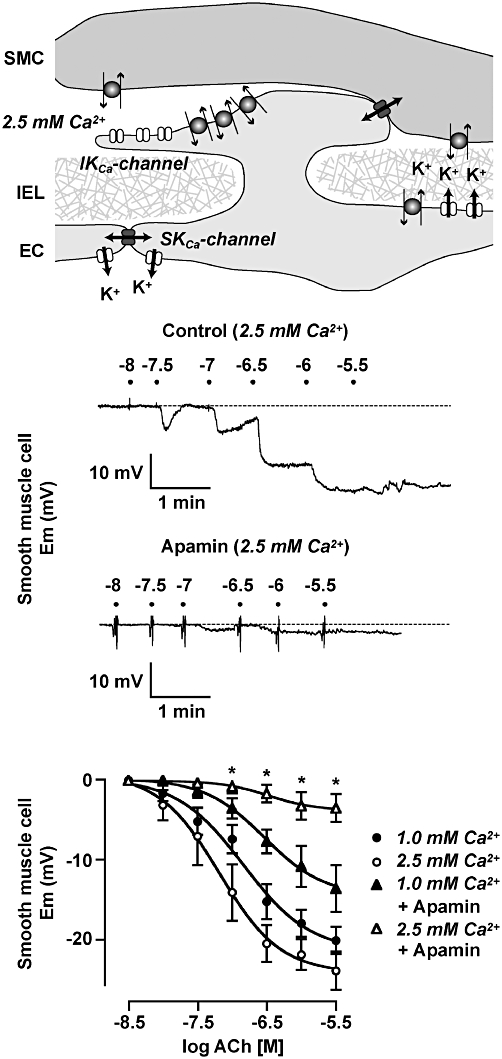
Role for SKCa channels in endothelium-dependent hyperpolarization responses depends on the extracellular Ca2+ concentration. In rat mesenteric arteries, SKCa (KCa2.3) channels are highly expressed at endothelial cell (EC) borders and to a limited extent, in the EC projections through the internal elastic lamina (IEL). In contrast, IKCa (KCa3.1) channels appear confined to the EC projection microdomain (top panel). The hyperpolarization to ACh when extracellular [Ca2+] is held at 2.5 mM is fully blocked by apamin (middle panels), but not so when extracellular Ca2+ is reduced to 1 mM (bottom panel). Modified from Crane et al. (2003); Dora et al. (2008). SMC, smooth muscle cell.

References

    1. Absi M, Burnham MP, Weston AH, Harno E, Rogers M, Edwards G. Effects of methyl beta-cyclodextrin on EDHF responses in pig and rat arteries; association between SK(Ca) channels and caveolin-rich domains. Br J Pharmacol. 2007;151:332–340. - PMC - PubMed
    1. Adeagbo AS, Triggle CR. Varying extracellular [K+]: a functional approach to separating EDHF- and EDNO-related mechanisms in perfused rat mesenteric arterial bed. J Cardiovasc Pharmacol. 1993;21:423–429. - PubMed
    1. Alexander SPH, Mathie A, Peters JA. Guide to Receptors and Channels (GRAC) Br J Pharmacol. (4th edn.) 2009;158(Suppl 1):S1–S254. - PMC - PubMed
    1. Anggard EE. The endothelium – the body's largest endocrine gland? J Endocrinol. 1990;127:371–375. - PubMed
    1. Atkinson J, Tatchum-Talom R, Capdeville-Atkinson C. Reduction of endothelial function with age in the mesenteric arterial bed of the normotensive rat. Br J Pharmacol. 1994;111:1184–1188. - PMC - PubMed

Publication types

MeSH terms

Substances