Comparative Study
. 2011 Feb;79(2):937-49.
doi: 10.1128/IAI.00445-10. Epub 2010 Dec 6.

Comparison of a regulated delayed antigen synthesis system with in vivo-inducible promoters for antigen delivery by live attenuated Salmonella vaccines

Affiliations
Comparative Study

Comparison of a regulated delayed antigen synthesis system with in vivo-inducible promoters for antigen delivery by live attenuated Salmonella vaccines

Shifeng Wang et al. Infect Immun. 2011 Feb.

Abstract

Induction of strong immune responses against a vectored antigen in hosts immunized with live attenuated Salmonella vaccines is related in part to the amount of antigen delivered and the overall fitness of the Salmonella vector in relation to its ability to stimulate the host immune system. Constitutive high-level antigen synthesis causes a metabolic burden to the vaccine vector strain that can reduce the vaccine strain's ability to interact with host lymphoid tissues, resulting in a compromised immune response. A solution to this problem is the use of systems that regulate antigen gene expression, permitting high levels of antigen synthesis only after the vaccine strain has reached its target tissues. In vivo-inducible promoters (IVIPs) are often used to accomplish this. We recently developed an alternative strategy, a regulated delayed antigen synthesis (RDAS) system, in which the LacI-repressible P(trc) promoter controls antigen gene expression by adding arabinose. In this paper, we compared the RDAS system with two commonly used IVIPs, P(ssaG) and P(pagC). Three nearly identical plasmids, differing only in the promoter used to direct transcription of the pneumococcal pspA gene, P(trc), P(ssaG), or P(pagC), were constructed and introduced into isogenic Salmonella vaccine strains with or without arabinose-inducible LacI synthesis. Mice immunized with the RDAS strain developed slightly higher titers of mucosal and serum anti-PspA antibodies than P(pagC)-immunized mice, while titers in mice immunized with the P(ssaG) strain were 100-fold lower. Both the RDAS and P(pagC) strains conferred similar levels of protection against Streptococcus pneumoniae challenge, significantly greater than those for the P(ssaG) strain or controls. Thus, RDAS provides another choice for inclusion in the live vaccine design to increase immunogenicity.


Figures
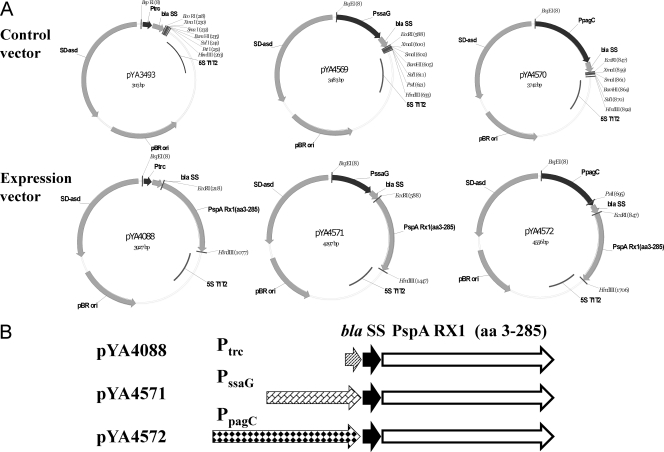
FIG. 1.
FIG. 1.
Recombinant plasmids for pspA expression. (A) Maps of recombinant plasmids pYA3493 (Ptrc), pYA4569 (PssaG), pYA4570 (PpagC), pYA4088 (Ptrc pspA), pYA4571 (PssaG pspA), and pYA4572 (PpagC pspA). (B) Schematic diagram of the promoter, secretion signal, and antigens. Black arrows, β-lactamase secretion signal; white arrows, pspA (amino acids 3 to 285); other arrows, indicated promoters.
FIG. 2.
FIG. 2.
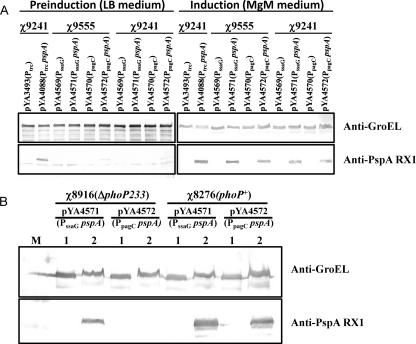
PspA synthesis in S. Typhimurium vaccine strains. Sample preparation and the Western blot procedure are described in Materials and Methods. Nitrocellulose membranes were probed with polyclonal antibodies specific for either PspA or GroEL. GroEL was used as a standardization marker. Relevant portions of each blot are shown. (A) Western blots showing PspA and GroEL synthesis in strains χ9241 and χ9555 harboring the indicated plasmids. (B) PspA synthesis in S. Typhimurium vaccine strains with or without phoP mutation. The Western blot shows PspA and GroEL synthesis in ΔphoP strains χ8916(pYA4571) (PssaG pspA) and χ8916(pYA4572) (PpagC pspA) and PhoP+ strains χ8276(pYA4571) (PssaG pspA) and χ8276(pYA4572) (PpagC pspA). M, protein marker. Lane 1, cells grown in LB medium (preinduction sample); lane 2, cells grown in MgM medium (induction sample).
FIG. 3.
FIG. 3.
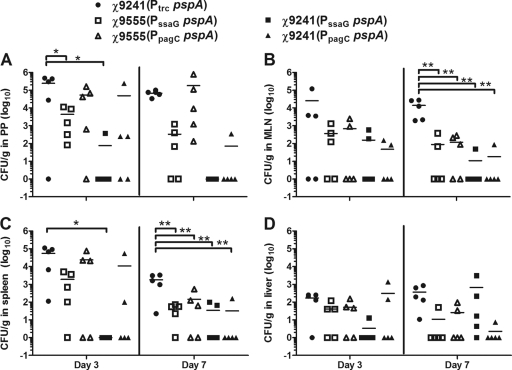
Colonization of BALB/c mice by attenuated S. Typhimurium vaccine strains. Bacterial numbers shown are recovered from PPs (A), MLNs (B), spleens (C), and livers (D) at 3 and 7 days postinoculation. For representation in graphic and statistical analysis, log10 was applied to the values. For graphic and statistical analysis, an entry of 1 CFU/g was listed in cases where no bacteria were recovered from a given tissue. The horizontal lines represent the means of each data set. Significant differences between groups are indicated and were determined using one-way analysis of variance (ANOVA) and Tukey's tests (*, P < 0.05; **, P < 0.01).
FIG. 4.
FIG. 4.
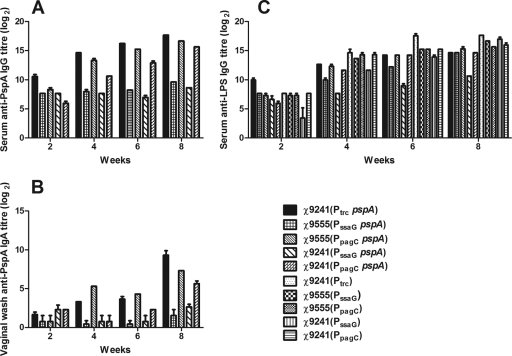
Reciprocal antibody titers in immunized mice. (A) Serum IgG against rPspA; (B) mucosal IgA against rPspA; (C) serum IgG against S. Typhimurium LPS. Mice were orally immunized with approximately 1 × 10⁹ CFU of the indicated strains. Serum and mucosal antibody titers in pooled samples were determined by ELISA. The data represent antibody in pooled sera from mice orally immunized with attenuated Salmonella harboring either control vector plasmids or pspA expression plasmids. The error bars represent the standard deviations.
FIG. 5.
FIG. 5.
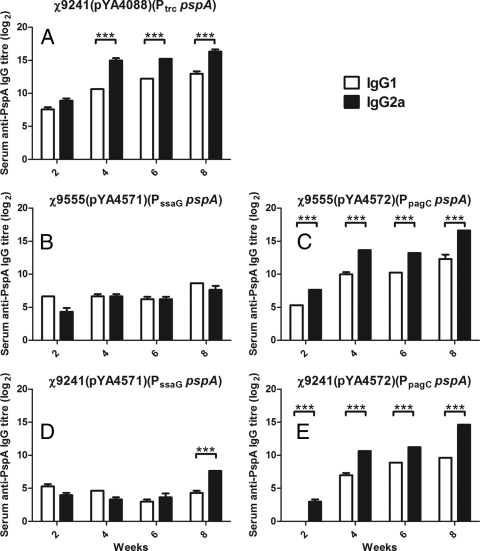
Serum IgG1 and IgG2a responses to rPspA in mice orally immunized with χ9241(pYA4088) (A), χ9555(pYA4571) (B), χ9555(pYA4572) (C), χ9241(pYA4571) (D), or χ9241(pYA4572) (E). Levels of IgG1 and IgG2a were determined in pooled serum samples by ELISA. The error bars represent the standard deviations. ***, P < 0.001.
FIG. 6.
FIG. 6.
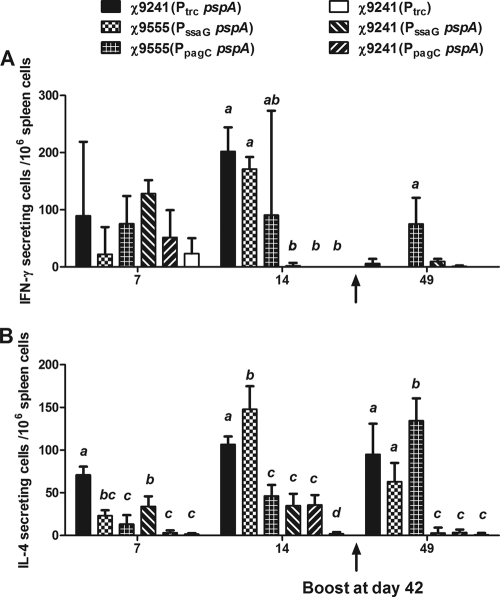
PspA-specific cytokine stimulation in mice immunized with χ9241(pYA3493) (Ptrc), χ9241(pYA4088) (Ptrc pspA), χ9555(pYA4571) (PssaG pspA), χ9555(pYA4572) (PpagC pspA), χ9241(pYA4571), and χ9241(pYA4572). Numbers of IFN-γ-producing (A) and IL-4-producing (B) cells were determined by ELISPOT assay. Splenectomies were performed on euthanized mice 7, 14, and 49 days after the first immunization. Splenocytes were harvested from three mice per group, and cells from each spleen were assayed in duplicate. The results from each well are expressed as ELISPOTs per million splenocytes minus the background (typically approximately 15 spots) from unpulsed mock controls. Significant differences between groups are indicated and were determined using one-way ANOVA and Tukey's tests. Groups with different letters are statistically different (P < 0.05). Groups with no letters or the same letters were not different.

References

    1. Altboum, Z., E. M. Barry, G. Losonsky, J. E. Galen, and M. M. Levine. 2001. Attenuated Shigella flexneri 2a ΔguaBA strain CVD 1204 expressing enterotoxigenic Escherichia coli (ETEC) CS2 and CS3 fimbriae as a live mucosal vaccine against Shigella and ETEC infection. Infect. Immun. 69:3150-3158. - PMC - PubMed
    1. Altboum, Z., M. M. Levine, J. E. Galen, and E. M. Barry. 2003. Genetic characterization and immunogenicity of coli surface antigen 4 from enterotoxigenic Escherichia coli when it is expressed in a Shigella live-vector strain. Infect. Immun. 71:1352-1360. - PMC - PubMed
    1. Angelakopoulos, H., and E. L. Hohmann. 2000. Pilot study of phoP/phoQ-deleted Salmonella enterica serovar Typhimurium expressing Helicobacter pylori urease in adult volunteers. Infect. Immun. 68:2135-2141. - PMC - PubMed
    1. Belden, W. J., and S. I. Miller. 1994. Further characterization of the PhoP regulon: identification of new PhoP-activated virulence loci. Infect. Immun. 62:5095-5101. - PMC - PubMed
    1. Bertani, G. 1951. Studies on lysogenesis. I. The mode of phage liberation by lysogenic Escherichia coli. J. Bacteriol. 62:293-300. - PMC - PubMed

Publication types

LinkOut - more resources