


Partial sleep deprivation reduces phase advances to light in humans
- PMID: 21135162
- PMCID: PMC3020570
- DOI: 10.1177/0748730410385544
Partial sleep deprivation reduces phase advances to light in humans
Abstract
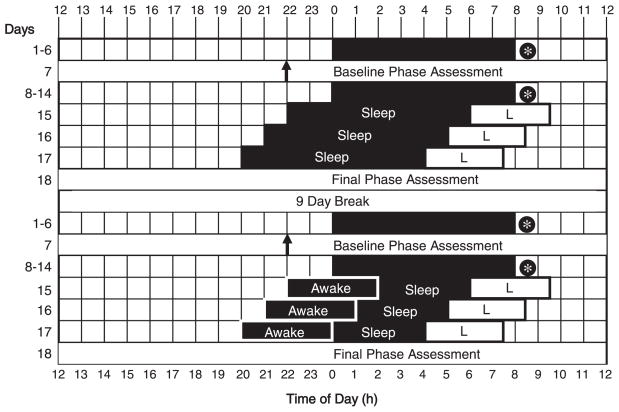
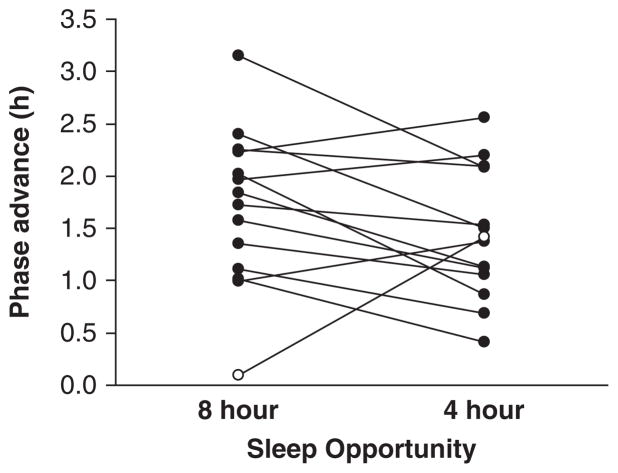
Partial sleep deprivation is increasingly common in modern society. This study examined for the first time if partial sleep deprivation alters circadian phase shifts to bright light in humans. Thirteen young healthy subjects participated in a repeated-measures counterbalanced design with 2 conditions. Each condition had baseline sleep, a dim-light circadian phase assessment, a 3-day phase-advancing protocol with morning bright light, then another phase assessment. In one condition (no sleep deprivation), subjects had an 8-h sleep opportunity per night during the advancing protocol. In the other condition (partial sleep deprivation), subjects were kept awake for 4 h in near darkness (<0.25 lux), immediately followed by a 4-h sleep opportunity per night during the advancing protocol. The morning bright light stimulus was four 30-min pulses of bright light (~5000 lux), separated by 30-min intervals of room light. The light always began at the same circadian phase, 8 h after the baseline dim-light melatonin onset (DLMO). The average phase advance without sleep deprivation was 1.8 ± 0.6 (SD) h, which reduced to 1.4 ± 0.6 h with partial sleep deprivation (p < 0.05). Ten of the 13 subjects showed reductions in phase advances with partial sleep deprivation, ranging from 0.2 to 1.2 h. These results indicate that short-term partial sleep deprivation can moderately reduce circadian phase shifts to bright light in humans. This may have significant implications for the sleep-deprived general population and for the bright light treatment of circadian rhythm sleep disorders such as delayed sleep phase disorder.
Figures
References
-
- Beck AT, Ward CH, Mendelson M, Mock J, Erbaugh J. An inventory for measuring depression. Arch Gen Psychiatry. 1961;4:53–63. - PubMed
-
- Boivin DB, Czeisler CA, Dijk DJ, Duffy JF, Folkard S, Minors DS, Totterdell P, Waterhouse JM. Complex interaction of the sleep-wake cycle and circadian phase modulates mood in healthy subjects. Arch Gen Psychiatry. 1997;54:145–152. - PubMed
Publication types
MeSH terms
Grants and funding
LinkOut - more resources
Full Text Sources
