. 2011 Feb;55(2):696-702.
doi: 10.1128/AAC.01419-10. Epub 2010 Dec 6.

Identification of high-affinity PB1-derived peptides with enhanced affinity to the PA protein of influenza A virus polymerase

Affiliations

Identification of high-affinity PB1-derived peptides with enhanced affinity to the PA protein of influenza A virus polymerase

Kerstin Wunderlich et al. Antimicrob Agents Chemother. 2011 Feb.

Abstract

The influenza A virus polymerase complex, consisting of the subunits PB1, PB2, and PA, represents a promising target for the development of new antiviral drugs. We have previously demonstrated the feasibility of targeting the protein-protein interaction domain between PA and PB1 using peptides derived from the extreme N terminus of PB1 (amino acids [aa] 1 to 15), comprising the PA-binding domain of PB1. To increase the binding affinity of these peptides, we performed a systematic structure-affinity relationship analysis. Alanine and aspartic acid scans revealed that almost all amino acids in the core binding region (aa 5 to 11) are indispensable for PA binding. Using a library of immobilized peptides representing all possible single amino acid substitutions, we were able to identify amino acid positions outside the core PA-binding region (aa 1, 3, 12, 14, and 15) that are variable and can be replaced by affinity-enhancing residues. Surface plasmon resonance binding studies revealed that combination of several affinity-enhancing mutations led to an additive effect. Thus, the feasibility to enhance the PA-binding affinity presents an intriguing possibility to increase antiviral activity of the PB1-derived peptide and one step forward in the development of an antiviral drug against influenza A viruses.


Figures
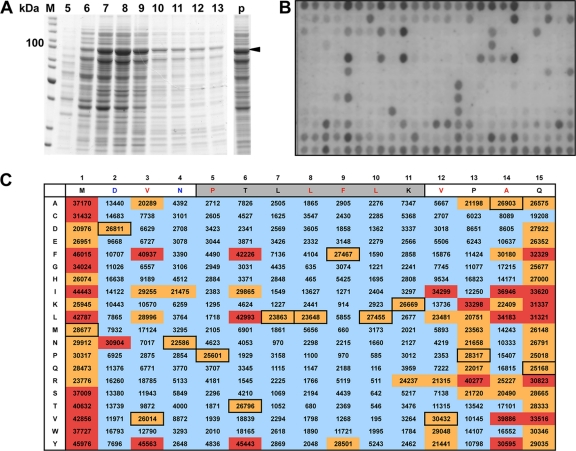
FIG. 1.
FIG. 1.
Binding characteristics of PA-HA to PB11-15 derivatives in an analogue peptide array. (A) Partial purification of PA-HA from yeast. C-terminally HA-tagged PA from A/WSN/33 was expressed in yeast, purified from the soluble fraction by anion-exchange chromatography via a Q-Sepharose column and analyzed for its purity by SDS-PAGE and subsequent Coomassie blue staining. Elution fractions 5 to 13 are shown. The arrow indicates the position of PA-HA. (B) Binding of PA-HA to immobilized PB11-15. An array with PB11-15 peptides harboring single amino acid substitutions as indicated in C was incubated with partially purified PA-HA (pooled fraction 6 to 9) from panel A. Bound PA-HA was detected by an HA-specific antibody and an AP-coupled secondary antibody. (C) Quantification of the signals on the peptide array in panel B. The PB11-15 wt sequence is shown horizontally; individual amino acid substitutions are shown vertically. Amino acids that mediate hydrogen bonds in the wt sequence are in blue letters; amino acids that mediate hydrophobic contacts are in red letters. The gray shading indicates the 310-helix. Numbers in black boxes represent wt peptide sequences, for which the mean is 26,427 with a standard deviation of 2,050. Quantifications of the signals of the array are categorized as <20,000 (blue shading), 20,000 to 30,500 (orange shading, including wt sequences), and >30,500 (red shading representing an increase in signal compared to wt sequences).
FIG. 2.
FIG. 2.
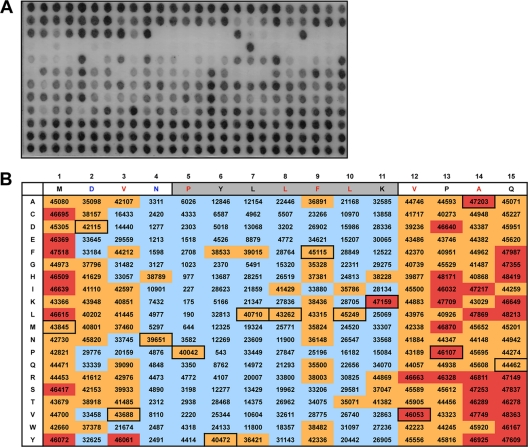
Binding characteristics of PA-HA to PB11-15T6Y derivatives in an analogue peptide array. (A) A peptide array with single point mutations in PB11-15T6Y as shown in panel B was incubated with partially purified PA-HA as described in Fig. 1. (B) Quantification of the signal intensities of the peptide array shown in panel A. The PB11-15T6Y sequence is shown horizontally; the individual amino acid substitutions are shown vertically. Labeling is identical with Fig. 1C except for the categories of quantifications: signals of the array are categorized as <35,000 (blue shading), 35,000 to 46,000 (orange shading, includes parent sequences PB11-15T6Y), and >46,000 (red shading representing an increase in signal compared to PB11-15T6Y sequences). The mean of the PB11-15T6Y sequences is 42,675 with a standard deviation of 2,596.
FIG. 3.
FIG. 3.
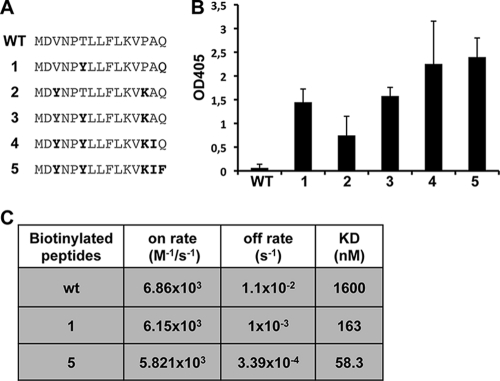
PB1 peptides with several affinity enhancing amino acid substitutions show limited increase in PA-binding. (A) Sequences of the biotinylated peptides with the sequential combination of the affinity-enhancing mutations. (B) Binding of PA-HA (A/WSN/33) to immobilized peptides was determined by ELISA. Shown are mean optical density at 405 nm (OD405) values from four independent experiments. The OD405 values represent the increase in bound PA-HA compared to a scrambled peptide. Error bars represent the standard deviations. Note that the PB11-15 wt shows only a slight increase compared to binding background. As a positive control, PB11-25 wt was used (not shown). These settings were chosen because they allow discrimination of high binding efficiencies. (C) Binding kinetics between PA-His and the indicated biotinylated peptides were determined by SPR. KD, dissociation constant.

References

    1. Biswas, S. K., and D. P. Nayak. 1996. Influenza virus polymerase basic protein 1 interacts with influenza virus polymerase basic protein 2 at multiple sites. J. Virol. 70:6716-6722. - PMC - PubMed
    1. Dias, A., et al. 2009. The cap-snatching endonuclease of influenza virus polymerase resides in the PA subunit. Nature 458:914-918. - PubMed
    1. Eckert, D. M., V. N. Malashkevich, L. H. Hong, P. A. Carr, and P. S. Kim. 1999. Inhibiting HIV-1 entry: discovery of D-peptide inhibitors that target the gp41 coiled-coil pocket. Cell 99:103-115. - PubMed
    1. Frank, R., and H. Overwin. 1996. SPOT synthesis. Epitope analysis with arrays of synthetic peptides prepared on cellulose membranes. Methods Mol. Biol. 66:149-169. - PubMed
    1. Ghanem, A., et al. 2007. Peptide-mediated interference with influenza A virus polymerase. J. Virol. 81:7801-7804. - PMC - PubMed

Publication types