


Reliability of bony anatomic landmark asymmetry assessment in the lumbopelvic region: application to osteopathic medical education
- PMID: 21135198
- PMCID: PMC3124075
Reliability of bony anatomic landmark asymmetry assessment in the lumbopelvic region: application to osteopathic medical education
Abstract
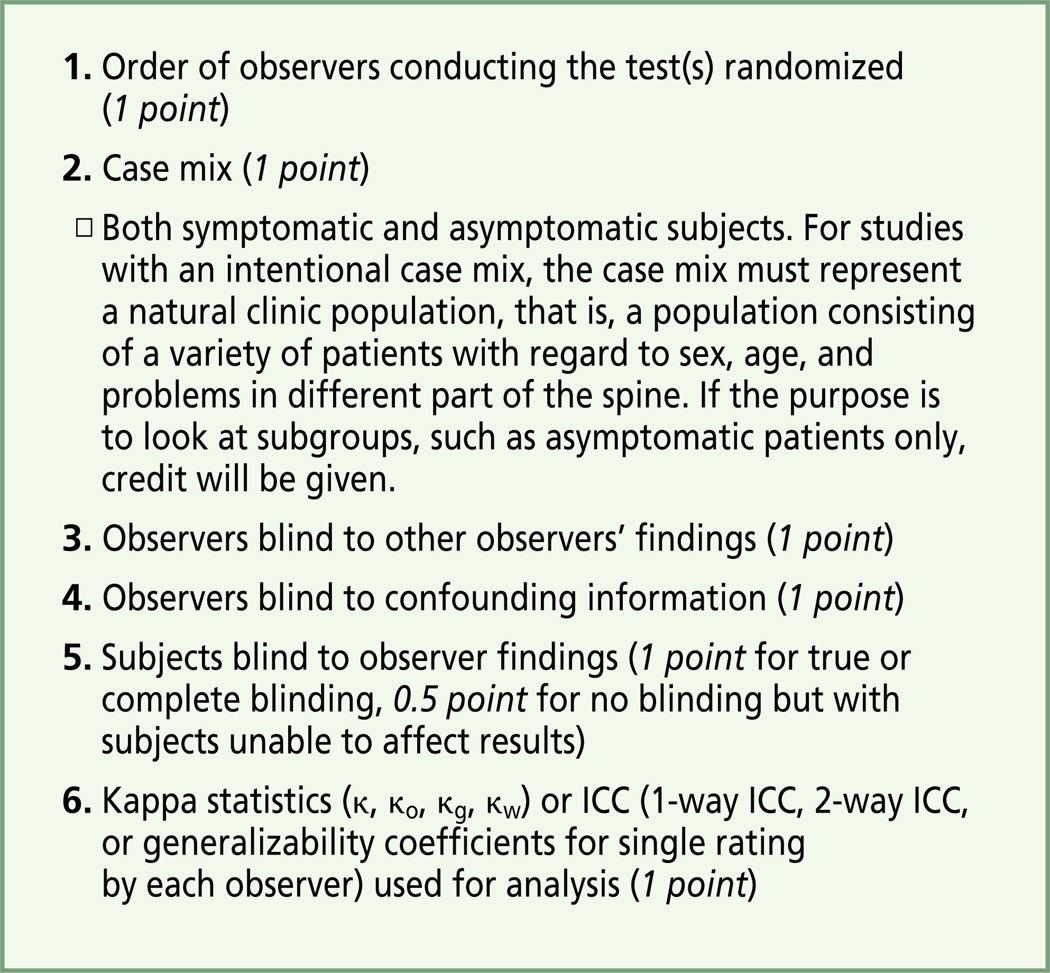
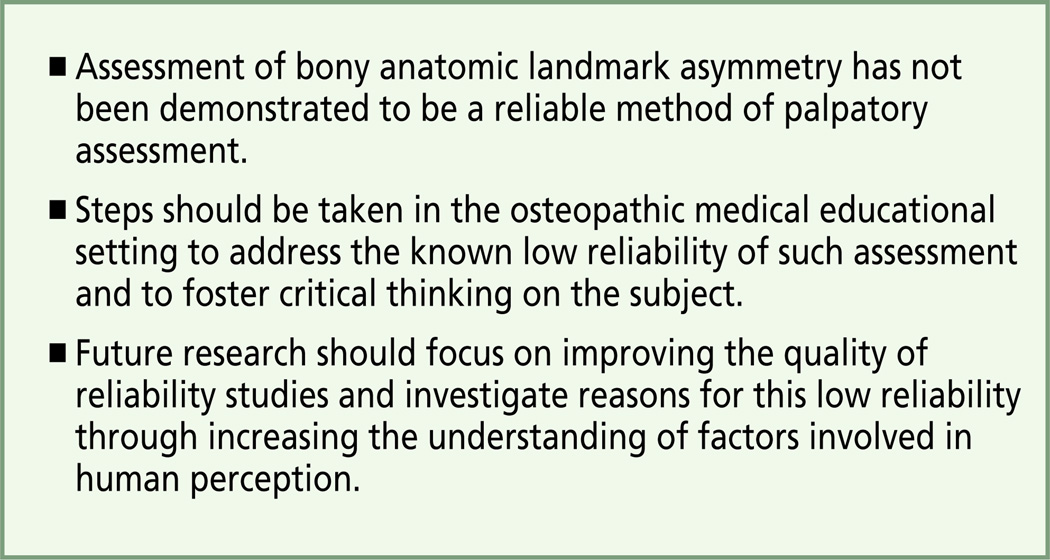
The objective of this review is to establish the current state of knowledge on the reliability of clinical assessment of asymmetry in the lumbar spine and pelvis. To search the literature, the authors consulted the databases of MEDLINE, CINAHL, AMED, MANTIS, Academic Search Complete, and Web of Knowledge using different combinations of the following keywords: palpation, asymmetry, inter or intraexaminer reliability, tissue texture, assessment, and anatomic landmark. Of the 23 studies identified, 14 did not meet the inclusion criteria and were excluded. The quality and methods of studies investigating the reliability of bony anatomic landmark asymmetry assessment are variable. The κ statistic ranges without training for interexaminer reliability were as follows: anterior superior iliac spine (ASIS), -0.01 to 0.19; posterior superior iliac spine (PSIS), 0.04 to 0.15; inferior lateral angle, transverse plane (ILA-A/P), -0.03 to 0.11; inferior lateral angles, coronal plane (ILA-S/I), -0.01 to 0.08; sacral sulcus (SS), -0.4 to 0.37; lumbar spine transverse processes L1 through L5, 0.04 to 0.17. The corresponding ranges for intraexaminer reliability were higher for all associated landmarks: ASIS, 0.19 to 0.4; PSIS, 0.13 to 0.49; ILA-A/P, 0.1 to 0.2; ILA-S/I, 0.03 to 0.21; SS, 0.24 to 0.28; lumbar spine transverse processes L1 through L5, not applicable. Further research is needed to better understand the reliability of asymmetry assessment methods in manipulative medicine.
Figures
References
-
- Isaacs ER, Bookhout MR, Bourdillon JF. Bourdillon’s Spinal Manipulation. 6th ed. Woburn, MA: Butterworth-Heinemann; 2002.
-
- Greenman PE. Principles of Manual Medicine. 3rd ed. Philadelphia, PA: Lippincott Williams & Wilkins; 2003.
-
- Bergmann TF, Peterson DH, Lawrence DJ. Chiropractic Technique: Principles and Procedures. New York, NY: Churchill Livingstone; 1993. p. 803.
-
- Mitchell FL, Mitchell PKG. The Muscle Energy Manual. East Lansing, MI: MET Press; 1995.
-
- Jones LH, Kusunose RS, Goering EK. Strain-Counterstrain. Boise, ID: Jones Strain-CounterStrain; 1995. p. 163.
Publication types
MeSH terms
Grants and funding
LinkOut - more resources
Full Text Sources
Research Materials