. 2010 Dec 21;107(51):22344-9.
doi: 10.1073/pnas.1013145107. Epub 2010 Dec 6.

Gravity-induced PIN transcytosis for polarization of auxin fluxes in gravity-sensing root cells

Affiliations

Gravity-induced PIN transcytosis for polarization of auxin fluxes in gravity-sensing root cells

Jürgen Kleine-Vehn et al. Proc Natl Acad Sci U S A. .

Abstract

Auxin is an essential plant-specific regulator of patterning processes that also controls directional growth of roots and shoots. In response to gravity stimulation, the PIN3 auxin transporter polarizes to the bottom side of gravity-sensing root cells, presumably redirecting the auxin flux toward the lower side of the root and triggering gravitropic bending. By combining live-cell imaging techniques with pharmacological and genetic approaches, we demonstrate that PIN3 polarization does not require secretion of de novo synthesized proteins or protein degradation, but instead involves rapid, transient stimulation of PIN endocytosis, presumably via a clathrin-dependent pathway. Moreover, gravity-induced PIN3 polarization requires the activity of the guanine nucleotide exchange factors for ARF GTPases (ARF-GEF) GNOM-dependent polar-targeting pathways and might involve endosome-based PIN3 translocation from one cell side to another. Our data suggest that gravity perception acts at several instances of PIN3 trafficking, ultimately leading to the polarization of PIN3, which presumably aligns auxin fluxes with gravity vector and mediates downstream root gravitropic response.


Conflict of interest statement

The authors declare no conflict of interest.

Figures
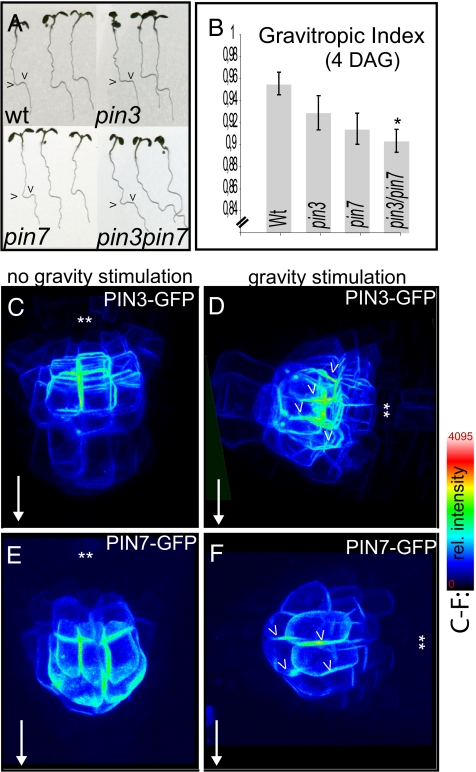
Fig. 1.
Fig. 1.
Redundant pathways for directional auxin efflux in gravity-sensing columella cells. (A and B) The gravitropic response of pin3 pin7 double mutants is reduced compared with wild-type, pin3 or pin7 single mutants (A). Plates were turned twice by 90° (indicated by arrowheads). The gravitropic response was significantly (error bars represent SD; *P < 0.05) affected in pin3 pin7 double mutants as early as 4 d after germination (B). (C–F) Functional PIN3-GFP (C and D) and PIN7-GFP (E and F) transgenic seedlings without (C and E) and with a gravity stimulus for 30 min (D and F). Arrowheads mark the preferential polarization of PIN3-GFP and PIN7-GFP. A semiquantitive color-coded heat-map of z-stack maximum projections (10 sections/each 2 μm) is provided (C–F). Arrows and asterisks indicate the gravity vector and the position of the quiescent center, respectively.
Fig. 2.
Fig. 2.
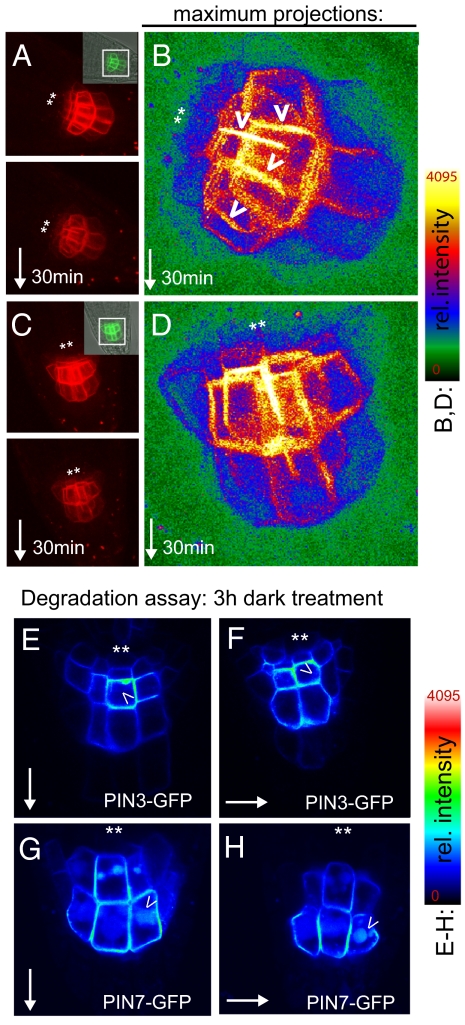
PIN polarization requires recycling. (A–D) Photoconvertible PIN3:PIN3-EosFP–expressing seedlings. PIN3-EosFP (green to red) was photoconverted to track PIN3 proteins independently of secretion (A and C; Inset shows PIN3-EosFP before conversion in green) and subsequently the seedlings were gravity-stimulated by 90° (B). Control seedlings were not stimulated after the photoconversion (D). Maximum projections (z-stack of 10 optical sections; each 2 μm) in conjunction with semiquantitive imaging techniques were used to evaluate the preferential PIN3-EosFP polarization after 30 min of gravity stimulation. (E–H) Vacuolar accumulation of PIN3-GFP (E and F) and PIN7-GFP (G and H) without (E and G) and in the presence of a gravity stimulus (F and H) was addressed with a dark treatment for 3 h. Arrows and asterisks indicate the gravity vector and the position of the quiescent center, respectively. Arrowheads highlight preferential PIN3 polarization (B) or vacuolar accumulation (EH).
Fig. 3.
Fig. 3.
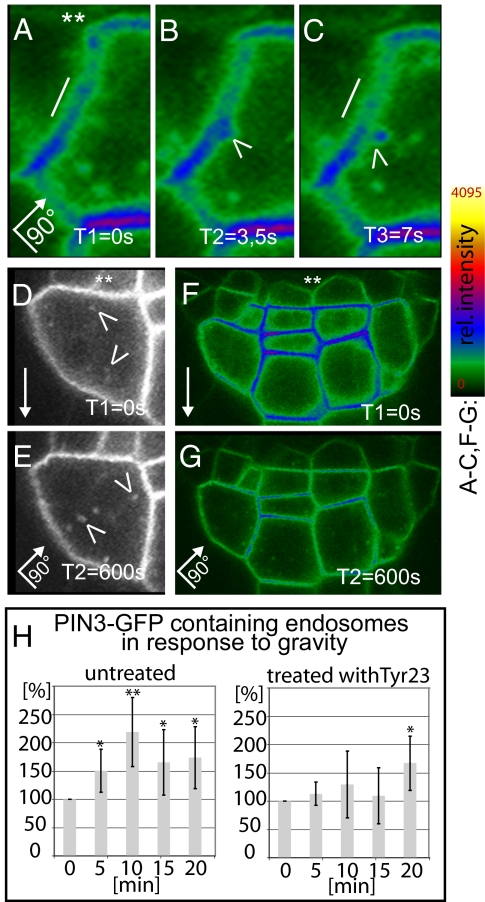
Gravity-induced PIN3 internalization. (A–C) Loss of PIN3-GFP intensity at the plasma membrane was correlated with endosomal proximity. Seedlings were gravity stimulated and frames were taken every 3.5 s. White bars highlight a region of PIN3 internalization and arrowheads mark endosomal proximity. (D and E) Nonstimulated seedlings show weak endosomal PIN3-GFP signal (D). Upon gravity stimulation (600 s), the endosomal PIN3 signal was enhanced (E). (F and G) Individual seedlings were gravity stimulated for 90°. PIN3 signal intensity at the plasma membrane (F) decreased after 600 s of gravity stimulation (G). (H) PIN3-GFP containing endosomes were counted 0, 5, 10, 15, and 20 min after gravity stimulation (n > 30 cells). Tyrphostin A23 treatment partially suppressed gravity-induced PIN3 internalization into endosomes (error bars represent SD; *P < 0.05; **P < 0.001). Arrows mark the gravity vector and asterisks the position of the quiescent center.
Fig. 4.
Fig. 4.
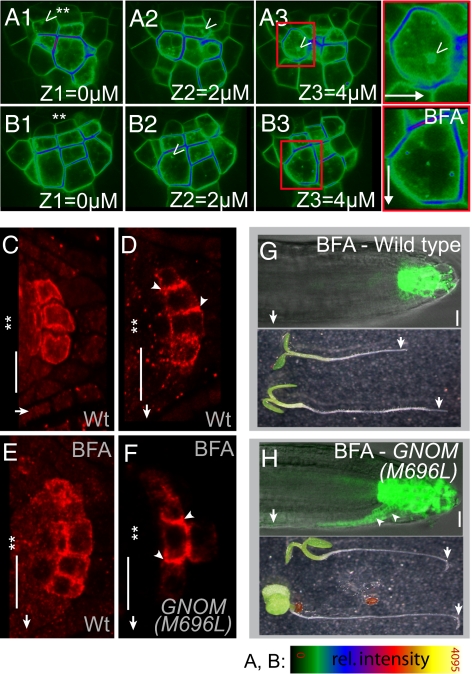
ARF-GEF GNOM regulates PIN3 polarization and asymmetric auxin flow. (A and B) Z-stack analysis of BFA-treated seedlings. Gravity-stimulated seedlings (A) display PIN3-GFP accumulation in BFA compartments (see red inset on the right). Nonstimulated seedlings display reduced BFA-mediated PIN3 accumulation (B). (C–F) Immunolocalization of endogenous PIN3 showed a nonpolar distribution in gravity-sensing columella cells (C), but was polarized strongly within 30 min of gravity stimulation (D). BFA treatment interfered with PIN3 polarization in wild-type (E), but an engineered, BFA-resistant GNOMM696L mutant polarized PIN3 upon a gravity stimulation even in the presence of BFA (F). Arrowheads mark polarized PIN3 signal (D and F). (G and H) BFA treatment interfered with the asymmetric auxin distribution (indirectly visualized by DR5rev::GFP in green) and gravitropic response (G) of wild-type seedlings. In contrast, GNOMM696L mutants displayed BFA-resistant asymmetric auxin distribution and gravitropic response (H). Arrowheads indicate asymmetric redistribution of auxin in response to gravity (H). Arrows and asterisks indicate the gravity vector and the orientation of the quiescent center, respectively. (Scale bars, 10 μm.)
Fig. 5.
Fig. 5.
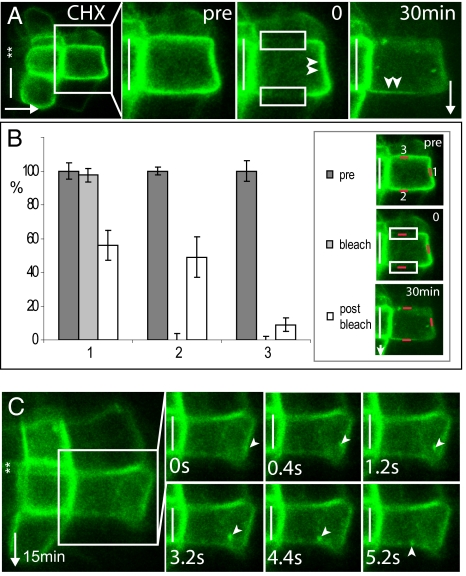
Gravity-induced transcytosis of PIN3. (A and B) CHX-treated seedlings were photobleached and subsequently stimulated with a 90° gravity stimulus for 30 min (A). Arrowheads mark loss of PIN3 signal at the lateral side of the cell and polar recovery in response to gravity at the bottom side of the cell (A). Percentage of fluorescent recovery of PIN3-GFP at different sides of the cell after gravity stimulation (B). FRAP experiment was done on six seedlings and a representative experiment is shown. (C) Seedlings were stimulated for 15 min prior time-lapse analysis. Note the transcytic endomembrane (arrowheads) traveling from the lateral to the new basal cell side. Arrows and asterisks indicate the gravity vector and the position of the quiescent center, respectively. (Scale bars, 5 μm.)

References

    1. Boutté Y, Ikeda Y, Grebe M. Mechanisms of auxin-dependent cell and tissue polarity. Curr Opin Plant Biol. 2007;10:616–623. - PubMed
    1. Robert HS, Offringa R. Regulation of auxin transport polarity by AGC kinases. Curr Opin Plant Biol. 2008;11:495–502. - PubMed
    1. Vanneste S, Friml J. Auxin: A trigger for change in plant development. Cell. 2009;136:1005–1016. - PubMed
    1. Petrásek J, et al. PIN proteins perform a rate-limiting function in cellular auxin efflux. Science. 2006;312:914–918. - PubMed
    1. Wiśniewska J, et al. Polar PIN localization directs auxin flow in plants. Science. 2006;312:883. - PubMed

Publication types

MeSH terms

Substances

LinkOut - more resources