


Examining the relationships between family meal practices, family stressors, and the weight of youth in the family
- PMID: 21136225
- PMCID: PMC3617927
- DOI: 10.1007/s12160-010-9243-z
Examining the relationships between family meal practices, family stressors, and the weight of youth in the family
Abstract
Background: Research is limited on how the social environment of the home is related to childhood obesity.
Purpose: The purpose of this research was to examine the relationships between positive family meal practices, family stressors, and the weight of youth and to examine parental weight status as a moderator of these relationships.
Methods: The study enrolled 368 parent/child dyads from a Minnesota sample. We used mediation analysis to examine the associations
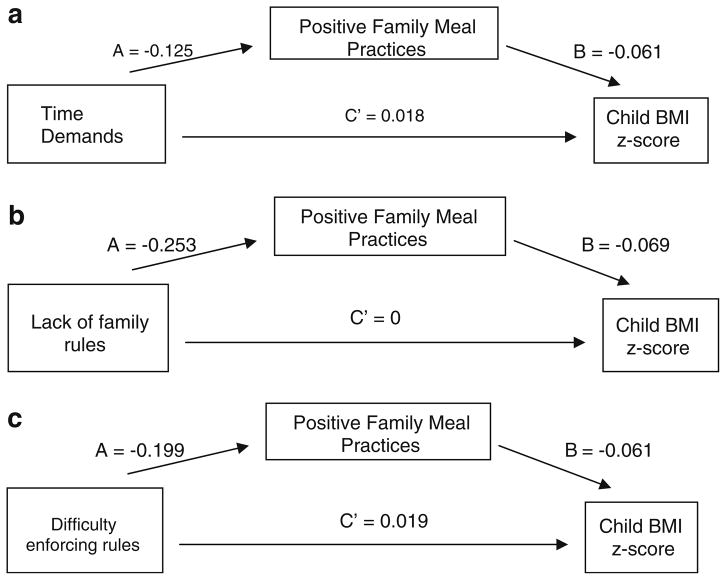
Results: Families represented by an overweight parent reported fewer positive family meal practices (p < 0.001), higher levels of depression (p = 0.01), and fewer family rules (p = 0.02) as compared to families represented by a healthy weight parent. For overweight parents, positive family meal practices mediated the relationship between some family stressors and child weight.
Conclusions: This research suggests that the home environment may affect the weight of children in the family, and the effect is more pronounced in families with at least one overweight parent.
Conflict of interest statement
Figures
References
-
- [Accessed 2006];Changes in Median Household Income: 1969 to 1996. 1998 http://www.census.gov/prod/3/98pubs/p23-196.pdf.
-
- Patrick H, Nicklas TA. A review of family and social determinants of children’s eating patterns and diet quality. J Am Coll Nutr. 2005 Apr;24(2):83–92. - PubMed
-
- Oliveria SA, Ellison RC, Moore LL, Gillman MW, Garrahie EJ, Singer MR. Parent-child relationships in nutrient intake: the Framingham children’s study. American Journal of Clinical Nutrition. 1992;56:593–598. - PubMed
-
- Johnson S, Birch L. Parents’ and children’s adiposity and eating style. Pediatrics. 1994;94:653–661. - PubMed
-
- Gillman MW, Rifas-Shiman S, Frazier AL, et al. Family dinner and diet quality among older children and adolescents. Archives of Family Medicine. 2000;9(3):235–240. - PubMed
