. 2011 Feb 18;286(7):5234-41.
doi: 10.1074/jbc.M110.164848. Epub 2010 Dec 7.

Extending half-life by indirect targeting of the neonatal Fc receptor (FcRn) using a minimal albumin binding domain

Affiliations

Extending half-life by indirect targeting of the neonatal Fc receptor (FcRn) using a minimal albumin binding domain

Jan Terje Andersen et al. J Biol Chem. .

Abstract

The therapeutic and diagnostic efficiency of engineered small proteins, peptides, and chemical drug candidates is hampered by short in vivo serum half-life. Thus, strategies to tailor their biodistribution and serum persistence are highly needed. An attractive approach is to take advantage of the exceptionally long circulation half-life of serum albumin or IgG, which is attributed to a pH-dependent interaction with the neonatal Fc receptor (FcRn) rescuing these proteins from intracellular degradation. Here, we present molecular evidence that a minimal albumin binding domain (ABD) derived from streptococcal protein G can be used for efficient half-life extension by indirect targeting of FcRn. We show that ABD, and ABD recombinantly fused to an Affibody molecule, in complex with albumin does not interfere with the strictly pH-dependent FcRn-albumin binding kinetics. The same result was obtained in the presence of IgG. An in vivo study performed in rat confirmed that the clinically relevant human epidermal growth factor 2 (HER2)-targeting Affibody molecule fused to ABD has a similar half-life and biodistribution profile as serum albumin. The proof-of-concept described may be broadly applicable to extend the in vivo half-life of short lived biological or chemical drugs ultimately resulting in enhanced therapeutic or diagnostic efficiency, a more favorable dosing regimen, and improved patient compliance.


Figures
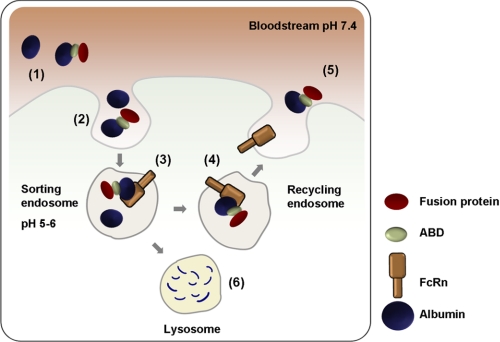
FIGURE 1.
FIGURE 1.
Schematic illustration of ABD-based indirect targeting of FcRn. Schematic represents a hematopoietic or endothelial cell surrounded by blood containing large amounts of albumin (∼40 mg/ml) and a minor fraction of albumin that is associated with an exogenously given ABD fusion protein (1). Both albumin and ABD-associated albumin are continually taken up by fluid phase endocytosis (2). FcRn resides predominantly within acidified intracellular compartments where the pH triggers binding of albumin and ABD-albumin complexes to the FcRn heavy chain. The acidic pH herein does not affect the interaction between ABD and albumin (3). The complex is then recycled back to the cell surface through a pH gradient until it is exposed to the physiological pH of the blood that subsequently disrupts the binding affinity for FcRn (4) followed by release of albumin and ABD-albumin complexes back into the bloodstream (5). Albumin and ABD fusions that escape binding to FcRn within in the acidified recycling compartments will go to lysosomal degradation (6).
FIGURE 2.
FIGURE 2.
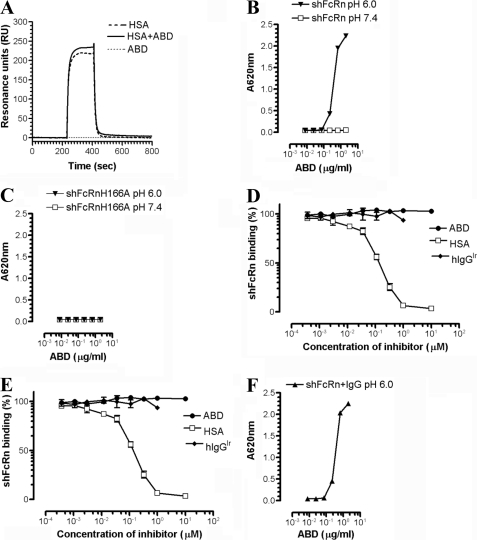
ABD in complex with HSA does not affect the pH-dependent binding of shFcRn to HSA or IgG. A, representative SPR sensorgrams showing the binding responses of 1 μm of monomeric HSA, 2 μm of ABD, and HSA in complex with ABD when injected over immobilized shFcRn (∼1500 RU) at pH 6.0. Injections were performed at a flow rate of 40 μl/min at 25 °C. B, ELISA measurements showing pH-dependent binding of shFcRn to HSA in complex with ABD. C, ELISA measurements showing no binding of shFcRnH166A to HSA in complex with ABD. D, competitive ELISAs show the inhibitory responses of ABD, HSA, and IgGIr on HSA. E, hIgG1NIP binds to shFcRn at pH 6.0. F, ELISA measurements showing pH-dependent binding of shFcRn to HSA in complex with ABD in the presence of hIgG1. The numbers given represent the mean of triplicates.
FIGURE 3.
FIGURE 3.
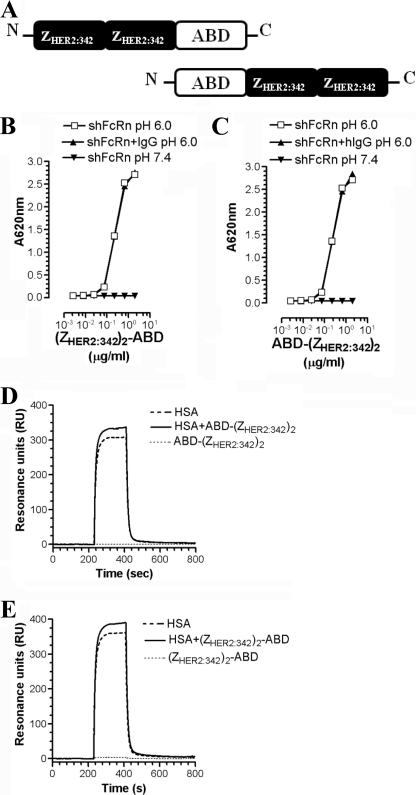
Genetic fusion of bivalent (ZHER2:342)2 to ABD does not interfere with the pH-dependent binding of HSA to shFcRn. A, illustration of the divalent (ZHER2:342)2 fused to the amino- or carboxyl-terminal end of ABD. B, ELISA measurements showing pH-dependent binding of shFcRn to HSA in complex with (ZHER2:342)2-ABD, and C, ABD-(ZHER2:342)2 in the absence or presence of hIgG1 at pH 6.0 and 7.4. The numbers given represent the mean of triplicates. Representative SPR sensorgrams showing the binding responses of 1 μm of monomeric HSA in complex with 2 μm (ZHER2:342)2-ABD (D) and 2 μm ABD-(ZHER2:342)2 (E) when injected over immobilized shFcRn (∼1500 RU) at pH 6.0, flow rate 40 μl/min at 25 °C.
FIGURE 4.
FIGURE 4.
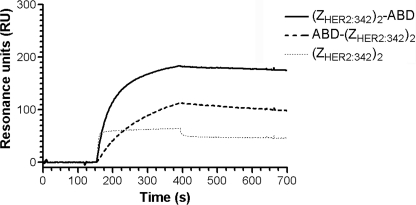
Impact of ABD fusion on HER2 binding. Representative SPR sensorgram showing injections of 80 nm of purified (ZHER2:342)2-ABD, ABD-(ZHER2:342)2, and nonfused (ZHER2:342)2 over immobilized recombinant HER2 (2430 RU) and in the presence of 4 μm HSA. The samples were injected with a flow rate of 50 μl/min at 25 °C.
FIGURE 5.
FIGURE 5.
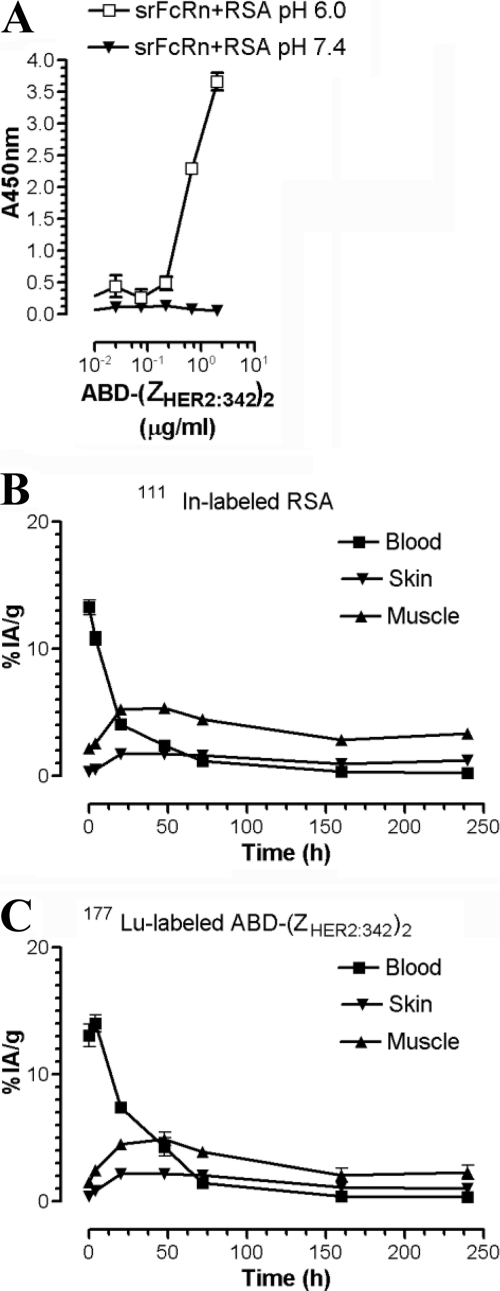
In vivo biodistribution of ABD-fused (ZHER2:342)2 in a preclinical rat model. A, ELISA measurements showing pH-dependent binding of srFcRn to RSA in complex with ABD-(ZHER2:342)2. The numbers given represent the mean of triplicates. The blood, skin, and muscle biodistribution of 111In-labeled-RSA (B) and 177Lu-labeled-ABD-(ZHER2:342)2 (C) in Sprague-Dawley rats (three rats/group and time point). Organ uptake is expressed as percent of injected radioactivity/g (%IA/g), and error bars indicate the S.E. The concentrations are based on the biodistribution data presented in supplemental Table 1 and corrected for interstitial volume as described under “Experimental Procedures.”

References

    1. Binz H. K., Amstutz P., Plückthun A. (2005) Nat. Biotechnol. 23, 1257–1268 - PubMed
    1. Brekke O. H., Sandlie I. (2003) Nat. Rev. Drug Discov. 2, 52–62 - PubMed
    1. McGregor D. P. (2008) Curr. Opin. Pharmacol. 8, 616–619 - PubMed
    1. Nelson A. L., Reichert J. M. (2009) Nat. Biotechnol. 27, 331–337 - PubMed
    1. Harris J. M., Chess R. B. (2003) Nat. Rev. Drug. Discov. 2, 214–221 - PubMed

Publication types

MeSH terms