. 2011 Feb 11;286(6):4165-72.
doi: 10.1074/jbc.M110.186973. Epub 2010 Dec 7.

Convergent potency of internalized gelonin immunotoxins across varied cell lines, antigens, and targeting moieties

Affiliations

Convergent potency of internalized gelonin immunotoxins across varied cell lines, antigens, and targeting moieties

Christopher M Pirie et al. J Biol Chem. .

Abstract

Gelonin-based immunotoxins vary widely in their cytotoxic potency as a function of antigen density, target cell internalization and trafficking kinetics, and conjugate properties. We have synthesized novel gelonin immunotoxins using two different binding scaffold types (single-chain antibody variable fragments and fibronectin domains) targeting two different tumor antigens (carcinoembryonic antigen and EGF receptor). Constructs were characterized using an antigen-negative cell line (HT-1080), cell lines positive for each antigen (HT-1080(CEA) for carcinoembryonic antigen and A431 for EGF receptor), and a cell line positive for both antigens (HT-29). Immunotoxins exhibited K(d) values between 8 and 15 nm and showed 20-2000-fold enhanced cytotoxicity compared with gelonin (IC(50) ∼ 0.25-30 nM versus 500 nM). Using quantitative fluorescence flow cytometry, we measured internalization of gelonin (via pinocytosis) and gelonin-based immunotoxins (via antigen-dependent, receptor-mediated endocytosis). Results were matched with cytotoxicity measurements made at equivalent concentration and exposures. Unexpectedly, when matched internalization and cytotoxicity data were combined, a conserved internalized cytotoxicity curve was generated that was common across experimental conditions. Considerable variations in antigen expression, trafficking kinetics, extracellular immunotoxin concentration, and exposure time were all found to collapse to a single potency curve on the basis of internalized immunotoxin. Fifty percent cytotoxicity occurred when ∼ 5 × 10(6) toxin molecules were internalized regardless of the mechanism of uptake. Cytotoxicity observed at a threshold internalization was consistent with the hypothesis that endosomal escape is a common, highly inefficient, rate-limiting step following internalization by any means tested. Methods designed to enhance endosomal escape might be utilized to improve the potency of gelonin-based immunotoxins.


Figures
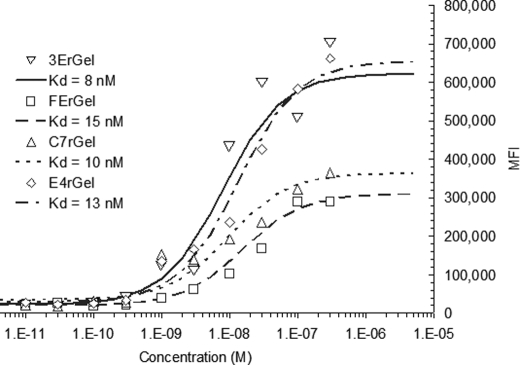
FIGURE 1.
FIGURE 1.
Antigen affinity of binding fragments is retained in their respective immunotoxin constructs. The four immunotoxins target either CEA or EGFR via either scFv or Fn3. The 3E and FE scFv clones targeting CEA, the C7 fibronectin clone targeting CEA, and the E4 fibronectin clone targeting EGFR were each fused to rGel and titrated for binding affinity on HT-1080(CEA) or A431 cells for CEA or EGFR, respectively. Binding on fixed cells was detected with goat anti-biotin-FITC antibody by flow cytometry. Data were fitted using least-squares regression with a binding isotherm, giving Kd values of 8 nm for 3ErGel, 15 nm for FErGel, 10 nm for C7rGel, and 13 nm for E4rGel.
FIGURE 2.
FIGURE 2.
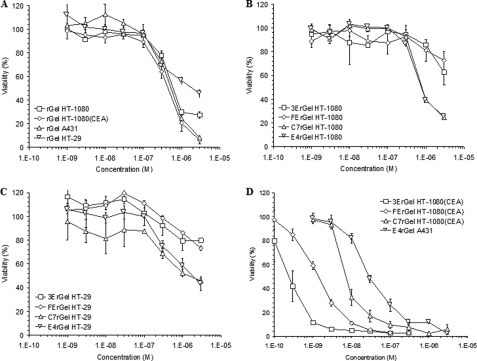
Fusion of scFv and Fn3 binding domains to rGel leads to enhanced cytotoxicity specific for antigen-positive cells. A, using the WST-1 assay, the cytotoxicity of soluble rGel was tested on all four cell lines used in the study. Across all cell lines, rGel showed an IC50 of ∼500 nm. B, antigen-negative cells (HT-1080) were treated with the four different immunotoxins that displayed roughly equivalent potency to soluble toxin. C, immunotoxins were also tested for cytotoxicity on the double-positive, low-antigen density HT-29 cell line. Surprisingly, none of the immunotoxins showed enhanced cytotoxicity compared with the IC50 of rGel. D, on high antigen-expressing cells (HT-1080(CEA) and A431), significantly greater potency was observed for the immunotoxins compared with the soluble toxin. Against cells expressing their respective antigen targets, they had IC50 values of 250 pm for 3ErGel, 1.5 nm for FErGel, 8 nm for C7rGel, and 30 nm for E4rGel.
FIGURE 3.
FIGURE 3.
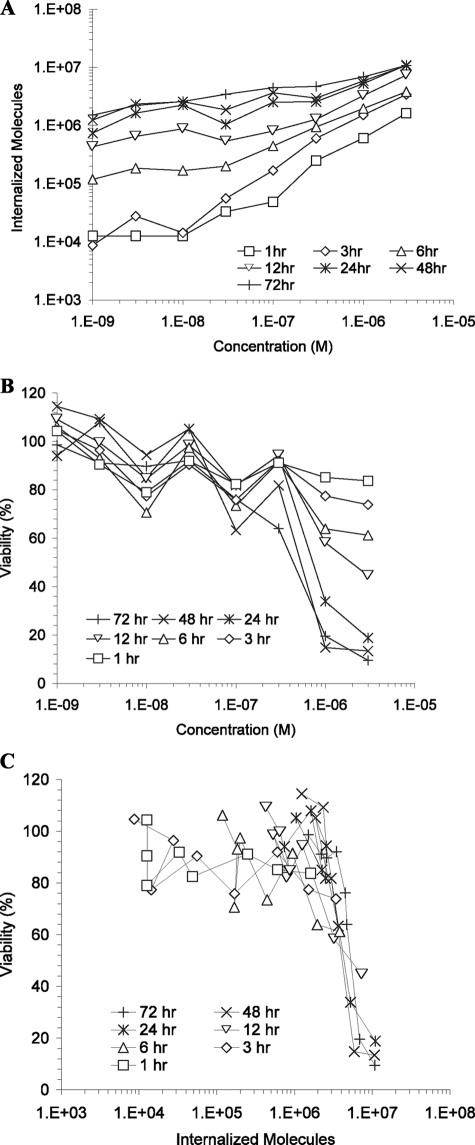
Correlated internalization and cytotoxicity measurements indicate that a precise number of rGel molecules must be internalized by a single cell before cytotoxicity is observed. A, time and concentration dependence of rGel internalization by HT-1080 cells using the described quantitative internalization flow cytometry assay. B, concentration- and exposure-matched cytotoxicity was measured using the WST-1 assay. C, data from A and B were combined and plotted to show the dependence of cytotoxicity on the number of internalized gelonin molecules, resulting in the determination of the TN50 near 5 × 10⁶.
FIGURE 4.
FIGURE 4.
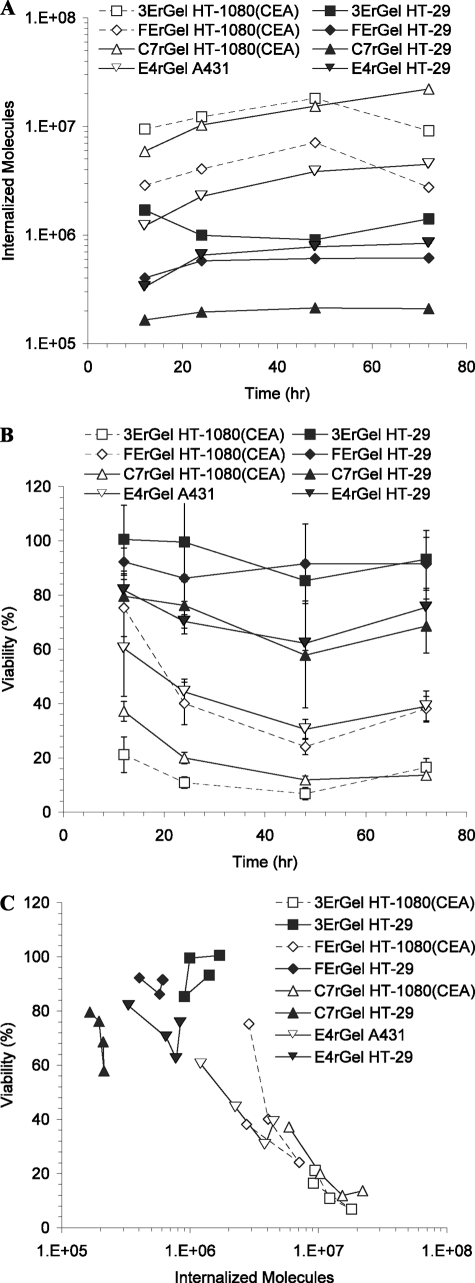
Rate-limiting toxicity step measured in rGel is similarly observed in scFv- and Fn3-targeted immunotoxins using antigen-dependent internalization. A, the internalization of immunotoxins by antigen-positive cells was measured by the quantitative internalization flow cytometry assay at varying times and concentrations. All HT-29 cells treatments were made at 30 nm, as were the C7rGel and E4rGel treatments on HT-1080(CEA) and A431 cells, respectively, whereas the 3ErGel and FErGel treatments on HT-1080(CEA) cells were made at 10 nm. For all treatments, strictly antigen-dependent internalization is reported by subtracting signal from cells blocked with an unlabeled competitor. B, concentration- and exposure-matched cytotoxicity was measured using the WST-1 assay. C, data from A and B were combined and plotted to show the dependence of cytotoxicity on the number of internal immunotoxins, resulting in the determination of the TN50 near 3 × 10⁶ for all species.
FIGURE 5.
FIGURE 5.
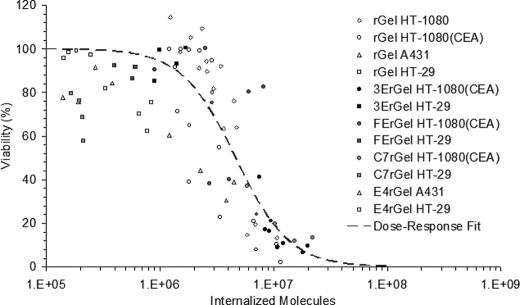
Aggregated data from experiments using different binding scaffolds, antigen targets, affinities, and cell lines all converge to the same TN50 curve. Shown are the accumulated internalized cytotoxicity data for rGel on all cell lines and immunotoxins on high and low antigen-expressing cells. The cumulative data set was fit using an exposure-response curve with variable slopes giving a TN50 of 4.7 × 10⁶.

References

    1. Pastan I., Hassan R., FitzGerald D. J., Kreitman R. J. (2007) Annu. Rev. Med. 58, 221–237 - PubMed
    1. Ackerman M. E., Pawlowski D., Wittrup K. D. (2008) Mol. Cancer Ther. 7, 2233–2240 - PMC - PubMed
    1. Wenning L. A., Murphy R. M. (1999) Biotechnol. Bioeng. 62, 562–575 - PubMed
    1. Thurber G. M., Schmidt M. M., Wittrup K. D. (2008) Adv. Drug Delivery Rev. 60, 1421–1434 - PMC - PubMed
    1. Roberts L. M., Lord J. M. (2004) Mini-Rev. Med. Chem. 4, 505–512 - PubMed

Publication types

MeSH terms