. 2011 Jan 6;364(1):33-42.
doi: 10.1056/NEJMoa1012928. Epub 2010 Dec 9.

The origin of the Haitian cholera outbreak strain

Affiliations

The origin of the Haitian cholera outbreak strain

Chen-Shan Chin et al. N Engl J Med. .

Abstract

Background: Although cholera has been present in Latin America since 1991, it had not been epidemic in Haiti for at least 100 years. Recently, however, there has been a severe outbreak of cholera in Haiti.

Methods: We used third-generation single-molecule real-time DNA sequencing to determine the genome sequences of 2 clinical Vibrio cholerae isolates from the current outbreak in Haiti, 1 strain that caused cholera in Latin America in 1991, and 2 strains isolated in South Asia in 2002 and 2008. Using primary sequence data, we compared the genomes of these 5 strains and a set of previously obtained partial genomic sequences of 23 diverse strains of V. cholerae to assess the likely origin of the cholera outbreak in Haiti.

Results: Both single-nucleotide variations and the presence and structure of hypervariable chromosomal elements indicate that there is a close relationship between the Haitian isolates and variant V. cholerae El Tor O1 strains isolated in Bangladesh in 2002 and 2008. In contrast, analysis of genomic variation of the Haitian isolates reveals a more distant relationship with circulating South American isolates.

Conclusions: The Haitian epidemic is probably the result of the introduction, through human activity, of a V. cholerae strain from a distant geographic source. (Funded by the National Institute of Allergy and Infectious Diseases and the Howard Hughes Medical Institute.).


Figures
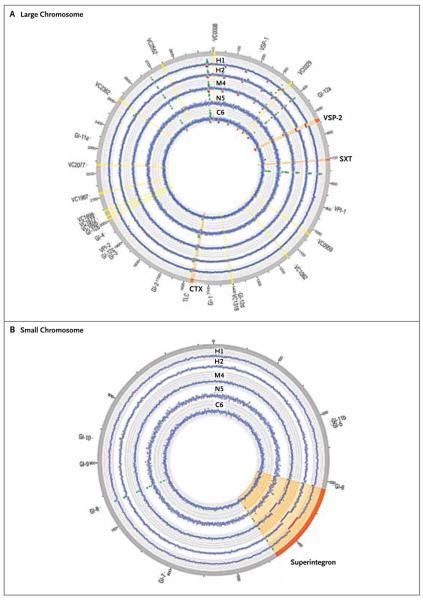
Figure 1
Figure 1. Sequence Depth of Coverage for the Five Vibrio cholerae Isolates
The figure shows the observed sequencing depth of coverage for the five isolates we sequenced (H1, H2, M4, N5, and C6), relative to the published sequence from the two chromosomes of V. cholerae N16961. Areas in the genome in which the read coverage was more than 4 SD higher than the background coverage are plotted with green points (repetitive regions). Areas in the genome in which the read coverage was more than 4 SD lower than the background coverage are plotted with red points (missing segments). Regions in the outer ring show known strain markers that allow the typing of these five isolates with respect to each other and to published strains. The locations of discriminating markers of single-nucleotide variations (SNVs) are shown as yellow bands, and the locations of discriminating mobile elements are shown as orange bands. The identifiers outside the outermost circle correspond to the positions of known mobile elements and strain-specific SNV markers.
Figure 2
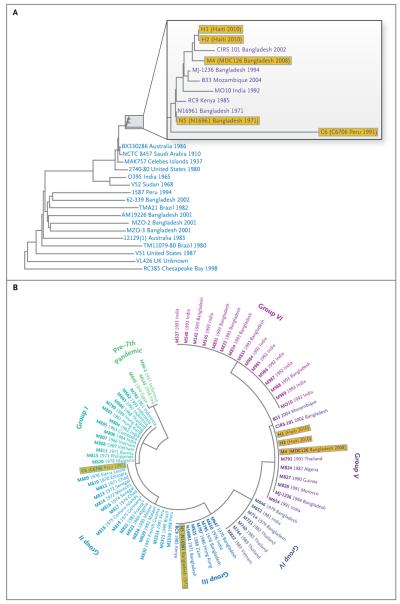
Figure 2. Reconstructing Phylogenetic Relationships among V. cholerae Strains
Panel A shows the phylogenetic relationships among pandemic V. cholerae strains on the basis of single- nucleotide variations identified among all strains for which a set of 1588 orthologous genes has been completely sequenced. The magnified inset represents strains in the seventh pandemic, including H1, H2, M4, C6, and N5. Panel B shows the phylogenetic relationships among a broad set of seventh-pandemic V. cholerae strains. The phylogenetic tree is rooted with three pre-seventh-pandemic strains.
Figure 3
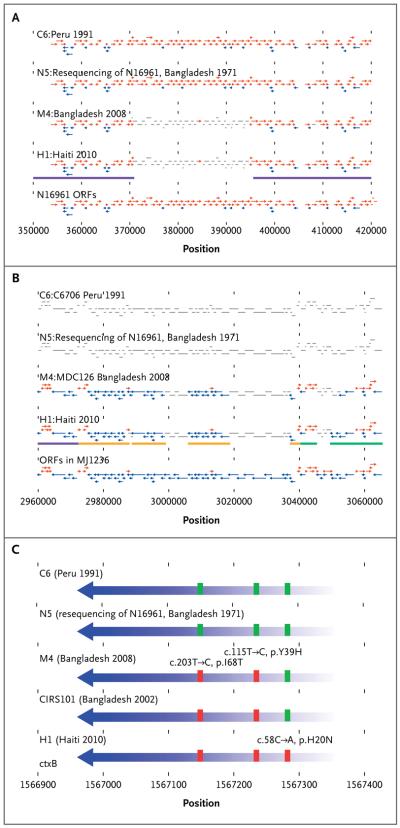
Figure 3. Gene Maps of the Superintegron, SXT, and ctxB Regions in the C6, N5, M4, and H1 V. cholerae Strains
Representations of the coverage with respect to open reading frames (ORFs) in each of these regions are shown. Open reading frames that are shown in red are mapped to the positive strand, and those shown in blue are mapped to the negative strand; gray indicates that the open reading frame was supported by no reads or by a very low number of reads for the indicated sample. Coverages for H1 and H2 were identical over all regions; therefore, only H1 is shown in the figure. Colored bars below the H1 plots indicate the CIRS101 genomic region to which the reference sequence for the indicated element maps. Gaps indicate segments in the reference that are missing from CIRS101. For the SI region (Panel A), no coverage gaps were observed between the N16961 and the C6 and N5 strains, whereas a single coverage gap was observed in M4 and H1 from base positions 370682 to 395783 covering 41 open reading frames. For SXT (Panel B), none of the reads from N5 or C6 mapped to the MJ-1236 SXT reference sequence; in the case of H1, four coverage gaps were observed, covering 27 open reading frames. M4 had three gaps overlapping with three of the H1 gaps, but the M4 gaps covered 4 open reading frames in addition to 25 of the 27 open reading frames covered by the H1 gaps. Also shown (Panel C) is the location of all variant calls found in the cholera enterotoxin subunit B (VC_1456) open reading frame. The boxes indicate three sites in which the alleles represented in H1, CIRS101, and M4 (red) differ from the alleles in the N16961 and C6 sequences (green) and lead to nonsynonymous changes. In Panel C, c denotes the nucleotide position, and p the amino acid position.

References

    1. Cholera vaccines: WHO position paper. Wkly Epidemiol Rec. 2010;85:117–28. - PubMed
    1. Sack DA, Sack RB, Nair GB, Siddique AK. Cholera. Lancet. 2004;363:223–33. - PubMed
    1. Centers for Disease Control and Prevention (CDC) Update: cholera outbreak — Haiti, 2010. MMWR Morb Mortal Wkly Rep. 2010;59:1473–9. - PubMed
    1. Enserink M. Infectious diseases: Haiti's outbreak is latest in cholera's new global assault. Science. 2010;330:738–9. - PubMed
    1. Faruque SM, Albert MJ, Mekalanos JJ. Epidemiology, genetics, and ecology of toxigenic Vibrio cholerae. Microbiol Mol Biol Rev. 1998;62:1301–14. - PMC - PubMed

Publication types