


Externalizing behaviors and cigarette smoking as predictors for use of illicit drugs: a longitudinal study among Finnish adolescent twins
- PMID: 21142931
- PMCID: PMC3596174
- DOI: 10.1375/twin.13.6.550
Externalizing behaviors and cigarette smoking as predictors for use of illicit drugs: a longitudinal study among Finnish adolescent twins
Abstract
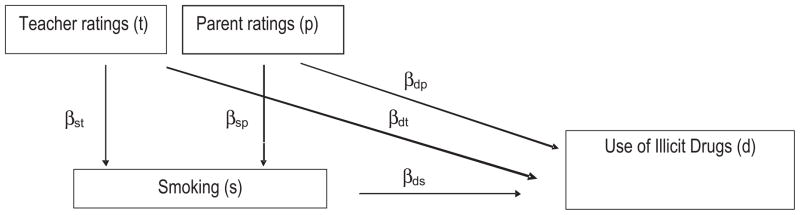
We examined whether externalizing problem behaviors (hyperactivity-impulsivity, aggressiveness, and inattention) predict illicit drug use independently, or whether their associations with drug use are mediated through cigarette smoking. We used a prospective longitudinal design within the FinnTwin12-17 study among Finnish adolescents with baseline at age 12 and follow-up surveys at ages 14 and 17. Path models were conducted with Mplus and included 1992 boys and 2123 girls. The outcome was self-reported ever use of cannabis or other illicit drugs at age 17. The predictors were: externalizing behaviors (hyperactivity-impulsivity, aggressiveness, and inattention) assessed by teachers and parents (age 12) and self-reported cigarette smoking (age 14). The findings differed across behavior studied. The association of hyperactivity-impulsivity with drug use was mostly mediated through earlier cigarette smoking. Concerning aggressiveness and inattention, the results were different among girls than boys. Among girls no significant mediation occurred, whereas among boys more consistent evidence on mediation was seen. Consistently in all models, the direct association of early cigarette smoking on drug use was strong and highly significant. We conclude that the associations of externalizing problem behaviors with illicit drug use are partially mediated through cigarette smoking. Although interventions targeting externalizing problem behaviors may protect adolescents from early onset smoking and subsequently experimenting with drugs, interventions to prevent cigarette smoking initiation are also important in reducing risk of later drug use.
Figures
References
-
- Barman SK, Pulkkinen L, Kaprio J, Rose RJ. Inattentiveness, parental smoking and adolescent smoking initiation. Addiction. 2004;99:1049–1061. - PubMed
-
- Biederman J, Monuteaux MC, Mick E, Wilens TE, Fontanella JA, Poetzl KM, Kirk T, Masse J, Faraone SV. Is cigarette smoking a gateway to alcohol and illicit drug use disorders? A study of youths with and without attention deficit hyperactivity disorder. Biological Psychiatry. 2006;59:258–264. - PubMed
-
- Chambers MS, Atack JR, Broughton HB, Collinson N, Cook S, Dawson GR, Hobbs SC, Marshall G, Maubach KA, Pillai GV, Reeve AJ, MacLeod AM. Identification of a novel, selective GABA(A) alpha5 receptor inverse agonist which enhances cognition. Journal of Medicinal Chemistry. 2003;46:2227–2240. - PubMed
-
- DiFranza JR, Savageau JA, Fletcher K, O’Loughlin J, Pbert L, Ockene JK, McNeill AD, Hazelton J, Friedman K, Dussault G, Wood C, Wellman RJ. Symptoms of tobacco dependence after brief intermittent use: The development and assessment of nicotine dependence in youth-2 study. Archives of Pediatrics & Adolescent Medicine. 2007;161:704–710. - PubMed
