. 2011 Mar;9(3):552-61.
doi: 10.1111/j.1538-7836.2010.04160.x.

In the presence of strong P2Y12 receptor blockade, aspirin provides little additional inhibition of platelet aggregation

Affiliations

In the presence of strong P2Y12 receptor blockade, aspirin provides little additional inhibition of platelet aggregation

P C J Armstrong et al. J Thromb Haemost. 2011 Mar.

Abstract

Background: Aspirin and antagonists of platelet ADP P2Y(12) receptors are often coprescribed for protection against thrombotic events. However, blockade of platelet P2Y(12) receptors can inhibit thromboxane A(2) (TXA(2))-dependent pathways of platelet activation independently of aspirin.

Objectives: To assess in vitro whether aspirin adds additional antiaggregatory effects to strong P2Y(12) receptor blockade.

Methods: With the use of platelet-rich plasma from healthy volunteers, determinations were made in 96-well plates of platelet aggregation, TXA(2) production and ADP/ATP release caused by ADP, arachidonic acid, collagen, epinephrine, TRAP-6 amide and U46619 (six concentrations of each) in the presence of prasugrel active metabolite (PAM; 0.1-10 μmol L(-1)), aspirin (30 μmol L(-1)), PAM + aspirin or vehicle. results: PAM concentration-dependently inhibited aggregation; for example, aggregation in response to all concentrations of ADP and U46619 was inhibited by ≥ 95% by PAM at > 3 μmol L(-1) . In further tests of PAM (3 μmol L(-1)), aspirin (30 μmol L(-1)) and PAM + aspirin, aspirin generally failed to produce more inhibition than PAM or additional inhibition to that caused by PAM. The antiaggregatory effects of PAM were associated with reductions in the platelet release of both TXA(2) and ATP + ADP. Similar effects were found when either citrate or lepirudin were used as anticoagulants, and when traditional light transmission aggregometry was conducted at low stirring speeds.

Conclusions: P2Y(12) receptors are critical to the generation of irreversible aggregation through the TXA(2) -dependent pathway. As a result, strong P2Y(12) receptor blockade alone causes inhibition of platelet aggregation that is little enhanced by aspirin. The clinical relevance of these observations remains to be determined.


Figures

Figure 1
Figure 1
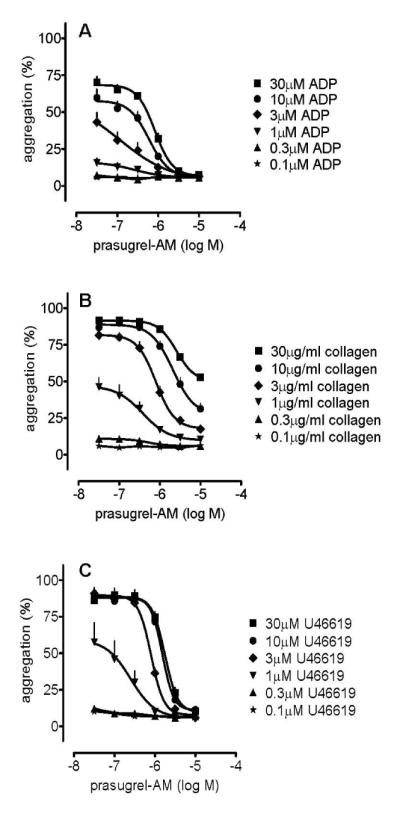
Platelet aggregations induced by ADP (0.1-30 μmol L−1; panel A), collagen (0.1-30 μg mL−1; panel B), or U46619 (0.1-30 μmol L−1; panel C) were inhibited in a concentration-dependent manner by PAM (p<0.05 for all; two way ANOVA). Curves for 0.1 μmol L−1 and 0.3 μmol L−1 ADP are superimposed upon one another (panel A), as are curves for 0.1 μmol L−1 and 0.3 μmol L−1 U46619 (panel B). Data shown are mean ± s.e.m. of responses measured by 96-well plate aggregometry in citrated PRP prepared from 6 different individuals.
Figure 2
Figure 2
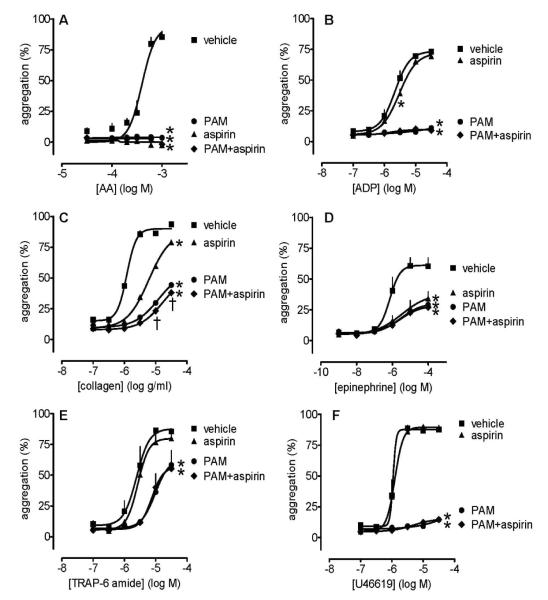
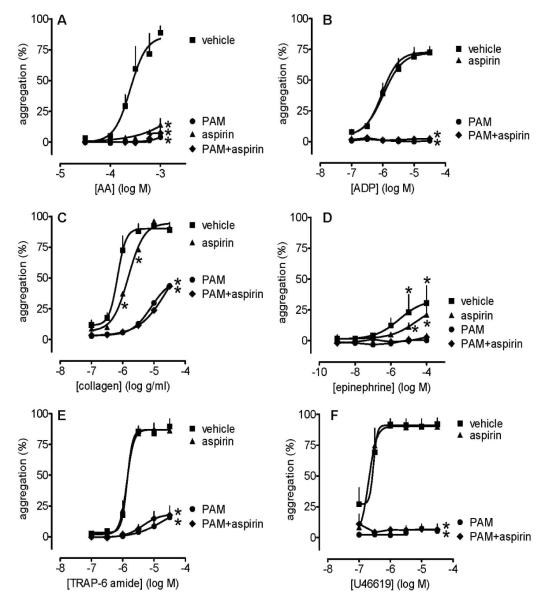
Platelet aggregation induced by arachidonic acid (0.03-1 mmol L−1; panel A), ADP (0.1-30 μmol L−1; panel B), collagen (0.1-30μg mL−1; panel C), epinephrine (0.001-100 μmol L−1; panel D), TRAP6 (0.1-30 μmol L−1; panel E) and U46619 (0.1-30 μmol L−1; panel F) in the presence of aspirin (30 μmol L−1) and/or PAM (3 μmol L−1). Data shown are mean ± s.e.m. of responses measured by 96-well plate aggregometry in citrated PRP measured prepared from 4 different individuals. * shows p<0.05 difference from vehicle by 2-way ANOVA plus Bonferroni post test; † shows p<0.05 difference between PAM and PAM+aspirin. Symbols at end of lines signify difference in set; symbols at individual points signify particular differences.
Figure 3
Figure 3
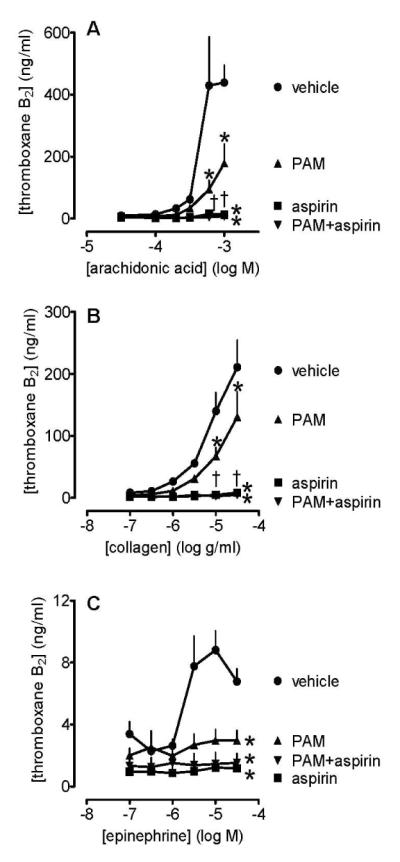
Platelet production of TXA2 induced by arachidonic acid (0.03-1 mmol L−1; panel A), collagen (0.1-30μg mL−1; panel B), and epinephrine (0.1-30 μmol L−1; panel C) in the presence of PAM (3 μmol L−1), and/or aspirin (30 μmol L−1), or vehicle (control, 0.1% DMSO). Data shown are mean ± s.e.m. of responses collected from 96-well plate aggregometry in citrated PRP prepared from 4 different individuals. * shows p<0.05 difference from vehicle by 2-way ANOVA plus Bonferroni post test; † shows p<0.05 difference between PAM and PAM+aspirin. Symbols at end of lines signify difference in set; symbols at individual points signify particular differences.
Figure 4
Figure 4
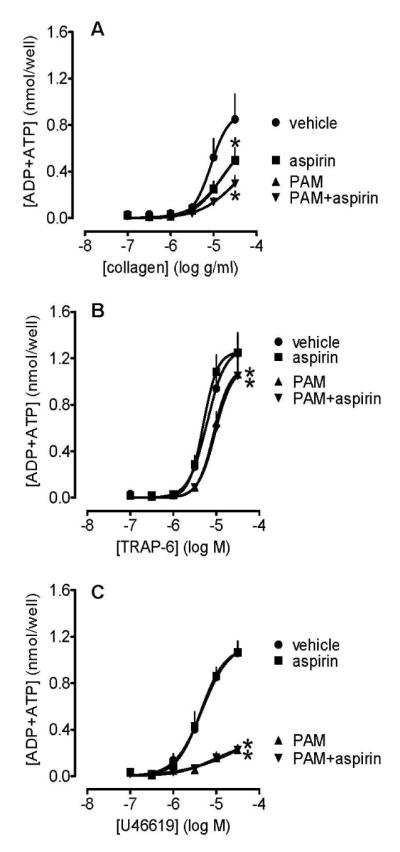
The release of ATP+ADP from platelets stimulated with collagen (0.1-30 μg mL−1; panel A), TRAP6 (0.1-30 μmol L−1; panel B) and U46619 (0.1-30 μmol L−1; panel C) in the presence of PAM (3 μmol L−1), and/or aspirin (30 μmol L−1), or vehicle (control, 0.1% DMSO). Data shown are mean ± s.e.m. of responses measured by 96-well plate aggregometry in citrated PRP prepared from 5 different individuals. * shows p<0.05 difference from vehicle by 2-way ANOVA plus Bonferroni post test. Symbols at end of lines signify difference in set; symbols at individual points signify particular differences.
Figure 5
Figure 5
Platelet aggregation induced by arachidonic acid (0.03-1 mmol L−1; panel A), ADP (0.1-30 μmol L−1; panel B), collagen (0.1-30μg mL−1; panel C), epinephrine (0.001-100 μmol L−1; panel D), TRAP6 (0.1-30 μmol L−1; panel E) and U46619 (0.1-30 μmol L−1; panel F) in the presence of aspirin (30 μmol L−1) and/or PAM (3 μmol L−1). Data shown are mean ± s.e.m. of responses measured by 96-well plate aggregometry in lepirudinized PRP prepared from 4 different individuals. * shows p<0.05 difference from vehicle by 2-way ANOVA plus Bonferroni post test. Symbols at end of lines signify difference in set; symbols at individual points signify particular differences.
Figure 6
Figure 6
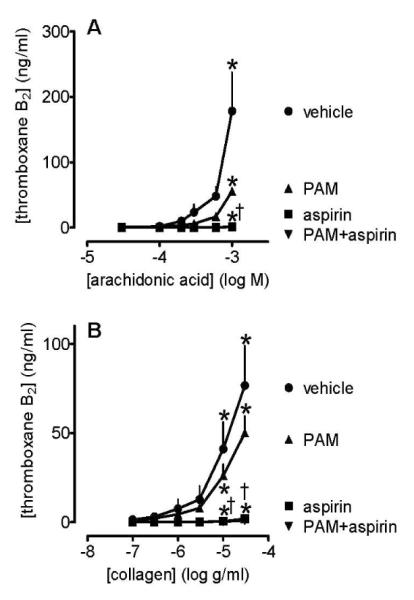
Platelet production of TXA2 induced by arachidonic acid (0.03-1 mmol L−1; panel A) and collagen (0.1-30 μg mL−1; panel B) in the presence of PAM (3 μmol L−1), and/or aspirin (30 μmol L−1), or vehicle (control, 0.1% DMSO). Data shown are mean ± s.e.m. of responses collected from 96-well plate aggregometry in lepirudinized PRP prepared from 4 different individuals. * shows p<0.05 difference from vehicle by 2-way ANOVA plus Bonferroni post test; † shows p<0.05 difference between PAM and PAM+aspirin. Symbols at end of lines signify difference in set; symbols at individual points signify particular differences.
Figure 7
Figure 7
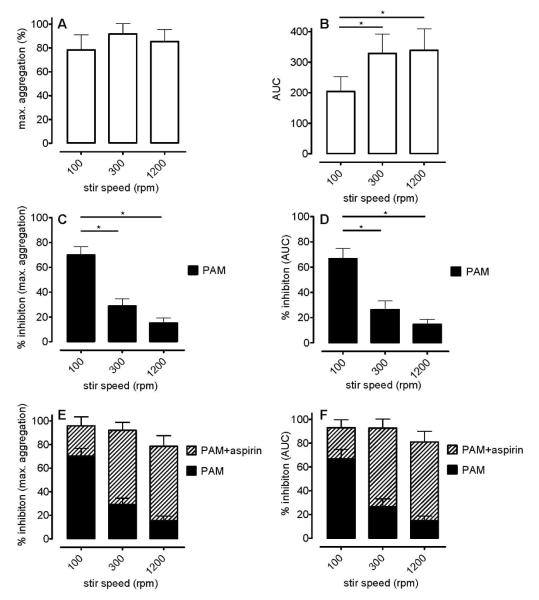
Platelet aggregation induced by collagen (3 μg mL−1) as measured by traditional light transmission aggregometry at stir speeds of 100, 300 or 1200 rpm using citrated PRP. Responses are shown as % maximum aggregation (panels A, C and E), and AUC of aggregation (panels B, D and F), as calculated over a 5 min aggregation period. Control responses shown in panels A and B; responses in the presence of PAM (3 μmol L−1) in panels C and D; responses in the presence of PAM (3 μmol L−1) + aspirin (30 μmol L−1) in panels E and F. Data shown are mean ± s.e.m. of responses in PRP prepared from 4 different individuals; * p<0.05, one-way ANOVA.
Figure 8
Figure 8
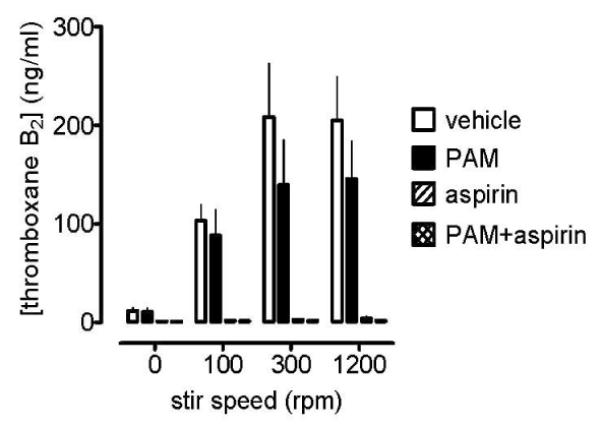
Platelet production of TXA2 induced by collagen (3μg mL−1) in the presence of PAM (3 μmol L−1), and/or aspirin (30 μmol L−1), or vehicle (control, 0.1% DMSO). Data shown are mean ± s.e.m. of samples collected from traditional light transmission aggregometry in citrated PRP prepared from 4 different individuals.

References

    1. Saw J, Madsen EH, Chan S, Maurer-Spurej E. The ELAPSE (Evaluation of Long-Term Clopidogrel Antiplatelet and Systemic Anti-Inflammatory Effects) Study. J Am Coll Cardiol. 2008;52:1826–33. - PubMed
    1. Antithrombotic Trialists’ Collaboration Collaborative meta-analysis of randomised trials of antiplatelet therapy for prevention of death, myocardial infarction, and stroke in high risk patients. BMJ. 2002;324:71–86. - PMC - PubMed
    1. Mehta SR, Yusuf S, Peters RJG, Bertrand ME, Lewis BS, Natarajan MK, Malmberg K, Rupprecht H-J, Zhao F, Chrolavicius S, Copland I, Fox KAA. Effects of pretreatment with clopidogrel and aspirin followed by long-term therapy in patients undergoing percutaneous coronary intervention: the PCI-CURE study. Lancet. 2001;358:527–33. - PubMed
    1. Bhatt DL. Role of antiplatelet therapy across the spectrum of patients with coronary artery disease. Am J Cardiol. 2009;103:11A–19A. - PubMed
    1. Jakubowski JA, Winters KJ, Naganuma H, Wallentin L. Prasugrel: a novel thienopyridine antiplatelet agent. A review of preclinical and clinical studies and the mechanistic basis for its distinct antiplatelet profile. Cardiovasc Drug Rev. 2007;25:357–74. - PubMed

Publication types

MeSH terms